|
 |
 |
 |
 |
 |
 |
 |
 |
 |
 |
 |
 |
 |
 |
 |
 |
 |
 |
 |
 |
 |
 |
 |
 |
 |
 |
 |
 |
 |
 |
 |
 |
 |
 |
58th FS - 59th FS - 60th FS

Asisbiz photo gallery and history of USS Ranger CV-4
Curtiss P-40F Warhawk 33FG Operation Torch Morocco Nov 1942 00
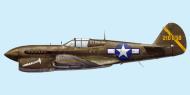
Profile 00: P-40F USAAF serial number 41-14315, 33rd Fighter Squadron during Operation Torch, the landings in French North Africa. Port Lyautey, Morocco, 11 November 1942. The aircraft from this group were launched from the aircraft carrier USS Ranger.
Curtiss P-40L USAAF 41-1437 Warhawk 33FG Dammit Novemebr 1942 00
Profile 01: P-40F Warhawk 33FG Nomads 41-14378 Dammit 1942 00
Photos USAAF 41-14378 P-40L Warhawk 33FG Dammit 01
1941014378 P-40L Warhawk 33FG Dammit 02
Curtiss P-40F Warhawk 33FG58FS Pilot John Bradley Tunisia Feb 1943
P-40F-20 flown by Capt John L. Bradley, 33rd FG, Tunisia, Feb 1943. Bradley scored five victories to become the 58th FS only ace. His first two victories were scored in this aircraft recently transferred from the 325th FG. The aircraft was destroyed on the same mission.
Curtiss P-40L Warhawk USAAF 42-10536 33FG58FS Pilot Ralph Grifith Naples, Italy Jan 1944 00
Profile 00: P-40L USAAF serial number 42-10536 was operated by 58th Fighter Squadron (33rd Fighter Group) Naples, Italy January 1944 and was flown by Lt. Ralph L. Grifith who scored a number of kills on the ground, but none in aerial combat.
Curtiss P-40L Warhawk 33FG58FS Pilot William Momyer Paesturn, Italy 1943 00
Profile 00: P-40L USAAF serial number 42-10568, 33rd Fighter Group, Paesturn, Italy, autumn 1943, flown by Col. William W. Momyer, commanding the group, an ace with 8 kills obtained between November 1942 and October 1943. Aircraft was named 'Spike'.
Curtiss P-40F Warhawk USAAF 42-10511 33FG59FS John P Crowder Jeep Thelepte Tunisia 1943 01-02
Profile 00: P-40L USAAF serial number 42-10568, 33rd Fighter Group, Paesturn, Italy, autumn 1943, flown by Col. William W. Momyer, commanding the group, an ace with 8 kills obtained between November 1942 and October 1943. Aircraft was named 'Spike'.
Curtiss P-40L Warhawk USAAF 42-11094 33FG59FS Pilot Charles Duncan Licata, Italy August 1943 00
Profile 01: P-40L, serial number 42-11094, 59th Fighter Squadron (33rd Fighter Group), Licata, Italy August 1943. Behind the Little Duge II there are four silhouettes of Me 109s shot down.
Curtiss P-40L Warhawk USAAF 42-10600 33FG60FS Pilot Levi Chase Sbeitla, Tunisia April 1943
Profile 00: P-40L USAAF serial number 42-10600, 60th Fighter Squadron (33rd Fighter Group), Sbeitla, Tunisia, April 1943 flown by Major Levi Chase, squadron commander, ten kills, of which six were with this rather anonymous machine coming from American stocks in Algeria.
Curtiss P-40F Warhawk 33FG Yellow 90 Janie USS Chenango CVE-28 Operation Torch 80-G-30512
Description: First army P-40 fighter to take off from USS CHENANGO (CVE-28), to fly shore for combat operations in Morocco, about 10 November 1942. Note U.S. flag markings, and bridge from catapult behind the plane.
Source: https://www.history.navy.mil/our-collections/photography/numerical-list-of-images/nhhc-series/nh-series/80-G-30000/80-G-30512.html
58th FS - 59th FS - 60th FS
33rd Fighter Group
Constituted as 33rd Pursuit Group (Interceptor) on 20 Nov 1940. Activated on 15 Jan 1941. Began training with P-39's but soon changed to P-40's. Served as part of the defense force for the east coast after the Japanese attack on Pearl Harbor. Redesignated 33rd Fighter Group in May 1942. Moved to North Africa, part of the group (including the pilots and their planes) arriving with the invasion force on 8th Nov 1942, and the remainder arriving shortly afterwards. Operated with Twelfth AF in the Mediterranean theater until Feb 1944. Provided close support for ground forces and flew bombing and strafing missions against personnel concentrations, port installations, fuel dumps, bridges, highways, and rail lines during the campaigns in North Africa. Received a DUC for action on 15 Jan 1943: when enemy aircraft attempted to knock out the group's base in Tunisia, the 33rd drove off the enemy's escort and destroyed most of the bombers. Took part in the reduction of Pantelleria and flew patrol missions while Allied troops landed after the enemy's garrison had surrendered. Participated in the invasion and conquest of Sicily. Supported landings at Salerno, Allied operations in southern Italy, and the beachhead at Anzio.
Moved to India in Feb 1944. Assigned to Tenth AF. Trained with P-38 and P-47 aircraft. Moved to China in Apr, became part of Fourteenth AF, continued training, and flew some patrol and interception missions. Returned to India in Sept 1944 and, as part of Tenth AF, flew dive-bombing and strafing missions in Burma until the Allied campaigns in that area had been completed. Returned to the US, Nov-Dec 1945. Inactivated on 8 Dec 1945.
Activated in Germany on 20 Aug 1946. Assigned to United States Air Forces in Europe and equipped with P-51's. Transferred, less personnel and equipment, to the US in 1947. Remanned and equipped with P-51's; converted to F-84's in Jun 1948 and F-86's in Feb 1949. Redesignated 33d Fighter-Interceptor Group in Jan 1950. Inactivated on 6 Feb 1952.
Redesignated 33rd Fighter Group (Air Defense). Activated on 18 Aug 1955. Assigned to Air Defense Command.
Squadrons. 58th: 1941-1945; 1946-1952; 1955-. 59th: 1941-1945; 1946-1952. 60th: 1941-1945; 1946-1952; 1955-.
Stations. Mitchel Field, NY, 15 Jan 1941; Philadelphia, Pa, 13 Dec 1941-Oct 1942; Port Lyautey, French Morocco, 10 Nov 1942; Casablanca, French Morocco, c. 13 Nov 1942; Telergma, Algeria, 24 Dec 1942; Thelepte, Tunisia, 7 Jan 1943; Youks-les-Bains, Algeria, 8 Feb 1943; Telergma, Algeria, c. 20 Feb 1943; Berteaux, Algeria, c. 2 Mar 1943; Ebba Ksour, Tunisia, c. 12 Apr 1943; Menzel Temime, Tunisia, 20 May 1943; Sousse, Tunisia, 9 Jun 1943; Pantelleria, 19 Jun 1943; Licata, Sicily, c. 18 Jul 1943; Paestum, Italy, 13 Sep 1943; Santa Maria, Italy, 18 Nov 1943; Cercola, Italy, c. 1 Jan-Feb 1944; Karachi, India, c. 20 Feb 1944; Shwangliu, China, c. 18 Apr 1944; Pungchacheng, China, 9 May 1944; Nagaghuli, India, 3 Sep 1944; Sahmaw, Burma, 26 Dec 1944; Piardoba, India, 5 May-c. 15 Nov 1945; Camp Shanks, NY, 7-8 Dec 1945. Neubiberg, Germany, 20 Aug 1946; Bad Kissingen, Germany, Jul-25 Aug 1947; Andrews Field, Md, 25 Aug 1947; Roswell AAFld, NM, 16 Sep 1947; Otis AFB, Mass, 16 Nov 1948-6 Feb 1952. Otis AFB, Mass, 18 Aug 1955-.
Commanders. Maj Minthorne W Reed, c. Jan 1941; Col Elwood R Quesada, 7 Oct 1941; Col William W Momyer, 29 Jun 1942; Col Loring F Stetson Jr, 17 Oct 1943; Lt Col Oliver G Cellini, 7 Jun 1944; Col David D Terry Jr, 9 Sep 1944; Col Frank L Dunn, 2 Mar 1945-unkn. Col Barton M Russell, 20 Aug 1946; Lt Col Albert A Cory, unkn; Col Gwen G Atkinson, Jan 1948; Lt Col Woodrow W Korges, c. May 1949; Col Charles H MacDonald, c. Aug 1949; Col Harrison R Thyng, 15 Jun 1950; Lt Col Willard W Millikan, c. Aug 1951-6 Feb 1952. Col Fred G Hook Jr, 1955-.
Campaigns. Air Combat, EAME Theater; Algeria-French Morocco; Tunisia; Sicily; Naples-Foggia; Anzio; Rome-Arno; India-Burma; China Defensive; Central Burma.
Decorations. Distinguished Unit Citation: Central Tunisia, 15 Jan 1943.
Insigne Shield: Azure, on a pale nebuly or a sword point to chief in pale of the field, flammant gules, all within a border of the second. Motto: Fire From The Clouds. (Approved 21 Feb 1942.)
- Curtiss P-40 Warhawk and Kittyhawk
IL-2 Sturmovik 'Cliff's of Dover' Blitz
IL-2 Sturmovik Battle of Stalingrad
DCS World - has no 3D model
Morocco Map Map
Pignataro, Frosinone, Italy Map
Bibliography: +
- Alexander, Kristin. Clive Caldwell: Air Ace. Crows Nest, NSW: Allen & Unwin, 2006. ISBN 1-74114-705-0.
- Angelucci, Enzo and Paolo Matricardi. World Aircraft: World War II, Volume II (Sampson Low Guides). Maidenhead, UK: Sampson Low, 1978. ISBN 0-562-00096-8.
- Arena, Nino. Macchi 205 "Veltro" (in Italian). Modena: Stem Mucchi Editore, 1994.
- Berliner, Don. Surviving Fighter Aircraft of World War Two: Fighters. London: Pen & Sword Aviation, 2011. ISBN 978-1-8488-4265-6.
- Boyne, Walter J. Clash of Titans. New York: Simon & Schuster, 1994. ISBN 0-671-79370-5.
- Boyne, Walter J. and Michael Fopp. Air Warfare: An International Encyclopedia. Santa Barbara, California: ABC-CLIO, 2002. ISBN 1-57607-345-9.
- Bowers, Peter M. Curtiss Aircraft, 1907–1947. London: Putnam & Company Ltd., 1979. ISBN 0-370-10029-8.
- Bowers, Peter M. and Enzo Angellucci. The American Fighter. New York: Orion Books, 1987. ISBN 0-517-56588-9.
- Brown, Russell. Desert Warriors: Australian P-40 Pilots at War in the Middle East and North Africa, 1941–1943. Maryborough, Australia: Banner Books, 1983. ISBN 1-875593-22-5.
- Coyle, Brendan. War on Our Doorstep: The Unknown Campaign on North America's West Coast. Victoria, BC: Heritage House Publishing Co. Ltd., 2002. ISBN 978-1-894384-46-9.
- Crawford, Jerry L. Messerschmitt BF 110 Zerstörer in action. Carrollton, Texas: Squadron/Signal Publications, 1977. ISBN 0-89747-029-X.
- Dean, Francis H. America's Hundred Thousand. Atglen, Pennsylvania: Schiffer Publishing Ltd., 1997. ISBN 0-7643-0072-5.
- Donald, David, ed. "Curtiss Model 81/87 (P-40 Warhawk)"Encyclopedia of World Aircraft. Etobicoke, Ontario, Canada: Prospero, 1997. ISBN 1-85605-375-X.
- Drabkin, Artem. The Red Air Force at War: Barbarossa and the Retreat to Moscow – Recollections of Fighter Pilots on the Eastern Front. Barnsley, South Yorkshire, UK: Pen & Sword Military, 2007. ISBN 1-84415-563-3.
- Ford, Daniel. Flying Tigers: Claire Chennault and His American Volunteers, 1941-1942. Washington, D.C.: HarperCollins|Smithsonian Books, 2007. ISBN 0-06-124655-7.
- Ethell, Jeffrey L. and Joe Christy. P-40 Hawks at War. Shepperton, UK: Ian Allan Ltd., 1979. ISBN 0-7110-0983-X.
- Ford, Daniel. 100 Hawks for China: The Story of the Shark-Nosed P-40 That Made the Flying Tigers Famous. Warbird Books, 2014
- Glancey, Jonathan. Spitfire: The Illustrated Biography. London: Atlantic Books, 2006. ISBN 978-1-84354-528-6.
- Gordon, Yefim. Soviet Air Power in World War 2. Hinckley, Leicestershire, UK: Midland Ian Allan Publishing, 2008. ISBN 978-1-85780-304-4.
- Green, William. War Planes of the Second World War, Volume Four: Fighters. London: MacDonald & Co. (Publishers) Ltd., 1961 (Sixth impression 1969). ISBN 0-356-01448-7.
- Green, William and Gordon Swanborough. WW2 Aircraft Fact Files: US Army Air Force Fighters, Part 1. London: Macdonald and Jane's Publishers Ltd., 1977. ISBN 0-356-08218-0.
- Gunston, Bill. Gli aerei della 2a Guerra Mondiale. Milan: Alberto Peruzzo Editore, 1984.
- Gunston, Bill, ed. The Illustrated History of Fighters. New York, New York: Exeter Books Division of Simon & Schuster, 1981. ISBN 0-89673-103-0.
- Hardesty, Von. Red Phoenix: The Rise of Soviet Air Power 1941–1945. Washington, D.C.: Smithsonian Institution, 1982. ISBN 0-87474-510-1.
- Higham, Robin. Flying American Combat Aircraft of WW II. Manhattan, Kansas: Sunflower University Press, 2004. ISBN 0-8117-3124-3.
- Horn, Alex. Wings Over the Pacific: The RNZAF in the Pacific Air War. Auckland, NZ: Random House New Zealand, 1992. ISBN 1-86941-152-8
- Johnsen, F.A. P-40 Warhawk (Warbird History). St. Paul, Minnesota: Motorbooks International, 1999. ISBN 0-7603-0253-7
- King, John. The Whole Nine Yards: The Story of an Anzac P-40. Auckland, NZ: Reed Books, 2002. ISBN 0-7900-0835-1. (A P-40 with No. 75 Squadron RAAF)
- Kinzey, Bert. Attack on Pearl Harbor: Japan Awakens a Sleeping Giant. Blacksburg, Virginia: Military Aviation Archives, 2010. ISBN 978-0-9844665-0-4.
- Lavigne, J.P.A. Michel and James F. Edwards. Kittyhawk Pilot. Battleford, Saskatchewan, Canada: Turner-Warwick, 1983. ISBN 0-919899-10-2.
- Matricardi, Paolo. Aerei Militari: Caccia e Ricognitori - Volume 1 (in Italian). Milan: Electa Mondadori, 2006.
- McDowell, Earnest R. Famous Aircraft: The P-40 Kittyhawk. New York: ARCO Publishing Company, 1968.
- Mellinger, George. Soviet Lend-Lease Fighter Aces of World War 2 (Osprey Aircraft of the Aces No. 74). Oxford, UK: Osprey Publishing, 2006. ISBN 1-84603-041-2.
- Merriam, Ray. U. S. Warplanes of World War II. Bennington, Virginia: Merriam Press, 2000. ISBN 1-57638-167-6.
- Molesworth, Carl. P-40 Warhawk Aces of the MTO (Osprey Aircraft of the Aces No. 43). London: Osprey Publishing, 2002. ISBN 1-84176-288-1.
- Molesworth, Carl. P-40 Warhawk Aces of the Pacific (Aircraft of the Aces). London: Osprey Publishing, 2003. ISBN 1-84176-536-8.
- Molesworth, Carl. P-40 Warhawk Aces of the CBI(Osprey Aircraft of the Aces No. 35). Oxford, UK: Osprey Publishing, 2000. ISBN 1-84176-079-X.
- Molesworth, Carl. P-40 Warhawk vs Ki-43 Oscar: China 1944–45. Oxford, UK: Osprey Publishing, 2008. ISBN 1-84603-295-4.
- Müller, Rolf-Dieter. Der Bombenkrieg 1939–1945 (in German). Berlin: Links Verlag, 2004. ISBN 3-86153-317-0.
- Murphy, Justin D. and Matthew A. McNiece. Military aircraft, 1919-1945: An Illustrated History of their Impact. Santa Barbara, California: ABC-CLIO, 2009. ISBN 978-1-85109-498-1.
- Neulen, Hans Werner. In the Skies of Europe: Air Forces Allied to the Luftwaffe, 1939–1945 Ramsbury, Marlborough, UK: The Crowood Press, 2005. ISBN 1-86126-799-1.
- Pentland, Geoffrey. The P-40 Kittyhawk in Service. Melbourne, Victoria, Australia: Kookaburra Technical Publications Pty. Ltd., 1974. ISBN 0-85880-012-8.
- Snedden, Robert. World War II Combat Aircraft. Bristol, UK: Factfinders Parragon, 1997. ISBN 0-7525-1684-1.
- Rudge, Chris. Air-To-Air: The Story Behind the Air-to-Air Combat Claims of the RNZAF. Lyttelton, Canterbury, New Zealand: Adventure Air, 2003 ISBN 0-473-09724-9.
- Scott, Robert L. Damned to Glory. New York: Scribner's, 1944. No ISBN.
- Scutts, Jerry. Bf 109 Aces of North Africa and the Mediterranean. London: Osprey Publishing, 1994. ISBN 1-85532-448-2.
- Shamburger, Page and Joe Christy. The Curtiss Hawk Fighters. New York: Sports Car Press Ltd., 1971. ISBN 0-87112-041-0.
- Shores, Christopher and Hans Ring. Fighters over the Desert. London: Neville Spearman Limited, 1969. ISBN 0-668-02070-9.
- Shores, Christopher and Clive Williams. Aces High: A Further Tribute to the Most Notable Fighter Pilots of the British and Commonwealth Air Forces in WWII, v. 2. London: Grub Street, 1994. ISBN 1-898697-00-0.
- Thomas, Andrew. Tomahawk and Kittyhawk Aces of the RAF and Commonwealth. London: Osprey Books, 2002. ISBN 1-84176-083-8.
- United States Air Force Museum Guidebook. Wright-Patterson AFB, Ohio: Air Force Museum Foundation, 1975.
- Vader, John. Pacific Hawk. London: MacDonald & Co, 1970.
- Weal, John. Jagdgeschwader 27 'Afrika' . Oxford, UK: Osprey, 2003. ISBN 1-84176-538-4.
Magazines: +
- Airfix Magazines (English) - http://www.airfix.com/
- Avions (French) - http://www.aerostories.org/~aerobiblio/rubrique10.html
- FlyPast (English) - http://www.flypast.com/
- Flugzeug Publikations GmbH (German) - http://vdmedien.com/flugzeug-publikations-gmbh-hersteller_verlag-vdm-heinz-nickel-33.html
- Flugzeug Classic (German) - http://www.flugzeugclassic.de/
- Klassiker (German) - http://shop.flugrevue.de/abo/klassiker-der-luftfahrt
- Le Fana de L'Aviation (French) - http://boutique.editions-lariviere.fr/site/abonnement-le-fana-de-l-aviation-626-4-6.html
- Le Fana de L'Aviation (French) - http://www.pdfmagazines.org/tags/Le+Fana+De+L+Aviation/
- Osprey (English) - http://www.ospreypublishing.com/
- Revi Magazines (Czech) - http://www.revi.cz/
Web References: +
- Wikipedia.org - https://en.wikipedia.org/wiki/Curtiss_P-40_Warhawk
- Military Aviation Museum - https://www.militaryaviationmuseum.org/aircraft/curtiss-p-40/

 Editor for Asisbiz: Matthew Laird Acred
If you love our website please donate so we can make this site even better !!
 33rd Fighter Group