 |
 |
 |
 |
 |
 |
 |
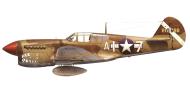 |
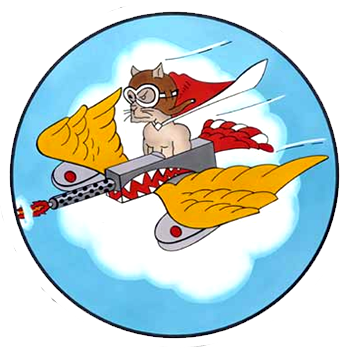
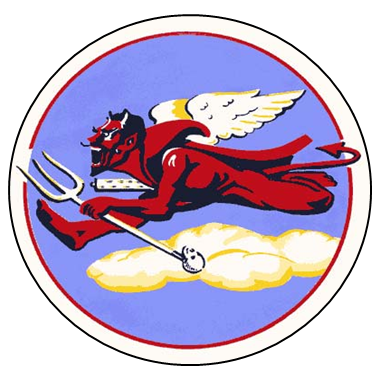
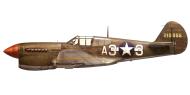
332d Fighter Group
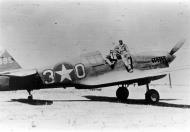
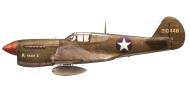
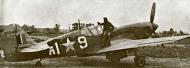
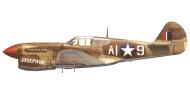
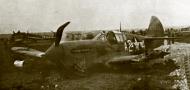
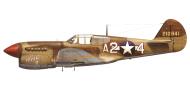
Constituted as 332d Fighter Group on 4 Jul 1942. Activated on 13 Oct 1942. Trained with P-39 and P-40 aircraft. Moved to Italy, arriving early in Feb 1944. Began operations with Twelfth AF on 5 Feb. Used P-39's to escort convoys, protect harbors, and fly armed reconnaissance missions. Converted to P-47's during Apr-May and changed to P-51's in Jun. Operated with Fifteenth AF from May 1944 to Apr 1945, being engaged primarily in protecting bombers that struck such objectives as oil refineries, factories, airfields, and marshalling yards in Italy, France, Germany, Poland, Czechoslovakia, Austria, Hungary, Yugoslavia, Rumania, Bulgaria, and Greece. Also made strafing attacks on airdromes, railroads, highways, bridges, river traffic, troop concentrations, radar facilities, power stations, and other targets. Received a DUC for a mission on 24 Mar 1945 when the group escorted B-17's during a raid on a tank factory at Berlin, fought the interceptors that attacked the formation, and strafed transportation facilities while flying back to the base in Italy. Returned to the US in Oct 1945. Inactivated on 19 Oct 1945.
Activated on 1 Jul 1947. Equipped with P-47's. Inactivated on 1 Jul 1949.
99th FS - 100th FS - 301st FS - 302d FS
Squadrons. 99th: 1944-1945; 1947-1949. 100th: 1942-1945; 1947-1949. 301st: 1942-1945; 1947-1949. 302d: 1942-1945.
Stations. Tuskegee, Ala, 13 Oct 1942; Selfridge Field, Mich, 29 Mar 1943; Oscoda, Mich, 12 Apr 1943; Selfridge Field, Mich, 9 Jul-22 Dec 1943; Montecorvino, Italy, 3 Feb 1944; Capodichino, Italy, 15 Apr 1944; Ramitelli Airfield, Italy, 28 May 1944; Cattolica, Italy, c. 4 May 1945; Lucera, Italy, c. 18 Jul-Sep 1945; Camp Kilmer, NJ, 17-19 Oct 1945. Lockbourne AAB, Ohio, 1 Jul 1947-1 Jul 1949.
Commanders. Lt Col Sam W Westbrook Jr, 19 Oct 1942; Col Robert R Selway Jr, 16 May 1943; Col Benjamin O Davis Jr, 8 Oct 1943; Maj George S Roberts, 3 Nov 1944; Col Benjamin O Davis Jr, 24 Dec 1944; Maj George S Roberts, 9 Jun 1945-unkn. Unkn, 1 Jul-28 Aug 1947; Maj William A Campbell, 28 Aug 1947-1 Jul 1949.
Campaigns. American Theater; Air Combat, EAME Theater; Rome-Arno; Normandy; Northern France; Southern France; North Apennines; Rhineland; Central Europe; Po Valley.
Decorations. Distinguished Unit Citation: Germany, 24 Mar 1945.
Insigne Shield: Azure on a fess nebule or, a panther passant sable armed and incensed gules. Motto: Spit Fire. (Approved 15 Jan 1943.)
- Curtiss P-40 Warhawk and Kittyhawk
IL-2 Sturmovik 'Cliff's of Dover' Blitz
IL-2 Sturmovik Battle of Stalingrad
DCS World - has no 3D model
Montecorvino Pugliano, Salerno, Italy Map
Bibliography: +
- Alexander, Kristin. Clive Caldwell: Air Ace. Crows Nest, NSW: Allen & Unwin, 2006. ISBN 1-74114-705-0.
- Angelucci, Enzo and Paolo Matricardi. World Aircraft: World War II, Volume II (Sampson Low Guides). Maidenhead, UK: Sampson Low, 1978. ISBN 0-562-00096-8.
- Arena, Nino. Macchi 205 "Veltro" (in Italian). Modena: Stem Mucchi Editore, 1994.
- Berliner, Don. Surviving Fighter Aircraft of World War Two: Fighters. London: Pen & Sword Aviation, 2011. ISBN 978-1-8488-4265-6.
- Boyne, Walter J. Clash of Titans. New York: Simon & Schuster, 1994. ISBN 0-671-79370-5.
- Boyne, Walter J. and Michael Fopp. Air Warfare: An International Encyclopedia. Santa Barbara, California: ABC-CLIO, 2002. ISBN 1-57607-345-9.
- Bowers, Peter M. Curtiss Aircraft, 1907–1947. London: Putnam & Company Ltd., 1979. ISBN 0-370-10029-8.
- Bowers, Peter M. and Enzo Angellucci. The American Fighter. New York: Orion Books, 1987. ISBN 0-517-56588-9.
- Brown, Russell. Desert Warriors: Australian P-40 Pilots at War in the Middle East and North Africa, 1941–1943. Maryborough, Australia: Banner Books, 1983. ISBN 1-875593-22-5.
- Coyle, Brendan. War on Our Doorstep: The Unknown Campaign on North America's West Coast. Victoria, BC: Heritage House Publishing Co. Ltd., 2002. ISBN 978-1-894384-46-9.
- Crawford, Jerry L. Messerschmitt BF 110 Zerstörer in action. Carrollton, Texas: Squadron/Signal Publications, 1977. ISBN 0-89747-029-X.
- Dean, Francis H. America's Hundred Thousand. Atglen, Pennsylvania: Schiffer Publishing Ltd., 1997. ISBN 0-7643-0072-5.
- Donald, David, ed. "Curtiss Model 81/87 (P-40 Warhawk)"Encyclopedia of World Aircraft. Etobicoke, Ontario, Canada: Prospero, 1997. ISBN 1-85605-375-X.
- Drabkin, Artem. The Red Air Force at War: Barbarossa and the Retreat to Moscow – Recollections of Fighter Pilots on the Eastern Front. Barnsley, South Yorkshire, UK: Pen & Sword Military, 2007. ISBN 1-84415-563-3.
- Ford, Daniel. Flying Tigers: Claire Chennault and His American Volunteers, 1941-1942. Washington, D.C.: HarperCollins|Smithsonian Books, 2007. ISBN 0-06-124655-7.
- Ethell, Jeffrey L. and Joe Christy. P-40 Hawks at War. Shepperton, UK: Ian Allan Ltd., 1979. ISBN 0-7110-0983-X.
- Ford, Daniel. 100 Hawks for China: The Story of the Shark-Nosed P-40 That Made the Flying Tigers Famous. Warbird Books, 2014
- Glancey, Jonathan. Spitfire: The Illustrated Biography. London: Atlantic Books, 2006. ISBN 978-1-84354-528-6.
- Gordon, Yefim. Soviet Air Power in World War 2. Hinckley, Leicestershire, UK: Midland Ian Allan Publishing, 2008. ISBN 978-1-85780-304-4.
- Green, William. War Planes of the Second World War, Volume Four: Fighters. London: MacDonald & Co. (Publishers) Ltd., 1961 (Sixth impression 1969). ISBN 0-356-01448-7.
- Green, William and Gordon Swanborough. WW2 Aircraft Fact Files: US Army Air Force Fighters, Part 1. London: Macdonald and Jane's Publishers Ltd., 1977. ISBN 0-356-08218-0.
- Gunston, Bill. Gli aerei della 2a Guerra Mondiale. Milan: Alberto Peruzzo Editore, 1984.
- Gunston, Bill, ed. The Illustrated History of Fighters. New York, New York: Exeter Books Division of Simon & Schuster, 1981. ISBN 0-89673-103-0.
- Hardesty, Von. Red Phoenix: The Rise of Soviet Air Power 1941–1945. Washington, D.C.: Smithsonian Institution, 1982. ISBN 0-87474-510-1.
- Higham, Robin. Flying American Combat Aircraft of WW II. Manhattan, Kansas: Sunflower University Press, 2004. ISBN 0-8117-3124-3.
- Horn, Alex. Wings Over the Pacific: The RNZAF in the Pacific Air War. Auckland, NZ: Random House New Zealand, 1992. ISBN 1-86941-152-8
- Johnsen, F.A. P-40 Warhawk (Warbird History). St. Paul, Minnesota: Motorbooks International, 1999. ISBN 0-7603-0253-7
- King, John. The Whole Nine Yards: The Story of an Anzac P-40. Auckland, NZ: Reed Books, 2002. ISBN 0-7900-0835-1. (A P-40 with No. 75 Squadron RAAF)
- Kinzey, Bert. Attack on Pearl Harbor: Japan Awakens a Sleeping Giant. Blacksburg, Virginia: Military Aviation Archives, 2010. ISBN 978-0-9844665-0-4.
- Lavigne, J.P.A. Michel and James F. Edwards. Kittyhawk Pilot. Battleford, Saskatchewan, Canada: Turner-Warwick, 1983. ISBN 0-919899-10-2.
- Matricardi, Paolo. Aerei Militari: Caccia e Ricognitori - Volume 1 (in Italian). Milan: Electa Mondadori, 2006.
- McDowell, Earnest R. Famous Aircraft: The P-40 Kittyhawk. New York: ARCO Publishing Company, 1968.
- Mellinger, George. Soviet Lend-Lease Fighter Aces of World War 2 (Osprey Aircraft of the Aces No. 74). Oxford, UK: Osprey Publishing, 2006. ISBN 1-84603-041-2.
- Merriam, Ray. U. S. Warplanes of World War II. Bennington, Virginia: Merriam Press, 2000. ISBN 1-57638-167-6.
- Molesworth, Carl. P-40 Warhawk Aces of the MTO (Osprey Aircraft of the Aces No. 43). London: Osprey Publishing, 2002. ISBN 1-84176-288-1.
- Molesworth, Carl. P-40 Warhawk Aces of the Pacific (Aircraft of the Aces). London: Osprey Publishing, 2003. ISBN 1-84176-536-8.
- Molesworth, Carl. P-40 Warhawk Aces of the CBI(Osprey Aircraft of the Aces No. 35). Oxford, UK: Osprey Publishing, 2000. ISBN 1-84176-079-X.
- Molesworth, Carl. P-40 Warhawk vs Ki-43 Oscar: China 1944–45. Oxford, UK: Osprey Publishing, 2008. ISBN 1-84603-295-4.
- Müller, Rolf-Dieter. Der Bombenkrieg 1939–1945 (in German). Berlin: Links Verlag, 2004. ISBN 3-86153-317-0.
- Murphy, Justin D. and Matthew A. McNiece. Military aircraft, 1919-1945: An Illustrated History of their Impact. Santa Barbara, California: ABC-CLIO, 2009. ISBN 978-1-85109-498-1.
- Neulen, Hans Werner. In the Skies of Europe: Air Forces Allied to the Luftwaffe, 1939–1945 Ramsbury, Marlborough, UK: The Crowood Press, 2005. ISBN 1-86126-799-1.
- Pentland, Geoffrey. The P-40 Kittyhawk in Service. Melbourne, Victoria, Australia: Kookaburra Technical Publications Pty. Ltd., 1974. ISBN 0-85880-012-8.
- Snedden, Robert. World War II Combat Aircraft. Bristol, UK: Factfinders Parragon, 1997. ISBN 0-7525-1684-1.
- Rudge, Chris. Air-To-Air: The Story Behind the Air-to-Air Combat Claims of the RNZAF. Lyttelton, Canterbury, New Zealand: Adventure Air, 2003 ISBN 0-473-09724-9.
- Scott, Robert L. Damned to Glory. New York: Scribner's, 1944. No ISBN.
- Scutts, Jerry. Bf 109 Aces of North Africa and the Mediterranean. London: Osprey Publishing, 1994. ISBN 1-85532-448-2.
- Shamburger, Page and Joe Christy. The Curtiss Hawk Fighters. New York: Sports Car Press Ltd., 1971. ISBN 0-87112-041-0.
- Shores, Christopher and Hans Ring. Fighters over the Desert. London: Neville Spearman Limited, 1969. ISBN 0-668-02070-9.
- Shores, Christopher and Clive Williams. Aces High: A Further Tribute to the Most Notable Fighter Pilots of the British and Commonwealth Air Forces in WWII, v. 2. London: Grub Street, 1994. ISBN 1-898697-00-0.
- Thomas, Andrew. Tomahawk and Kittyhawk Aces of the RAF and Commonwealth. London: Osprey Books, 2002. ISBN 1-84176-083-8.
- United States Air Force Museum Guidebook. Wright-Patterson AFB, Ohio: Air Force Museum Foundation, 1975.
- Vader, John. Pacific Hawk. London: MacDonald & Co, 1970.
- Weal, John. Jagdgeschwader 27 'Afrika' . Oxford, UK: Osprey, 2003. ISBN 1-84176-538-4.
Magazines: +
- Airfix Magazines (English) - http://www.airfix.com/
- Avions (French) - http://www.aerostories.org/~aerobiblio/rubrique10.html
- FlyPast (English) - http://www.flypast.com/
- Flugzeug Publikations GmbH (German) - http://vdmedien.com/flugzeug-publikations-gmbh-hersteller_verlag-vdm-heinz-nickel-33.html
- Flugzeug Classic (German) - http://www.flugzeugclassic.de/
- Klassiker (German) - http://shop.flugrevue.de/abo/klassiker-der-luftfahrt
- Le Fana de L'Aviation (French) - http://boutique.editions-lariviere.fr/site/abonnement-le-fana-de-l-aviation-626-4-6.html
- Le Fana de L'Aviation (French) - http://www.pdfmagazines.org/tags/Le+Fana+De+L+Aviation/
- Osprey (English) - http://www.ospreypublishing.com/
- Revi Magazines (Czech) - http://www.revi.cz/
Web References: +
- Wikipedia.org - https://en.wikipedia.org/wiki/Curtiss_P-40_Warhawk
- Military Aviation Museum - https://www.militaryaviationmuseum.org/aircraft/curtiss-p-40/

 Editor for Asisbiz: Matthew Laird Acred
If you love our website please donate so we can make this site even better !!
 332th Fighter Group