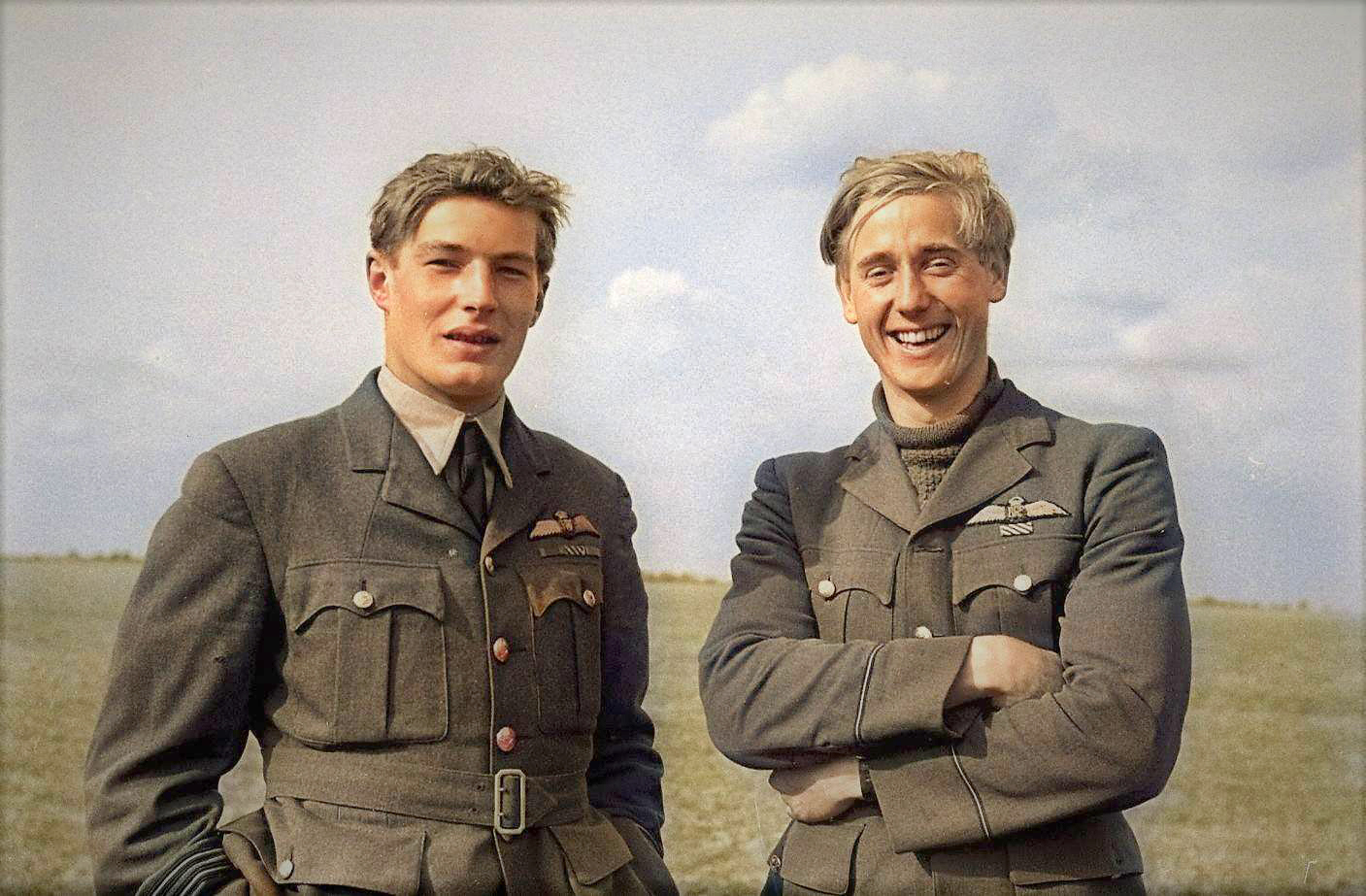
Caption: Aircrew RAF 85Sqn at Lille Seclin May 1940
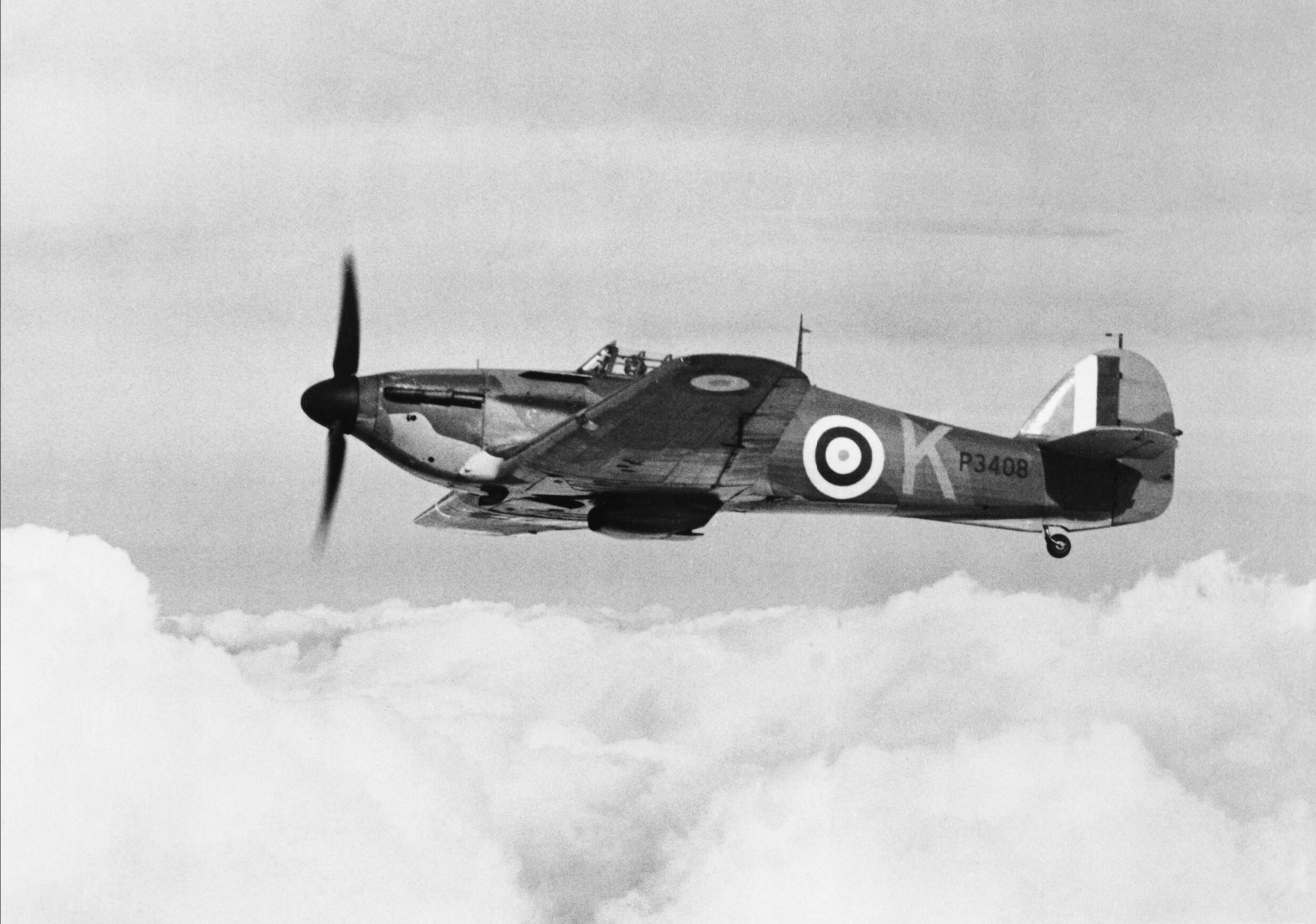
Caption: Hawker Hurricane I RAF 85Sqn VYK P3408 based at Church Fenton Yorkshire 1940 IWM CH1501
Caption: Hawker Hurricane I RAF 85Sqn VYR Albert G Lewis P2923 scramble at Castle Camps Jul 1940 IWM HU104483
Caption: Hurricane Is RAF 85Sqn during the Battle of Britain Oct 1940 IWM CH1510
RAF No 85 Squadron
Motto: Nocto Diuque Venamur (We hunt by day and night)
Formed as a fighter squadron at Upavon on 1 August 1917, the squadron was equipped with SE5As, which it took to France in May 1918. In March 1918, the squadron received Maj W A Bishop VC as it's CO, who in turn was replaced by Maj 'Mick' Mannock VC, making it one of the few squadrons to be commanded by two VC holders. It operated for the remainder of the war on fighter and ground attacks sweeps until returning to Britain in February 1919 and disbanding on 3 July the same year.
The squadron reformed at Debden on 1 June 1938 from 'A' Flight of No 311 Squadron. Following two temporary CO's, it's first 'full time' CO was Sqn Ldr D F W Atcherley, one of the famous twins. Initially equipped with Gladiators, these were replaced in September 1938 by Hurricanes. It was thus equipped when it moved to France as part of the Air Component of the BEF in September 1939. Following the German attack on France, the squadron was involved in supporting the ground forces until it only possessed four serviceable aircraft, when it returned to Britain to re-equip.
Re-equipped the squadron rejoined the fray in June and undertook operations during the first half of the Battle of Britain, but in September it moved to Church Fenton for a rest and in October to Kirton-in-Lindsey where it began night operations. These operations continued on its return south but success was hampered by a lack of radar, so Defiants were received in January 1941. However, these proved to be short-lived as Havocs arrived the following month. The squadron continued in the night fighter role, with Mosquitos from August 1942, until March 1943 when it began intruder operations over enemy territory. On 1 May 1944 the squadron became part of No 100 Group and whilst continuing the intruder role, it also took on the bomber support role, accompanying the Main Force on its deep penetrations mission into Germany.
With the end of the war, the squadron was retained as part of the UK based night fighter defences, continuing to use the Mosquito NF Mk 36 at West Malling until 1951 when the jet powered Meteor NF Mk 11 arrived. These, in their turn were replaced by NF Mk 12s and 14s, with both types being flown until disbandment on 31 October 1958 at Church Fenton, where the squadron had moved in September 1957. During this period, 11 February 1949 - 28 February 1952, No 85 was linked to No 145 Squadron, a process designed to keep famous squadron numbers active.
The squadron reformed less than month later on 30 November when No 89 Squadron was re-numbered. The unit was now based at Stradishall and was equipped with the Gloster Javelin. Initially equipped with the FAW Mk 2 and 6, these were superseded by the FAW Mk 8 in May 1960, by which time the squadron was at West Malling and these remained its sole equipment until 31 March 1963 when the squadron was disbanded again at West Raynham, to where it had moved in September 1960. The following day, however, the number was revived by renaming the Target Facilities Squadron at West Raynham.
The squadron was now equipped with a mixture of Meteor F Mk 8s, until 1970, and various models of Canberra and these were used to provide target facilities for both ground and air based customers. The squadron was eventually disbanded by being absorbed by No 100 Squadron on 19 December 1975. Meanwhile the same day, the number plate was passed to a Bloodhound unit with its HQ at West Raynham and operational flights at North Coates ('B') and Bawdsey ('C') as well as West Raynham ('A') itself. On 1 October 1989, 85 absorbed No 25 Squadron and added Flights at Barkston Heath ('D'), Wattisham ('E') and Wyton ('F'). On 1 December 1990, the Flights at North Coates, Bawdsey, Barkston Heath and Wyton were disbanded, the remaining Flights and Squadron HQ finally following on 1 July 1991. In around 2008 the number was allocated to the Yorkshire Universities Air Squadron and No 9 Air Experience Flight at RAF Church Fenton, but disbanded in late 2011.
Standards:
Award of Standard originally announced on 17 Jul 1962, effective from 1 Apr 1962 but presented:- 4 June 1965 AM Sir Douglas Morris
Battle Honours:
Battle Honours: Western Front, 1917-1918: France & Low Countries, 1939-1940: Battle of Britain, 1940: Home Defence, 1940-1944: Fortress Europe, 1943: Normandy, 1944: France & Germany, 1944-1945:
Squadron Codes used: - NO Allocated Sep 1938 - Sep 1939 | VY Sep 1939 - Apr 1951
No. 85 Squadron was a squadron of the Royal Air Force. It last served in 2011, as No. 85 (Reserve) Squadron posted to RAF Church Fenton.
History
In World War I
No. 85 Squadron was formed at Upavon on 1 August 1917; the station was home to the Royal Flying Corps Central Flying School. Shortly afterwards, the squadron moved to Mousehold Heath near Norwich under the command of Major R A Archer. During November 1917 the squadron transferred to Hounslow Heath Aerodrome, and in March 1918 Major William Avery Bishop VC, DSO, MC, took command and carried out his orders to prepare and train for front line duties in France. On 1 April 1918 No. 85 Squadron was transferred into the newly formed Royal Air Force. Following this period of training the squadron deployed to France during May 1918. Equipped with the Sopwith Dolphin and later the Royal Aircraft Factory S.E.5A, it flew fighter patrols and ground attack sorties over the Western Front until the Armistice was signed.
On 21 June 1918, there was a change of command and training methods following the arrival of the new CO, Major Edward "Mick" Mannock DSO, MC. Rather than fight as individuals, the squadron was taught to act as a unit during combat. During a patrol on 26 July 1918, accompanying Lt DC Inglis over the front line, Major Mannock failed to return, depriving 85 Squadron of its leader. On 18 July 1919, Major Mannock was awarded a posthumous VC. No. 85 Squadron amassed 99 victories during its short involvement in the conflict. Besides Bishop and Mannock, the squadron had other notable aces, such as Malcolm C. McGregor, Arthur Randall, John Warner, Alec Reid, Spencer B. Horn, Walter H. Longton and Lawrence Callahan. 85 Squadron returned to the UK in February 1919. The squadron disbanded on 3 July 1919.
The Squadron became notorious after it rejected the ace James McCudden, who had risen through the ranks, as commanding officer because of its officers' snobbery.
World War II
No. 85 Sqdn Hurricanes, October 1940
On 1 June 1938, the squadron was reformed from the renumbered elements of "A" Flight of No. 87 Squadron RAF and placed under the command of Flight Lieutenant D. E. Turner. The squadron was posted to RAF Debden in Essex and commenced training on the Gloster Gladiator (the RAF's last biplane fighter). On 4 September the first Hawker Hurricanes began arriving in numbers. With war looking likely in Europe, No. 85 Squadron received the signal ordering its immediate mobilisation on 23 August 1939, the aircraft making up both "A" and "B" Flights were kept at a state of constant readiness and by 1 September the squadron had completed its preparation for the impending move to France.
On the outbreak of the Second World War, the squadron moved its 16 Hurricanes to Boos as part of the Air Component of the British Expeditionary Force (BEF) 60 Fighter Wing. Their primary role was to give support to the Fairey Battle and Bristol Blenheim units deployed around Rheims and to provide vital air defence cover for their airfields. Initial sorties involved patrols over the English Channel and a move to Merville was instigated in late September. By 1 November 1939, another move saw the squadron posted to Lille Seclin and to maintain its patrols over the Channel, sections were detached to Le Touquet and Saint-Inglevert. During one such patrol over the Boulogne area, the squadron scored its first victory of the war, when Flight Lieutenant R. H. A. Lee attacked a Heinkel He 111 which crashed into the Channel, exploding on impact.
December 1939 saw a Royal visit from his Majesty the King accompanied by the Duke of Gloucester and Viscount Lord Gort. The onset of winter proved to be an additional challenge as bitterly cold weather prevented flying, caused damage to aircraft and took its toll on the health of the airmen, who were living in fairly primitive conditions. When the German invasion (Blitzkrieg) commenced in May 1940, No 85 Squadron found itself locked in a bitter contest with the Luftwaffe, and with attacks on its aerodromes commonplace there was no respite from operations.
In an eleven-day period the squadron accounted for a confirmed total of 90 enemy aircraft; there were many more claims that could not be substantiated. The final sorties saw the squadron giving fighter cover to the Allied armies until its airfields were overrun and the three remaining aircraft returned to the UK. During the intense battles over France, the squadron lost seventeen pilots; two killed, six wounded and nine missing, this figure included their new CO Squadron Leader Peacock but had once again had acquitted itself well in the face of many adversities.
Flight Lieutenant Richard Lee, left, and Flying Officer Kenneth Blair were recognised with gallantry medals for their service with No. 85 Squadron during the Battle of France
The squadron re-equipped and resumed full operations early in June 1940. After taking part in the first half of the Battle of Britain over southern England, the squadron moved to Yorkshire in September and in October following a change in role commenced night fighter patrols. For the remainder of the Second World War No. 85 Squadron continued its nocturnal pursuit of intercepting enemy raiders. It had a brief period providing Bomber Support as part of No. 100 Group RAF and even took part in the famous anti-diver patrols intercepting V1 flying bombs.
Entering the jet age
Bloodhound SAM at the RAF Museum, Hendon, London, formerly of No.85 Squadron
Following the end of war in Europe, 85 Squadron remained active as a night-fighter unit, and flying operations continued into the jet age with new aircraft types such as the NF 11 and NF 14 Gloster Meteor, Gloster Javelin and English Electric Canberra. In its final reformation on 19 December 1975, No. 85 Squadron was a Bristol Bloodhound Mark II surface-to-air missile unit. It was operational at several RAF stations in the United Kingdom with headquarters at RAF West Raynham in Norfolk. The squadron continued to play a significant part in Air Defence operations as part of 11 Group RAF Strike Command until the 1990s. The collapse of the Warsaw Pact and the end of the Cold War period heralded wide sweeping changes in the United Kingdom's Air Defence needs. No. 85 Squadron was disbanded on 31 July 1991 and the Standard bearing the squadron's battle honours was interred and is in the safekeeping of Ely Cathedral. At the end the flights of No. 85 were based at the following airfields:
No. 85 Squadron at RAF West Raynham
A Flight at RAF West Raynham
B Flight at RAF North Coates
C Flight at RAF Bawdsey
D Flight at RAF Barkston Heath*
E Flight at RAF Wattisham*
F Flight at RAF Wyton*
* Joined the squadron after No. 25 Squadron converted to Tornado F3 on 1 August 1989.
2017 marked the 100th Anniversary of No. 85 Squadron, its Association met in June to celebrate the rich history gained throughout the many years of service to the Nation and the Crown. No. 85 Squadron reformed as No 85 (Reserve) Squadron in 2008, located at RAF Church Fenton, teaching Elementary Flying Training in the Grob Tutor. In August 2011, the squadron was disbanded due to the reductions in the RAF and Fleet Air Arm following the 2010 Strategic Defence and Security Review.
Paddy Hemingway, who had served in the squadron, was the last Battle of Britain survivor when he died on 17 March 2025, at the age of 105.
Commanding Officers of RAF No. 85 Squadron From To Name Aug 1917 Mar 1918 Maj. R.A. Archer Mar 1918 Jun 1918 Maj. W.A. Bishop, VC, DSO & Bar, MC, DFC Jun 1918 Aug 1918 Maj. E. Mannock, VC, DSO and two Bars, MC & Bar Aug 1918 Jan 1919 Maj. Cyril Crowe Jan 1919 Feb 1919 Maj. J.O. Leach Jun 1938 Aug 1938 F/Lt. D.E. Turner Aug 1938 Nov 1938 F/Lt. A.C.P. Carver Nov 1938 Jan 1940 S/Ldr. D.F.W. Atcherley Jan 1940 May 1940 S/Ldr. J.O.W. Oliver, DSO, DFC, CB May 1940 May 1940 S/Ldr. M. Peacock May 1940 Jun 1941 S/Ldr. P. Townsend, CVO, DSO, DFC and Bar Jun 1941 Oct 1941 W/Cdr. A.T.D. Saunders Nov 1941 May 1942 W/Cdr. R.K. Hamblin May 1942 Jan 1943 W/Cdr. G.L. Raphael, DFC Jan 1943 Feb 1944 W/Cdr. J. Cunningham, DSO, DFC Feb 1944 Oct 1944 W/Cdr. C.M. Miller, DFC Oct 1944 Jan 1945 W/Cdr. F.S. Gonsalves, DFC Jan 1945 Jan 1946 W/Cdr. W.K. Davison DSO DFC Jan 1946 Jan 1946 Sqn Ldr R.H. Farrell DFC Jan 1946 May 1946 Sqn Ldr A.J. Owen DFC AFC DFM May 1946 Jan 1947 Sqn Ldr D.C. Furse DFC Jan 1947 Mar 1948 Sqn Ldr P.F. Allen DFC Mar 1948 Aug 1948 Sqn Ldr L.W.G. Gill DSO Aug 1948 Jul 1950 S/Ldr J.R. Gardner Jul 1950 Sep 1950 Flt Lt A. Hollingworth Sep 1950 Jan 1952 Sqn Ldr W.A. Griffiths DFC Jan 1952 May 1954 Sqn Ldr J.D. Hawkins AFC May 1954 Dec 1955 Sqn Ldr B. Scandrett AFC Dec 1955 Jan 1958 Wg Cdr A.F. Binks DFC Jan 1958 Oct 1958 W/Cdr. L.G. Martin Nov 1958 Mar 1960 W/Cdr. G.A. Martin, DFC, AFC Mar 1960 Dec 1961 W/Cdr. S.J. Perkins, AFC Dec 1961 Mar 1963 W/Cdr. D.A.P. Saunders-Davies Apr 1963 Dec 1963 Sqn Ldr A.C. Warren Dec 1963 Apr 1966 Sqn Ldr A. French OBE Apr 1966 Jan 1968 Sqn Ldr J.B. Mountain MBE Jan 1968 Jan 1969 Sqn Ldr A.G. Topham Jan 1969 Jan 1971 Wg Cdr J.B. Cowton Jan 1971 Jan 1973 Wg Cdr I.H. Panton Jan 1973 Jan 1975 Wg Cdr M.G. King Jan 1975 Dec 1975 Wg Cdr J.D. Harvey Dec 1975 Jan 1978 Wg Cdr G.C. Gayton Jan 1978 Jun 1980 Wg Cdr P.G. Masterman Jun 1980 Jul 1983 Wg Cdr A.C. Reed Jul 1983 Nov 1985 Wg Cdr J.B. Thornton Nov 1985 1988 Wg Cdr J. Sewell 1988 1990 Wg Cdr R.R.Wood 1990 1991 Wg Cdr R.D. Clements 2008 2011 Sqn Ldr A. Paul






 Editor for Asisbiz: Matthew Laird Acred
If you love our website please subscribe to our YouTube video channel
Please donate so we can make this site even better !!