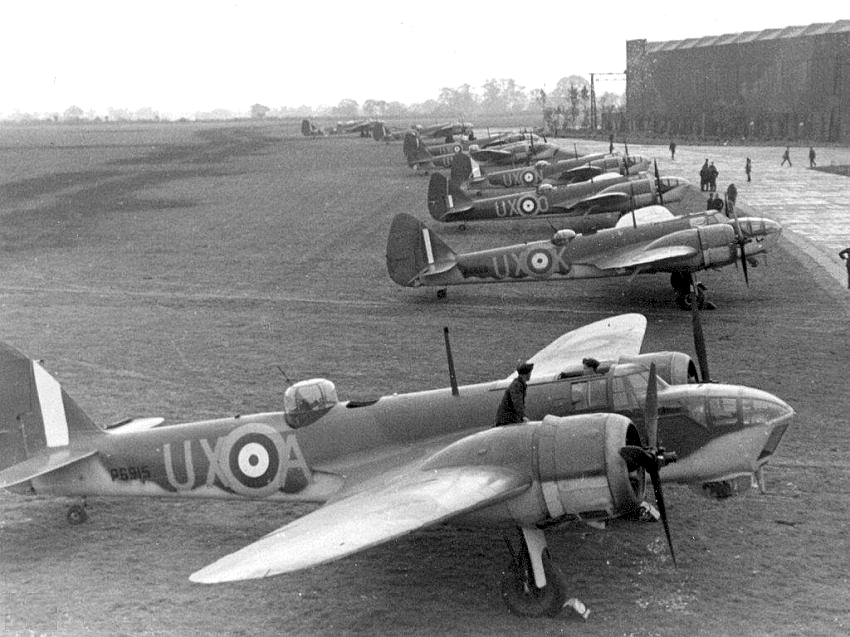
Caption: Bristol Blenheim IV RAF 82Sqn UX Watton Norfolk 1940
Caption: Bristol Blenheim IV RAF 82Sqn UXZ force landed France 1940
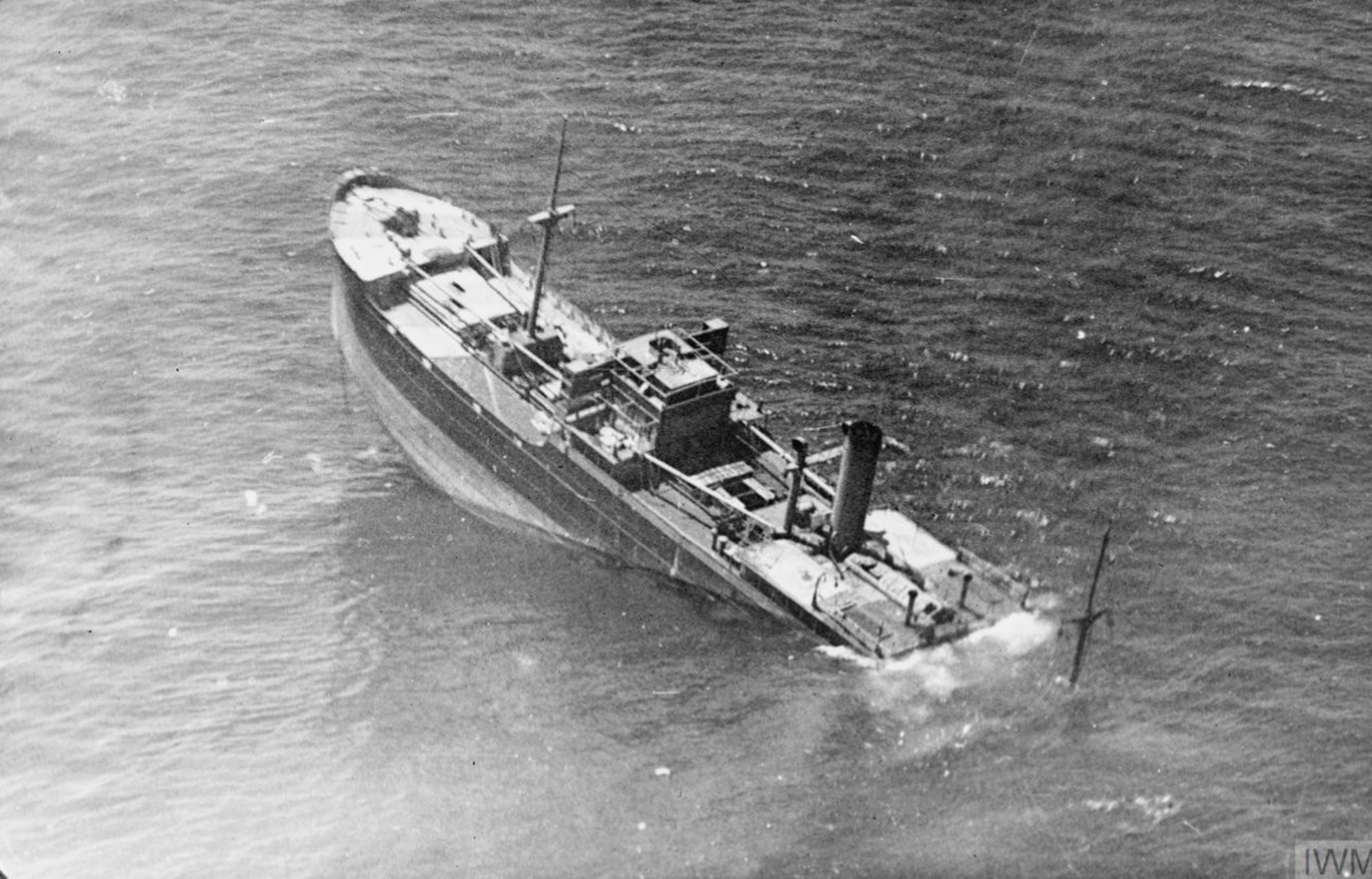
Caption: Blenheim IV RAF 82Sqn recon Italian SV Pietro Querini off the Kerkenna Islands IWM C1913
RAF No 82 (United Provinces) SquadronRAF No 82 (United Provinces) Squadron
Motto: Super omnia ubique (Over all things everywhere)
Formed at Doncaster on 7 January 1917 as a Corps reconnaissance unit equipped with Armstrong Whitworth FK8s, it moved to the Western Front in November, operating for the remainder of the war in its designated role. It returned to the Shoreham in February 1919, moving to Tangmere in May, where it disbanded on 30 June 1919.
The squadron reformed at Andover from 'B' Flight of no 142 Squadron in the light bomber role on 14 June 1937, equipped with Hawker Hinds. This was only intended as interim equipment and in March 1938, it received Blenheim Mk Is. By the outbreak of war, the squadron had re-equipped with Blenheim IVs, which it used against German lines of communications and later invasion barges in the channel ports.
In 1940 the squadron received a new commanding officer in the form of Wing Commander The Earl of Bandon. On 17 May 1940, his squadron was detailed to carry out a raid against German columns around Gembloux. When the expected fighter escort did not arrive, having already been intercepted by Bf109's, the twelve Blenhiems pressed on to the target and were themselves attacked by Bf109's. All but one of the aircraft were shot down and that one collapsed when it landed back at base. Faced with a squadron consisting of himself, one flight commander, two Sergeant pilots and the ground crews, it was planned to disband the squadron but Paddy Bandon put forward the case on behalf of the ground crews that the squadron should be re-equipped and won the day. That evening twelve new Blenhiems were delivered together with their crews. The following day they carried out a practice flight and that night he led six of them on raid into Germany. This quality of leadership earned him a well deserved DSO.
With the Battle of Britain over, the squadron then began anti-shipping operations but in June 1941 most of the squadron moved to Malta. However, in March 1942, the squadron was transferred to the Far East, leaving its Blenheims on Malta for distribution amongst other units. Although the squadron arrived at Karachi in May, it was August before any aircraft were received in the form of Vengence dive-bombers. These were initially used in the coastal patrol role until June 1943, when it began bombing raids against the Japanese in Burma. In July 1944, No 82 received Mosquito VIs, which it operated until 12 May 1945 against Japanese ground targets, at which point it was withdrawn to India to prepare for the invasion of Malaya. In the event the dropping of the atomic bombs on Japan negated the need for the invasion and No 82 Squadron disbanded at St. Thomas Mount on 15 March 1946.
The squadron soon reformed, on 1 October 1946, at Benson, from a nucleus of a flight of No 541 Squadron. Equipped with Lancaster PR Is and Spitfire XIXs, it undertook a photographic survey of the Gold Coast (Ghana), Gambia, Nigeria and Sierra Leone, which lasted until May 1947, when it re-located to Kenya and completed a similar survey of East Africa before returning to the UK in October 1952. From Benson and Wyton from March 1953, the squadron carried out a survey of Germany, re-equipping with Canberras in 1953 before disbanding on 1 September 1956. Its last incarnation, so far, began on 22 July 1959 when it reformed as a Thor Intermediate Range Ballistic Missile unit at Shepherds Grove, finally disbanding on 10 July 1963.
Squadron Codes used: - OZ Allocated Nov 1938 - Sep 1939 | UX Sep 1939 - Mar 1946
No. 82 Squadron RAF was a Royal Air Force squadron that was first formed in 1917 and disbanded in 1963. It served at times as a bomber unit, a reconnaissance unit and lastly as an Intermediate Range Ballistic Missile (IRBM) unit.
History
Formation and First World War
No.82 Squadron Royal Flying Corps was formed at RAF Doncaster, Yorkshire as an army co-operation unit on 7 January 1917. It deployed to France flying Armstrong Whitworth FK8 aircraft on 20 November 1917, It was declared operational in January 1918, flying artillery spotting and photo-reconnaissance over the Western Front, undertaking numerous missions in response to the German spring offensive. It continued to fly army co-operation missions until the Armistice ended the fighting on the Western Front. The squadron was disbanded on 30 June 1919.
Reformation and Second World War
No. 82 Squadron was reformed as a light-bomber squadron from a flight detached from No. 142 Squadron, equipped with the Hawker Hind at RAF Andover on 14 June 1937 and joining No. 2 Group. The squadron transferred to No. 1 Group and moved to RAF Cranfield on 8 July 1937. It re-equipped with Blenheim Mk Is during 1938, returning to 2 Group on 15 July that year and received the more advanced Blenheim Mk.IV in August 1939, moving to RAF Watton on 22 August.
The squadron started the Second World War flying anti-shipping missions over the North Sea, one of its aircraft sinking the German submarine U-31 near Wilhelmshaven on 11 March 1940, though U-31 was subsequently raised, and returned to service, only to be sunk again, this time by a destroyer, in November. On 10 May 1940, Germany invaded France and the Low Countries, and 82 Squadron was deployed in attacks against the German forces. On 17 May, 12 Blenheims were sent to attack German forces near Gembloux, Belgium, but the expected fighter escort did not show up, and after one Blenheim was shot by German flak, the remaining aircraft were intercepted by Messerschmitt Bf 109s, with ten more aircraft being shot down. 22 aircrew were killed and 3 taken prisoner. Despite these losses, it continued to fly missions in support of the BEF, and after the evacuation from Dunkirk, against German held airfields and invasion barges in the Channel ports. On 13 August, a raid on an airfield at Aalborg, Denmark again suffered catastrophic losses to German fighters, losing eleven out of twelve.
From early 1941, the squadron played a prominent part in No. 2 Group's offensive against shipping in the English Channel and North Sea. Losses continued both to fighters and to flak defences.
A detachment was sent to Malta in May 1941, with the rest of the Squadron following in June. It flew ships against enemy shipping and ports through into July, but extremely heavy losses led to it being withdrawn back to the UK at the end of the month, being replaced by 110 Squadron. Once back in the UK, it continued anti-shipping strikes as part of 2 Group.
To India
The squadron left Bomber Command and relocated to RAF Cholavarum, India in early 1942. Re-equipped with Vultee Vengeance dive-bombers the squadron began anti-submarine patrols on 17 November. In June 1943, the squadron began bombing operations against Imperial Japanese targets in Burma from RAF Salbani. it was deployed against the Japanese offensive against Imphal and Kohima. The squadron was re-equipped with Mosquitoes in July 1944, but was temporarily grounded due to failures in the wooden structure before commencing ground attack sorties on 19 December. These operations continued until 12 May 1945, when the squadron was withdrawn to India to prepare for the proposed invasion of Malaya. This operation did not occur due to the end of the war, and the squadron was disbanded on 15 March 1946.
Post-war operations in Africa
On 1 October 1946, the squadron was reformed at RAF Benson equipped with Avro Lancasters and Supermarine Spitfire PR. XIXs to undertake aerial surveys of Nigeria, the Gold Coast, Sierra Leone and Gambia. The squadron moved to Kenya in October 1947, it was flying from RAF Eastleigh, Nairobi, by 1950. In 1952, the squadron relocated to the UK and was re-equipped with Canberras in November 1953, remaining in the reconnaissance role. On 1 September 1956 the squadron was disbanded.
On Thor missiles
No. 82 Squadron reformed once again on 22 July 1959 at RAF Shepherds Grove as a Thor missile unit, part of Project Emily. The upcoming ICBM missiles however soon made the Thor Intermediate Range Ballistic Missile obsolete, and in 1962 the Minister of Defence announced the phase-out of the Thor missiles. The unit therefore was disbanded the last time on 10 July 1963.
Aircraft Operated by RAF No. 82 Squadron From To Aircraft Variant Aug 1917 Feb 1919 Royal Aircraft Factory F.E.8 AW FK8 Jun 1937 Mar 1938 Hawker Hart Mar 1938 Sep 1939 Bristol Blenheim Mk.I Aug 1939 Mar 1942 Bristol Blenheim Mk.IV Aug 1942 Jul 1944 Vultee Vengeance Mks.I, Ia Apr 1943 Jul 1944 Vultee Vengeance Mk.II Mar 1944 Jul 1944 Vultee Vengeance Mk.III Jul 1944 Mar 1946 de Havilland Mosquito Mk.VI Oct 1946 Oct 1947 Supermarine Spitfire PR.19 Oct 1946 Dec 1953 Avro Lancaster PR.1 Nov 1953 Feb 1955 English Electric Canberra PR.3 Oct 1954 Sep 1956 English Electric Canberra PR.7 Jul 1959 Jul 1963 PGM-17 Thor
Aircraft bases Operated by RAF No. 82 Squadron From To Place County/Country 7 Jan 1917 6 Feb 1917 RAF Doncaster Yorkshire 6 Feb 1917 30 Mar 1917 Beverley Yorkshire 30 Mar 1917 17 Nov 1917 RAF Waddington Lincolnshire 17 Nov 1917 20 Nov 1917 Saint-Omer Pas-de-Calais, France 20 Nov 1917 22 Jan 1918 Savy Aisne, France 22 Jan 1918 22 Mar 1918 Golancourt (Bonneuil) Oise, France 22 Mar 1918 24 Mar 1918 Catigny Oise, France 25 Aug 1939 1 Oct 1940 RAF Watton Norfolk 1 Oct 1940 18 Apr 1941 RAF Bodney Norfolk 18 Apr 1941 3 May 1941 RAF Lossiemouth Morayshire 3 May 1941 21 Mar 1942 RAF Bodney Norfolk 11 June 1941 21 Mar 1942 Luqa (Detachment) Malta 24 May 1942 11 Jun 1942 Karachi Sindh, British India (then, now Sindh, Pakistan) 11 Jun 1942 6 Jul 1942 Quetta Baluchistan (then, now Balochistan (Pakistan)) 6 Jul 1942 5 Mar 1943 Cholavaram Madras Presidency (then, now Tamil Nadu, India) 2 Jul 1942 28 Oct 1942 Karachi (Detachment) Sindh 26 Feb 1943 5 Mar 1943 Madhaiganj (Detachment) United Provinces (now Uttar Pradesh, India) 5 Mar 1943 12 Apr 1943 Madhaiganj United Provinces 12 Apr 1943 23 May 1943 Asansol Bengal (then, now West Bengal, India) 23 May 1943 13 Aug 1943 Salboni Bengal (then, now West Bengal, India) 31 May 1943 20 Jun 1943 Chittagong (Detachment) Bengal (then, now Chittagong Division, Bangladesh) 13 Aug 1943 21 Nov 1943 Feni Airfield Bengal (then, now Feni District, Bangladesh) 21 Nov 1943 22 Jan 1944 Dohazari Bengal (then, now Chittagong Division, Bangladesh) 22 Jan 1944 25 May 1944 Jumchar Bengal (then, now Chittagong Division, Bangladesh) 20 Mar 1944 9 Apr 1944 Kumbhirgram (Detachment) Assam, India 25 May 1944 5 Oct 1944 Kolar Karnataka, India 5 Oct 1944 13 Dec 1944 Ranchi Bihar (then, now Jharkhand, India) 13 Dec 1944 19 Dec 1944 Chharra United Provinces 19 Dec 1944 26 Apr 1945 Kumbhirgram Assam 26 Apr 1945 4 Jun 1945 Joari Bengal (then, now Chittagong Division, Bangladesh) 4 Jun 1945 14 Oct 1945 Cholavaram Madras Presidency (then, now Tamil Nadu, India)





 Editor for Asisbiz: Matthew Laird Acred
If you love our website please subscribe to our YouTube video channel
Please donate so we can make this site even better !!