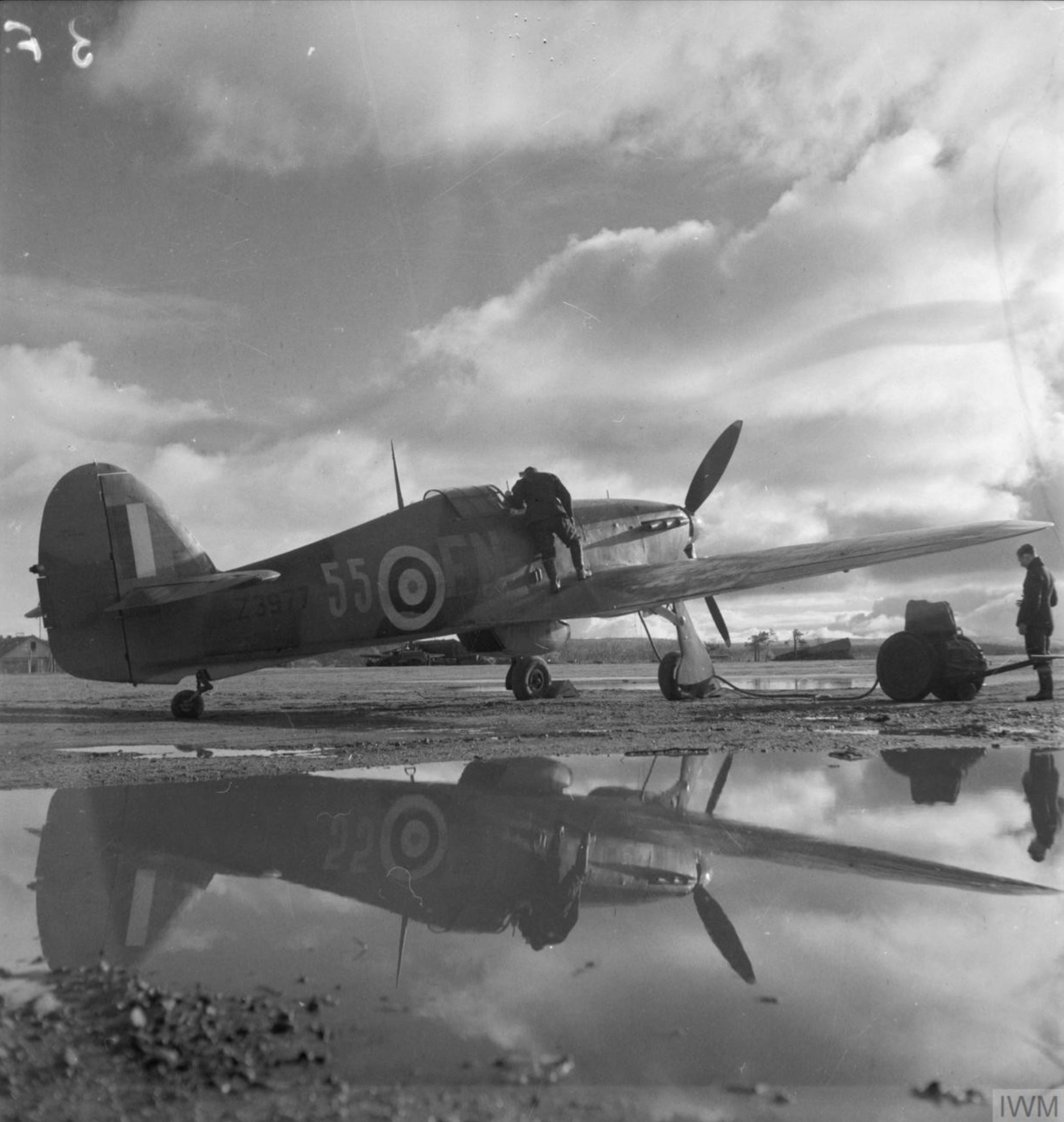
Caption: Hurricane IIb Trop RAF 151 Wing 81Sqn FN55 Z3577 Vaenga USSR Oct 1941 IWM CR36
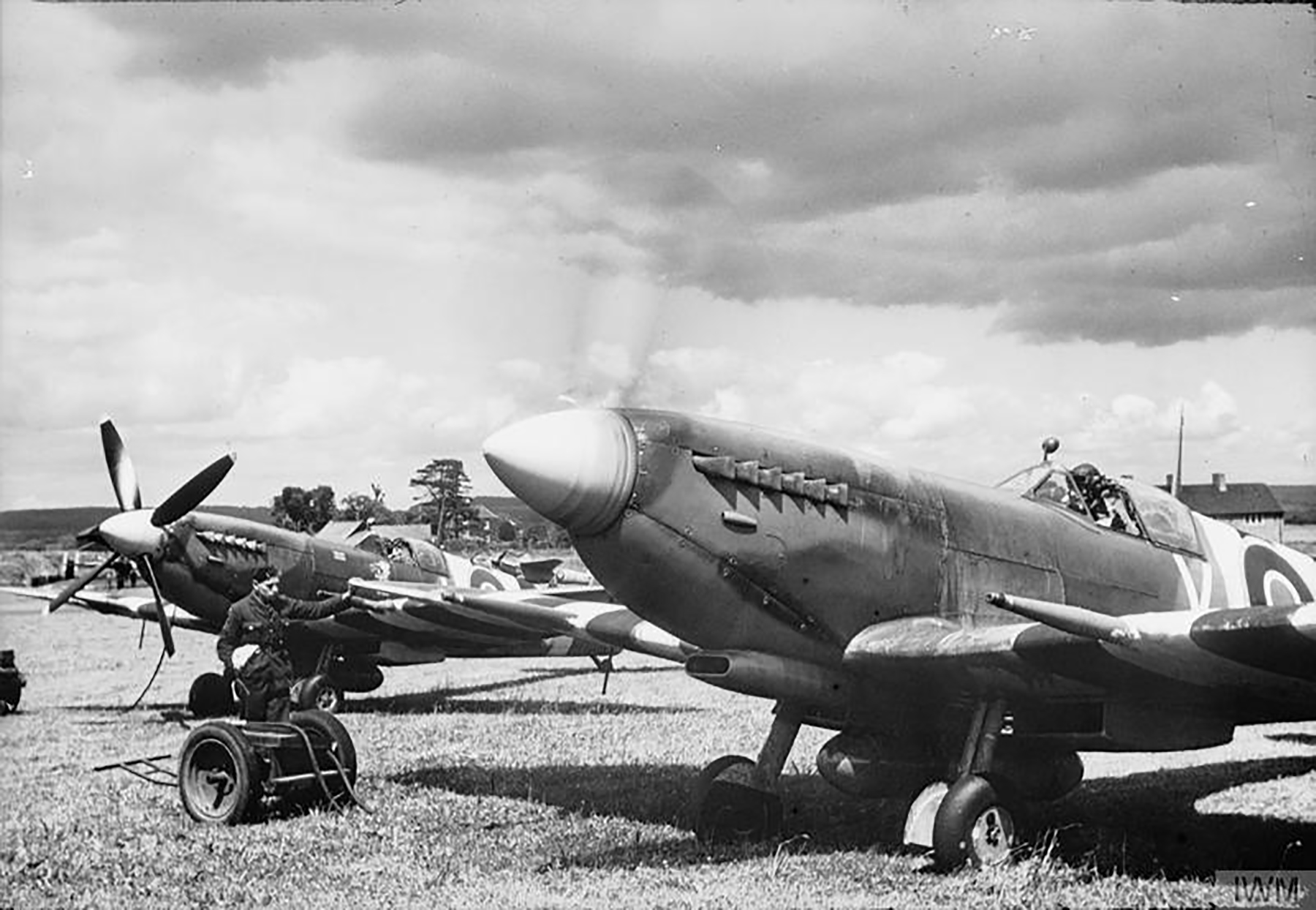
Caption: Spitfire MkIXc RAF 81Sqn FLV 1944
Caption: Spitfire MkIXc RAF 81Sqn FLV 1944
Caption: Spitfire MkIX RAF 81Sqn EN445 with Sqn Ldr CF Gray at Souk el Khemis Tunisia
RAF No 81 Squadron
Motto: Non solum nobis (Not for us alone)
Formed as a training unit at Gosport on 7 January 1917, it disbanded on 4 July 1918. It reformed at Wyton two weeks after the Armistice (25 November 1918) in the fighter role being composed of Canadian personnel, with the alternative designation, No 1 Squadron, Canadian Air Force. However, it disbanded on1 February 1920.
Reformed from the Communication Squadron at Mountjoie in France on 1 December 1939, it flew Tiger Moths until the German invasion necessitated its withdrawal back to Britain, where it disbanded on 15 June 1940. Just over a year later, it reformed at Leconfield on 29 July 1941 in the fighter role, equipped with Hurricanes. In September it moved to North Russia, flying its aircraft from HMS Argus, here it flew operations as well as training Russian pilots to operate the Hurricanes, which were then left with the Russians when the squadron returned to Turnhouse in November.
In January 1942 it re-equipped with Spitfires, which it used operationally for the first time on 1 February 1942. It operated in the North of England and Scotland until May when it joined No 11 Group at Hornchurch, taking part in offensive operations until October. It now became part of the air assets involved in the invasion of North Africa (Operation Torch), when it moved to Gibraltar. From here it moved into its new home at Maison Blanche on 8 November. It them provided support for the 1st Army until the campaign in North Africa ended.
In June 1943 a move to Malta allowed it to support the Allied invasion of Sicily and in September it transferred to the Italian mainland but in November it was transferred to India. Its aircraft arrived at Alipore in early December 1943 and the squadron began ground support operations in January 1944, maintaining these until August 1944 when the squadron moved to Ceylon, where it disbanded on 20 June 1945. The same day No 123 Squadron, which was re-equipping with Thunderbolts at Bobbili, was re-numbered No 81. However, the war ended before the squadron could become operational on its new aircraft, but it was sent to Java in October in the tactical reconnaissance and convoy protection role, finally disbanding on 30 June 1946.
No 81 Squadron reformed on 1 September 1946 at Seletar in Singapore when No 684 Squadron was re-numbered. It was now operating in the Photo-Reconnaissance role equipped with Mosquitoes and later some Spitfires. It remained in the Far East, being heavily involved in Operation Firedog from 1947. The squadron holds the distinction of carrying out the last operational flights of both the Spitfire (1 April 1954) and the Mosquito (15 December 1955). From December 1953 it began to operate Meteor PR Mk 10s and in 1956 some Pembroke C (PR) Mk 1s were received and in 1958 Canberras began to arrive, but it was three years before these fully supplanted the Meteors. No 81 Squadron finally disbanded as the Far East Air Force was being run down on 16 January 1970.
Standards Battle Honours*
Award of Standard originally announced on 30 Jun 1964, effective from 1 Apr 1964 but presented:- France & Low Countries, 1939-40: Russia, 1941: Fortress Europe, 1942: Home Defence, 1942: Channel & North Sea, 1942:Dieppe: North Africa, 1942-43: Mediterranean, 1943: Sicily, 1943: Salerno: Italy, 1943: Burma 1944: Arakan, 1944: North Burma, 1944: Manipur, 1944
Squadron Codes used: -
WK Allocated Apr 1939 - Sep 1939
Russian Characters These were carried whilst the squadron was serving in the USSR, Jul - Nov 1941
FL Dec 1941 - Jun 1946No. 81 Squadron, Royal Air Force was a squadron of the Royal Air Force. It flew fighter aircraft during the Second World War, reconnaissance aircraft in the Far East after the war, and was disbanded in 1969.
History
First World War
No. 81 Squadron Royal Flying Corps was formed on 7 January 1917 at Gosport as a training unit, but unlike many other Training squadrons during the First World War, it was not mobilised for active service and was disbanded on 4 July 1918.
The squadron reformed 25 November 1918 with all Canadian personnel and was officially known as No. 1 Squadron, Canadian Air Force until disbanding again on 1 February 1920.
Second World War
The rebirth of No. 81 Squadron seemingly can be traced to the Air Component Field Force Communication Squadron RAF formed in August 1939, probably associated with the British Expeditionary Force Air Component under Air Vice-Marshal Charles Blount (see British Air Forces in France).
On 1 December 1939 the Communications Squadron at Mountjoie, France (see fr:Montjoi), operating de Havilland Tiger Moths, was redesignated No. 81 Squadron. It was disbanded on 15 June 1940, when the advancing German forces forced its withdrawal to the United Kingdom.
A Hawker Hurricane of No. 81 Squadron at Vaenga in Russia, late 1941
Following the German Invasion of the Soviet Union, it was decided to send a wing of Hawker Hurricane fighters to assist the Soviet war effort, and No. 81 Squadron, commanded by Squadron Leader Anthony Rook, reformed at RAF Leconfield on 29 July 1941 as part of No. 151 Wing RAF. In September the squadron embarked on the carrier HMS Argus, which transported them towards Murmansk in Northwest Russia, deploying them to Vaenga Airfield as part of Operation Benedict. The wing flew both defensive sorties and escort missions for Soviet bombers, while carrying out its principal role of training Soviet pilots on the Hurricane. After a few weeks of operations the Hurricanes were handed over to the Soviets and the RAF personnel left to return to the UK at the end of November.
When the squadron arrived back in Britain, it was equipped with Supermarine Spitfires at RAF Turnhouse, Edinburgh, being declared operational on 1 February 1942. It moved to RAF Hornchurch near London in May, flying its first operation, escorting Hurricanes bombing Bruges on 1 June. At the end of October the Squadron moved to Gibraltar and on 8 November, 19 Spitfires moved to the newly captured airfield at Maison Blanche, Algiers. Following the German surrender in North Africa, it moved to Malta in preparation for the Invasion of Sicily. It then moved to Italy in September but was withdrawn to Egypt in November to prepare for deployment to the Far East. During operations in the Mediterranean, they found their most frequent opponents were Jagdgeschwader 53 who had an ace of spades motif on their aircraft. As the squadron commander considered that they had 'bested' their enemy, they took the motif and started applying it to their aircraft.
A Thunderbolt of No. 81 Squadron being prepared for action against Indonesian nationalists at Kemajoran airfield, Batavia
It arrived at Alipore, India in December 1943, equipped with more modern Spitfire VIII, starting operations in January, flying fighter and ground attack missions in support of the Second Battle of Arakan and the Battle of Imphal as part of the RAF Third Tactical Air Force. It was withdrawn to Ceylon in August and disbanded on 20 June 1945. On the same day 123 Squadron was renumbered 81 Squadron but its Thunderbolts did not become operational before the war ended. In October, the squadron was sent to Java during the Indonesian War of Independence, flying tactical reconnaissance duties and covering Allied road convoys, while attacking nationalist held airfields and ammunition dumps. On 30 June 1946, the squadron was again disbanded.
Postwar reconnaissance operations
On 1 September 1946, No. 684 Squadron, the Far east photo-reconnaissance squadron flying de Havilland Mosquito PR.34s and Spitfire PR.19s, was renumbered as No. 81. It added fighter-reconnaissance Spitfires in August 1947, when it became involved in the Malayan Emergency. Conversion to Meteor PR.10s began in September 1953, with the Squadron flying the RAF's last operational Spitfire mission on 1 April 1954 and the last operational RAF Mosquito mission on 15 December 1955. It received a few Percival Pembrokes for survey operations in 1956 and began converting to the English Electric Canberra in 1958, flying its last Meteor mission on 7 July 1961, retaining the Canberra until the Squadron was disbanded as part of Britain's withdrawal from bases East of Suez on 16 January 1970.
The Squadron was based at RAF Seletar and RAF Tengah in Singapore from 1947 to 1970 with a small detachment at RAF Kai Tak in Hong Kong from 1947 to 1954.






 Editor for Asisbiz: Matthew Laird Acred
If you love our website please subscribe to our YouTube video channel
Please donate so we can make this site even better !!