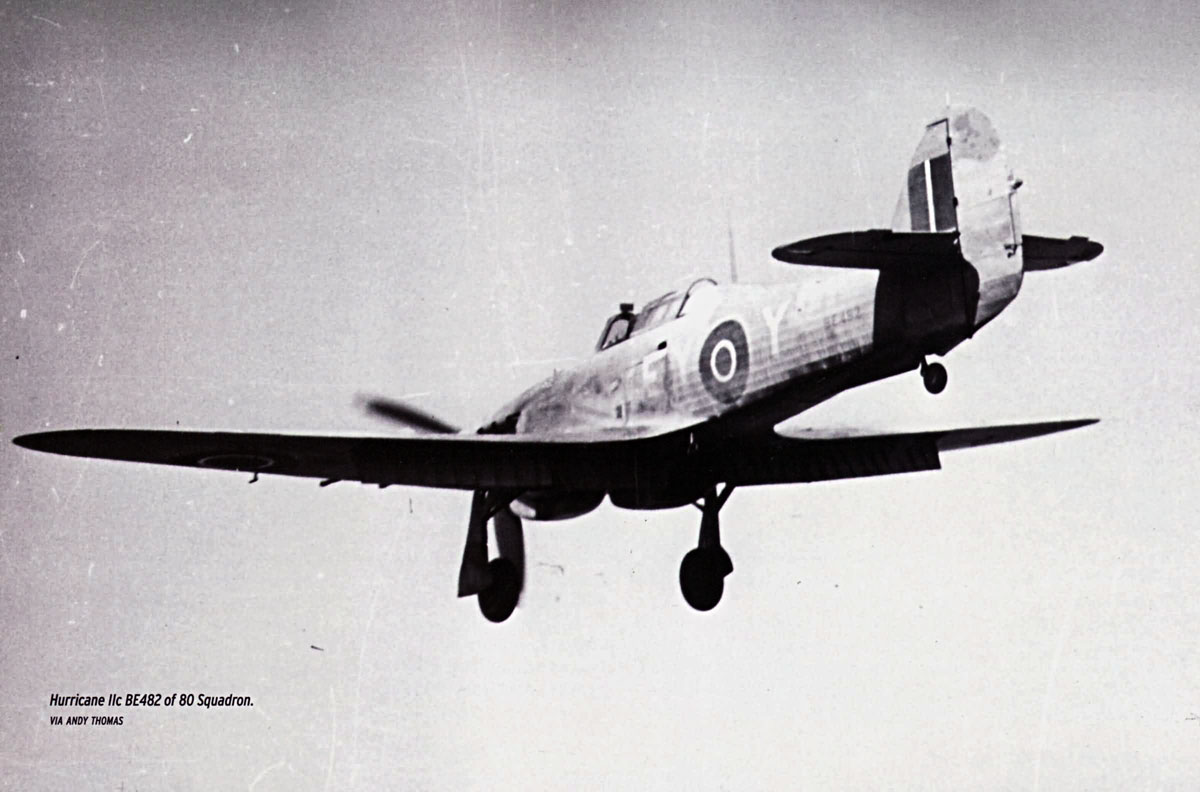
Caption: Hawker Hurricane IIc Trop RAF 80Sqn EYY BE482 North Africa
Caption: Hurricane I Trop RAF 80Sqn J Pattle L1669 Collies Battleship Paramithia Greece Feb 1941
Caption: Hawker Hurricane I RAF 80Sqn YKQ V7599 at Eleusis Greece IWM MERAF1088
RAF No 80 Squadron
Motto: Strike true
Formed at Montrose on 1 August 1917 as a fighter unit equipped with Camels. It moved to the Western Front in January 1918 conducting fighter patrols, but after the German offensive of March 1918, it began ground attack operations, which it continued up until the end of war. Retained in France after the Armistice, it replaced its Camels with Snipes in December and in May 1919 it was transferred to Egypt, where on 1 February 1920, it was disbanded by being renumbered No 56 Squadron.
The squadron reformed, once again as a fighter unit on 8 March 1937 at Kenley, initially equipped with Gauntlets, these were replaced by Gladiators in May. In April 1938 the squadron was once again sent out to Egypt as an air defence unit. Following the Italian declaration of war , the squadron moved to the Libyan border but in November was one of the units sent to assist the Greeks following the Italian invasion of that country. Re-equipment with Hurricanes began in February 1941 but when British forces were compelled to evacuate the country, the squadron was still equipped with Gladiators as well.
On its return from Greece the squadron was sent to Syria, from where it operated detachments in Palestine and Cyprus before moving totally to Cyprus in July 1941 and then back to Syria in August. The squadron finally joined the fighting in the Western Desert in October 1941 and following the breakout at El Alamein it was tasked with covering the lines of communication, remaining in North Africa until January 1944. A move to Italy was short-lived as in April the squadron was sent back to Britain in preparation for Operation 'Overlord'.
Back in the UK, it re-equipped with Spitfire IXs and began fighter sweeps, escort duties and armed reconnaissance missions. The Spitfires were replaced by Tempest Vs in August 1944 and these were soon being used to combat the V-1 flying bomb attacks against the South of England. Once the V-1 launching sites had been over-run by te advancing armies, the squadron was able to move onto the continent and continue it previous duties in September until the end of war.
Retained as part of the occupation forces, it continued to operate Tempests until January 1948, when these were replaced by Spitfire F Mk 24s, which it then took to Honk Kong in July 1949. At this time a Communist revolution was taking place in nearby Chain, and No 80's task was to increase the air defences of colony. The Spitfires were replaced by Hornets in December 1951 and the squadron continued to serve in the colony until disbanding on 1 May 1955. The squadron reformed, when No 80 Squadron was renumbered, just over a month later on 1 August 1955 as a photo-reconnaissance unit in RAF Germany at Laarbruch. Equipped with Canberra PR Mk 7s, it moved to Bruggen in June 1957 and remained there until disbanding on 28 September 1969.
Standards:
Battle Honours:
Lys: Western Front, 1918: Marne, 1918: Somme, 1918: Egypt & Libya, 1940-43: Greece, 1940-41: Syria 1941: El Alamein: Mediterranean, 1940-43: Italy 1944: South-East Europe, 1944: Normandy 1944: Home Defence 1944: Fortress Europe 1944: France & Germany 1944-45: Arnhem: Rhine:
Squadron Codes used: - GK Oct 1938 - May 1939, 1940 - Jun 1940 | OD May 1939 - 1940 | YK Jun 1940 - Jan 1941 | EY Apr 1943 - Apr 1944 | W2 Apr 1944 - 1952
British team at the Australia, Canada and United Kingdom Reprogramming Laboratory (ACURL).[5] It was a Royal Flying Corps (RFC) and Royal Air Force (RAF) squadron active from 1917 until 1969. It was operative during both the First and Second World Wars.
History
Establishment and early service
Founded on 1 August 1917 at Montrose Air Station, Scotland, equipped with the Sopwith Camel and intended as a fighter squadron, 80 Squadron was sent to France to serve on the Western Front in January 1918, acting initially in a fighter role. However, German offensives in March of the same year resulted in 80 Sqn being reallocated in a ground-attack role, still with Camels. It continued this duty until the end of the war. As a result, the squadron had only one ace, Harold Whistler, although it claimed approximately 60 aerial victories.
The Camels were replaced with Sopwith Snipes in December 1918 and in May the following year the squadron moved to Egypt, where it served for a short period of time before being amalgamated into No. 56 Squadron RAF.
Reinstatement and the Second World War
The squadron was reformed in March 1937 again as No. 80 Squadron, now equipped with Gloster Gauntlet fighter. However, by now the Gauntlet was considered by many to be outdated, and as a result the Gauntlets were replaced by the Gloster Gladiator just two months later. In 1938, the squadron again returned to Egypt as an 'air defence unit'. After Italy's declaration of war on Britain on 10 June 1940, No. 80 Squadron was moved to the Egyptian-Libyan border but was subsequently one of the units sent to aid the Greeks during the Greco-Italian War, initially flying Gladiators and then re-equipping with the Hawker Hurricane from February 1941.[9] The squadron lost most of its aircraft during the Greek and Crete actions and reformed at RAF Aqir in Palestine in May 1941 before deploying detachments to Nicosia in Cyprus and 'A' Flight to RAF Haifa. The squadron moved totally to Cyprus in July 1941, before returning to Syria the next month, and then joining the fighting in North Africa two months later. During the Battle of El Alamein it was responsible for defending communications lines. It remained in that area until early 1944, when it returned to Britain to prepare for Operation Overlord (the Allied invasion of Europe). It was equipped with the Supermarine Spitfire Mk IX operating from RAF Detling as part of Air Defence of Great Britain Command (ADGB), though under the operational control of RAF Second Tactical Air Force (2nd TAF).[10] When 2nd TAF began moving to Normandy after D-Day, the squadron remained in ADGB, re-equipping with Hawker Tempest aircraft on anti-V-1 flying bomb duties as part of Operation Diver. After this threat diminished, No. 80 Squadron moved on to the continent and resumed a fighter role until the end of the war in Europe.
Aircraft Operated by RAF No. 80 Squadron From To Aircraft Version Aug 1917 Dec 1918 Sopwith Camel Dec 1918 Feb 1920 Sopwith Snipe Mar 1937 Mar 1937 Gloster Gauntlet Mk.II Mar 1937 Nov 1940 Gloster Gladiator Mk.I Jun 1940 Aug 1940 Hawker Hurricane Mk.I Nov 1940 Mar 1941 Gloster Gladiator Mk.II Feb 1941 Jan 1942 Hawker Hurricane Mk.I Jan 1942 Apr 1943 Hawker Hurricane Mk.IIc Apr 1943 Apr 1944 Supermarine Spitfire Mk.Vc Sep 1943 Jan 1944 Supermarine Spitfire Mk.IX Jan 1944 Apr 1944 Supermarine Spitfire Mk.Vb May 1944 Aug 1944 Supermarine Spitfire Mk.IX Aug 1944 Jan 1948 Hawker Tempest Mk.V Jan 1948 Jan 1952 Supermarine Spitfire F.24 Dec 1951 May 1955 de Havilland Hornet F.3 & F.4 Aug 1955 Sep 1969 English Electric Canberra PR.7







 Editor for Asisbiz: Matthew Laird Acred
If you love our website please subscribe to our YouTube video channel
Please donate so we can make this site even better !!