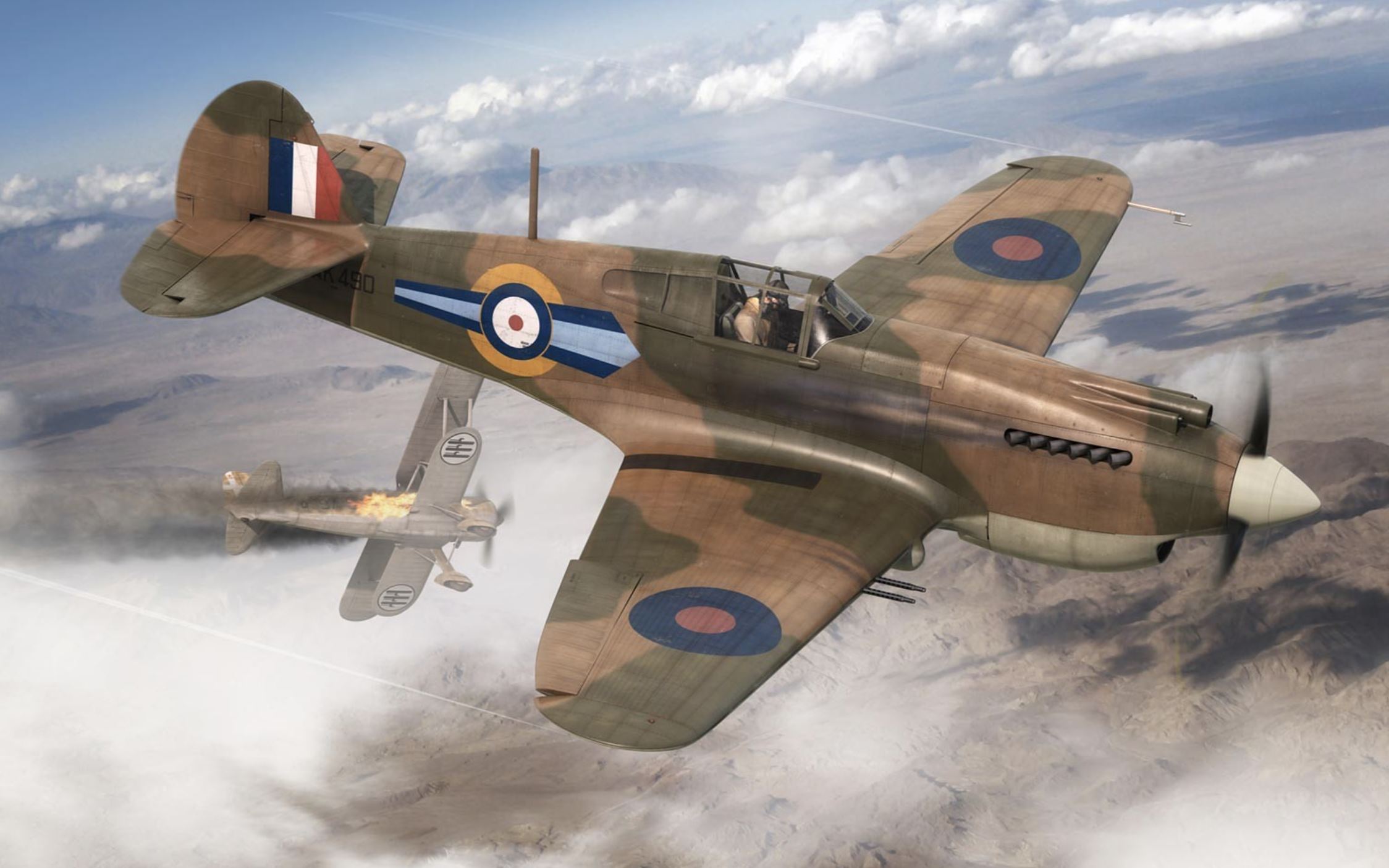
Caption: Artwork of a Curtiss Tomahawk IIB RAF 73Sqn AK490 Wykeham Barnes Egypt 1941 Airfix box art
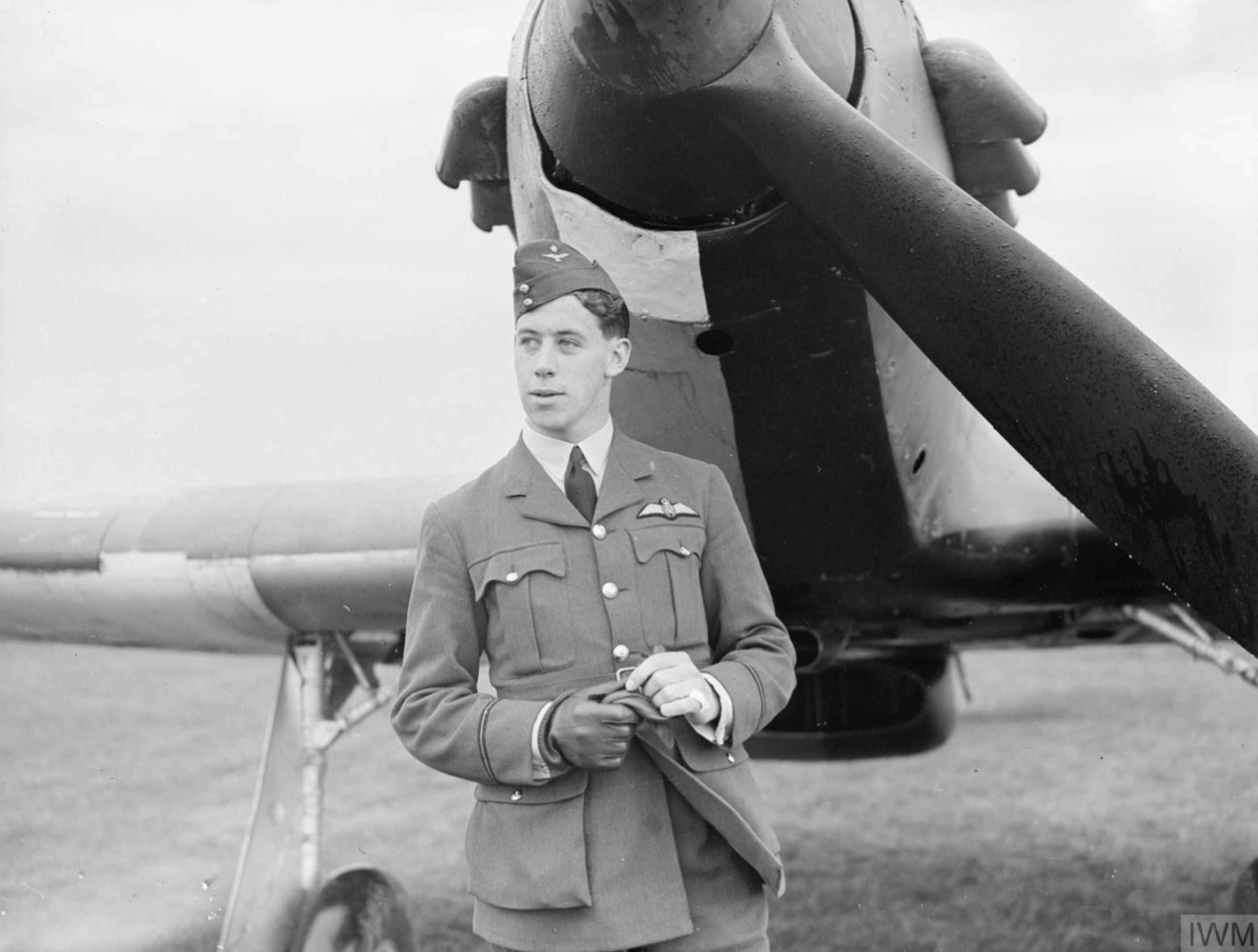
Caption: Aircrew RAF 73Sqn Edgar Cobber Kain April 1940 IWM C1148
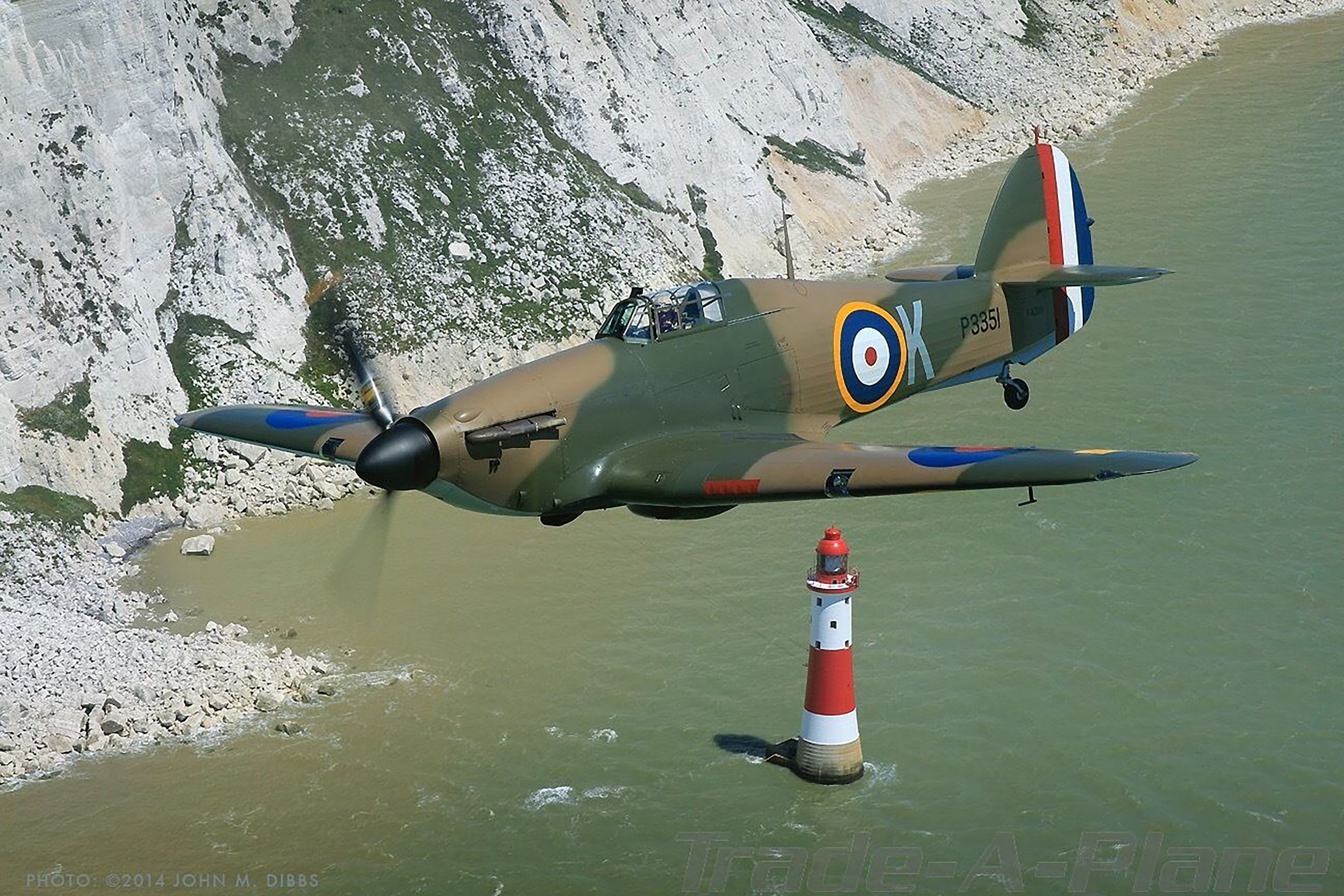
Caption: Airworthy Hawker Hurricane as RAF 73Sqn TPK P3351
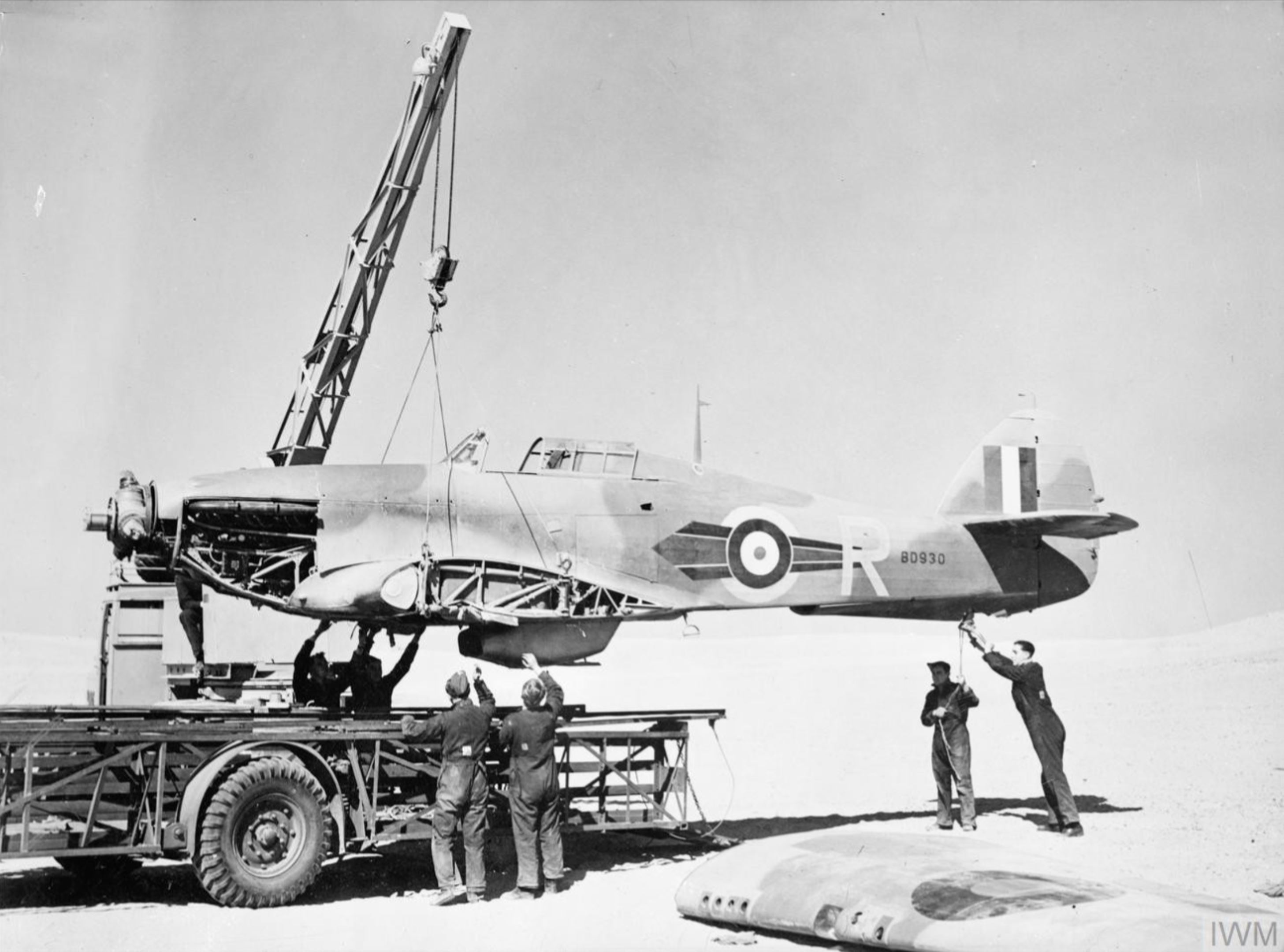
Caption: Hawker Hurricane IIb RAF 73Sqn R BD930 being salvaged by 53RSU North Africa 1942 IWM CM2240
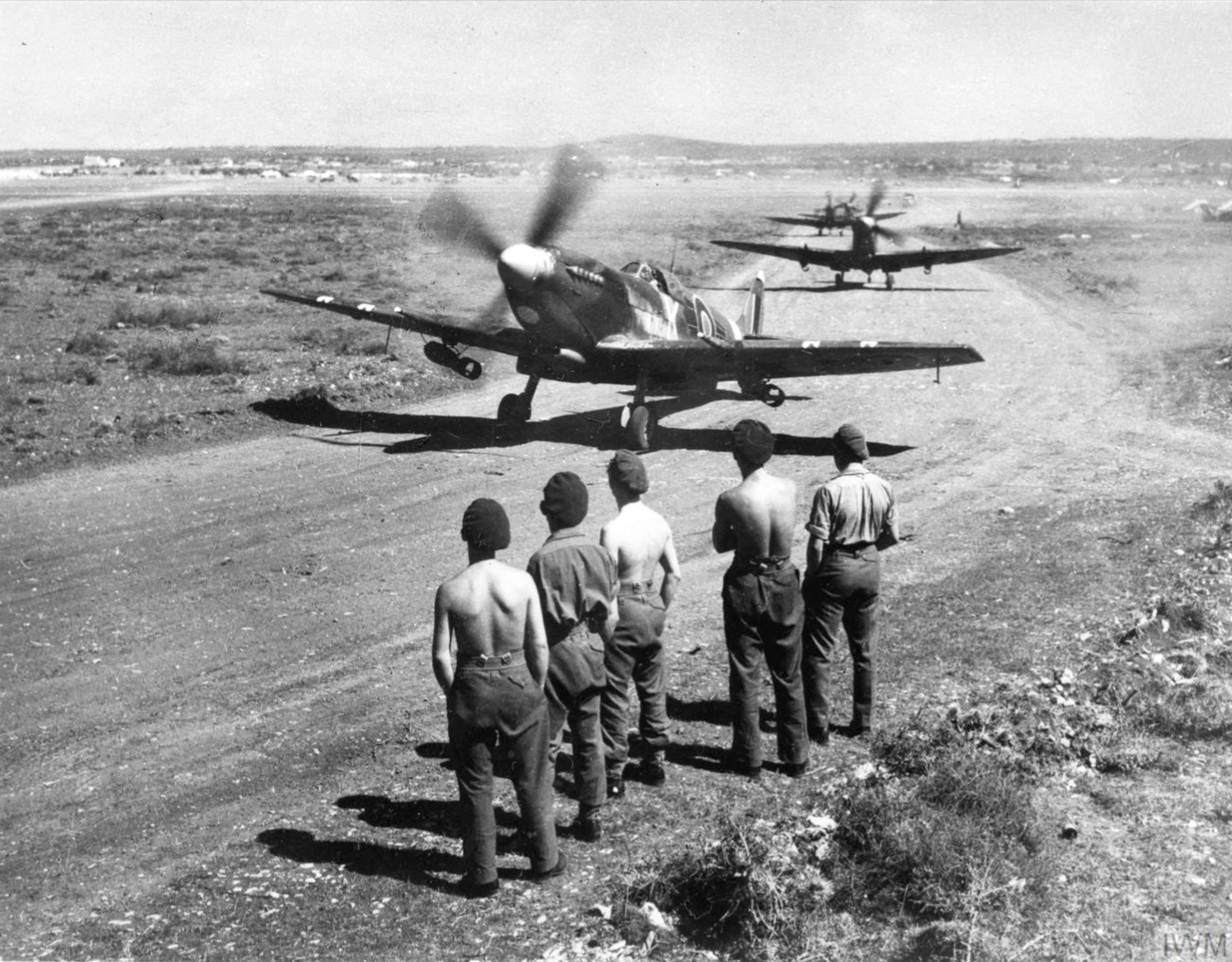
Caption: Spitfire MkIXs RAF 73Sqn at Prkos near Zadar Yugoslavia 22nd April 1945 IWM CNA3527
Caption: Spitfire MkIXs RAF 73Sqn taxing at Prkos near Zadar Yugoslavia 22nd April 1945 IWM CNA3525
RAF No 73 Squadron
Motto: Tutor et Ultor (Protector and Avenger)
Formed at Upavon on 1 July 1917, it trained as a Camel fighter unit and moved to France in January 1918. Initially conducting fighter patrols and escort duties, following the German 'Michael' Offensive of March 1918, it found itself carrying ot ground attack sorties as well. It later developed tactics in co-operating with tanks, which it continued until the end of the war. It did not remain on the continent long after the Armistice, returning to Yatesbury in February 1919, where it disbanded on 2 July.
The squadron reformed, again in the fighter role on 15 March 1937, moving to Debden in June. At the same time its initial equipment of Furies were replaced by Gladiators. In November the squadron moved again, this time to Digby where in July 1938, it converted to Hurricanes. With the outbreak of war the squadron joined the Advanced Air Striking Force in France to provide defensive cover to the AASF's airfields. As the German advance continued after May 1940, the squadron moved further back towards the coast until 18 June, when it returned to Church Fenton to recuperate and re-equip. It spent most of the Battle of Britain here in the night fighter role, moving to Castle Camps in September.
The squadron was now earmarked for service in the Middle East and in October it ceased operations and on 13 November it boarded HMS Furious and left for Takoradi in West Africa. The ground echelon had travelled separately and they arrived in Egypt at the end of November, with the air echelon flying the Takoradi Route, arriving at Heliopolis on 6 December. For the remainder of the North African campaign, the squadron flew shipping escort patrols, ground-attack operations and night fighter patrols. New equipment arrived in June 1943, when the squadron received Spitfires and these were taken to Italy in October. The squadron converted to the fighter-bomber role in April 1944, operating in this role over the Balkans for the remainder of the war. A detachment was sent to Greece to help put down a Communist take over from December 1944 to January 1945. In April 1945, the squadron moved to Yugoslavia remaining there until July, when it transferred to Malta.
It now became one of Malta's permanent units and converted to Vampires, in Cyprus, from August to October 1948. Venoms replaced these in November/December 1954 at Habbaniya, to where the squadron had moved in May 1953. Two years after this, with the withdrawal of the RAF from Iraq, the squadron moved to Cyprus, where it converted to the Canberra in May 1957. When the Akrotiri Strike Wing was replaced by Vulcans, the squadron finally disbanded on 3 February 1969.
Standards Battle Honours*
Western Front, 1918: Maine, 1918: Lys: Amiens: Arras: Hindenburg Line: France & Low Countries, 1939-40: Battle of Britain, 1940: Egypt & Libya, 1940-43: Mediterranean, 1941-43: El Alamein: El Hamma: South East Europe 1943-45: Italy 1943-45:
Squadron Codes used: - HV Oct 1938 - Sep 1939 | TP Sep 1939 - Nov 1940
No. 73 Squadron, Royal Air Force was formed on 2 July 1917 during the First World War. It was disbanded in 1969.
World War I
It was initially a unit of the Royal Flying Corps and was formed out of the Central Flying School, based at Upavon, Wiltshire. Eight days later, the new unit moved to RFC Lilbourne, near Rugby.
The squadron, only for a matter of days led by Lieutenant C A Mercer, came under the command of Major H F A Gordon and started a phase of training at Lilbourne. From September 1917, this became more specifically targeted towards operating in combat when a Programme of Development was received, instructing the unit to prepare for an overseas deployment on 22 December.
This training phase saw a number of accidents and incidents, not uncommon in military aviation at that time. On one day, 29 October 1917, the squadron had four aircraft damaged in accidents: two in a mid-air collision, when one aircraft had its propeller damaged, the other lost part of its lower left wing and aileron; one aircraft was damaged when it had to be crash-landed after its pilot became lost; a fourth aircraft was damaged when the pilot crashed at the aerodrome. All incidents are shown in the squadron records as applying to 'A' Flight.
The squadron's first fatality appears to have been 2nd Lieutenant E G Higginson, a 23-year-old Canadian, who died on 4 October 1917 as the result of a flying accident.
Combat operations
By stages, the unit deployed to France through January 1918; by the 20th, the full squadron complement was based at Liettres and available for operations. Due to bad weather, the first patrols were not sent up until 30 January. Two flights each comprising six machines undertook practice patrols, one along the balloon lines from Boesinghe to Flerbaix and then Bethune to Arras.
The first offensive patrols over enemy lines took place on 18 February 1918. On the 20th, all 18 Camels, divided into three 'Flights' patrolled a line between Roeselare and Menin and the first combat report was completed by Captain Gus Orlebar, submitting that an Albatros D.V may have been damaged. It was the start of a combat record that would show ten aces serving in the squadron, including Owen Baldwin, Gavin L. Graham, William Stephenson, William Henry Hubbard, Emile John Lussier, Robert Chandler, Norman Cooper, Maurice Le Blanc-Smith, Thomas Sharpe, and future Air Vice-Marshal Geoffrey Pidcock.
In March 1918 the squadron was moved to the south of the British Front where it became engaged in the German offensive between Cambrai and St. Quentin where low level strafing was carried out.
In August the squadron was attached to the Tank Corps for special duties in connection with anti-tank gun strafing and took part in a succession of battles on the Third and Fourth Army Fronts. During this phase the squadron expended 25,000 rounds of ammunition and 160 25 lb. Cooper bombs in one day's flying.
At the cessation of hostilities the Camels of No. 73 were disposed of and the personnel posted to RAF Yatesbury, where the squadron was disbanded. During wartime operations the pilots of the squadron had destroyed or sent down out of control 132 enemy aircraft.
Aircraft used
As at 1 October 1917, the squadron had the following aircraft:
Aircraft Operated by RAF No. 73 Squadron Flight Aircraft 'A' Flight 2 Sopwith Camels, 1 Sopwith Pup, 2 Nieuports 'B' Flight 2 Avros, 1 Nieuport 'C' Flight 1 Avro From November 1917, the squadron began to re-equip entirely with Sopwith Camels powered by 130hp Clerget engines. By the time it deployed to France in January 1918, the squadron had 18 Camels, which it retained throughout the rest of the Great War.
World War II
In September 1939, 73 Squadron, along with No. 1 Squadron were then posted to North-East France on the outbreak of war as part of the RAF Advanced Air Striking Force. Early in the campaign the squadron controlled the Cherbourg Peninsula, before a move to Rouvres in October. One of the outstanding pilots on the squadron at this time was F/O. E. J. 'Cobber' Kain, who destroyed a Do 17 at 27,000 feet. 'Cobber' was killed in a flying accident on 7 June 1940. Another 'ace' in the squadron at this time was F/O Newell 'Fanny' Orton.
After the German attack on 10 May 1940, No. 73 provided cover over Allied airfields and bases, falling back as its airfields were overrun by enemy columns. On 17 June 1940 the squadron had withdrawn from France. The squadron suffered tragedy during the withdrawal when RMS Lancastria was sunk off the coast of St. Nazaire with the loss of around 40 ground crew.
During the Battle of Britain No.73 Squadron, operating from RAF Debden on 5 September until late October, when the unit withdrew in preparation for a move to the Middle East.
The squadron Hurricanes were shipped to Takoradi on the Gold Coast on board HMS Furious, and were then flown in stages across Africa to Egypt. The squadron took part in the series of campaigns in the Western Desert and Tunisia, helping cover the supply routes to Tobruk and taking part in ground-attack operations. In December 1942 the squadron recorded their 300th victory when F/S Beard shot down a Ju 88 over the sea of Benghazi.
In June 1943 the squadron converted to the Spitfire, and were posted to Italy in October. In April 1944 the squadron began to operate over the Balkans, in the fighter-bomber role. In December 1944 part of the squadron was moved to Greece to take part in the fighting against the Communist resistance attempting to seize power. In January 1945 the squadron returned to Italy, and in April moved to Yugoslavia, where it remained until the end of the war moving to Malta in July 1945. Initially at RAF Hal Far, the squadron soon moved to RAF Ta Kali.
1950s
The squadron, now flying de Havilland Vampire FB.9, Venom FB.1s, was moved to Habbaniya in Iraq in May 1953. In 1955 it was in Cyprus, and deployed to Aden from 1956–57 for the Suez Crisis. The squadron arrived in Akrotiri in March 1957 to form part of the Middle East Air Force Strike Wing, equipped with Canberra B2s. The squadron was disbanded on 10 January 1969.





 Editor for Asisbiz: Matthew Laird Acred
If you love our website please subscribe to our YouTube video channel
Please donate so we can make this site even better !!