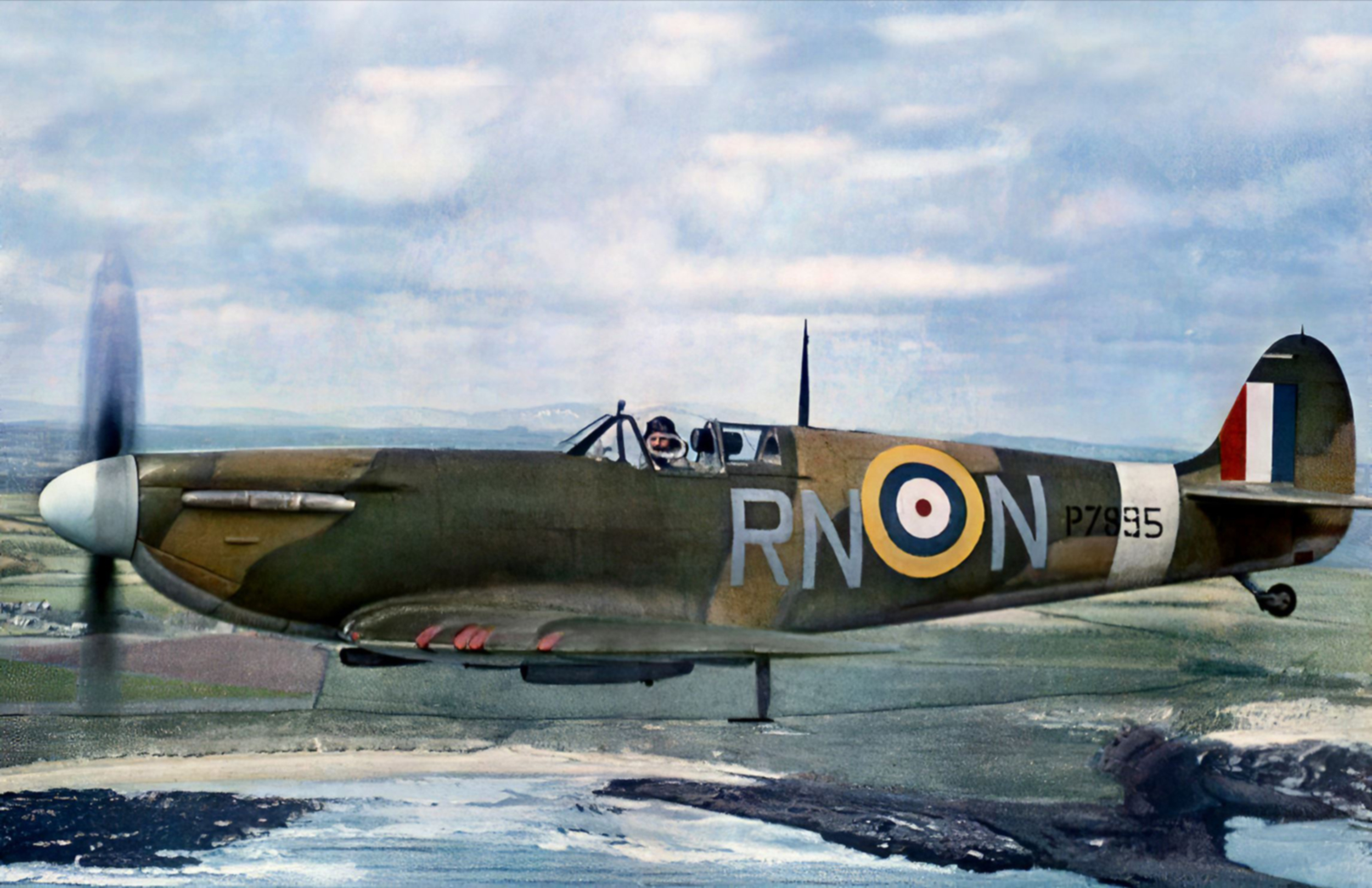
Caption: Spitfire MkIIa RAF 72Sqn RNN Flt Lt R Deacon Elliot P7895 based at Acklington Northumberland April 1941
Caption: Spitfire MkIIa RAF 72Sqn RNN P7895 based at Acklington Northumberland in flight over the coast piloted by FLt R Deacon Elliot April 1941
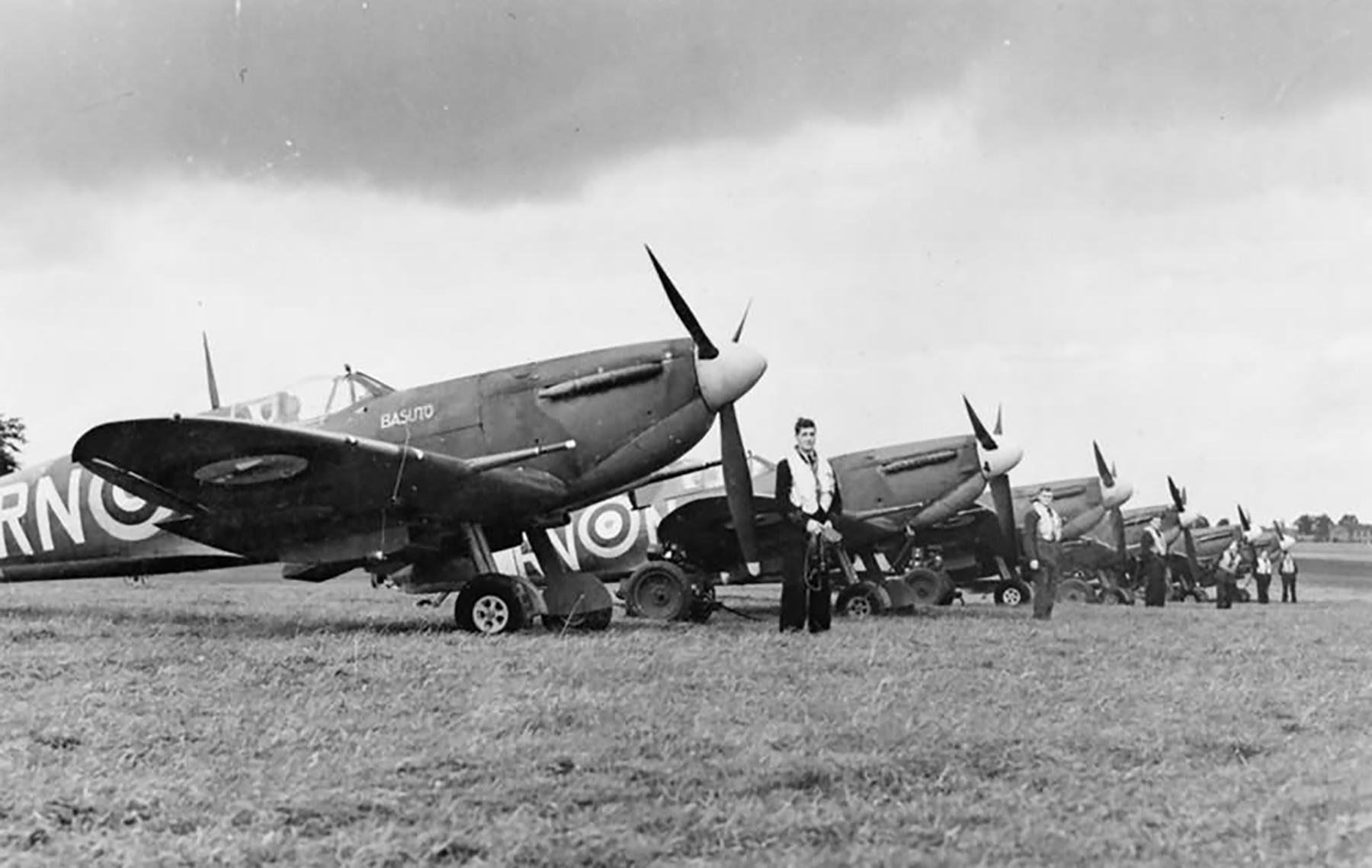
Caption: Spitfire MkVb RAF 72Sqn RNN line up 1941
RAF No 72 (Basutoland) Squadron
Motto: Swift
Formed from a nucleus provided by the CFS, it formed on 2 July 1917 and following training, it was spilt into a number of parties, which were then transported to Mesopotamia. The squadron came back together at Basrah on 2 March 1918, but its varied equipment was again spilt into detachments, which were attached to numerous Army formations to provide fighter cover and reconnaissance facilities. The squadron finally re-assembled at Baghdad with the end of war and on 13 February 1919 it was reduced to cadre for return to the UK, disbanding on 22 September 1919.
The squadron reformed on 22 February 1937 at Tangmere from a nucleus provided by No 1 Squadron. Again it was as a fighter unit, its initial equipment being Gladiators and on 1 June 1937 it moved north to Church Fenton. Spitfires arrived in April 1939, but the squadron remained in the north until June 1940, when it moved to Gravesend to assist in covering the evacuation from Dunkirk. It operated throughout the Battle of Britain as part of the Biggin Hill sector moving to Coltishall and then Leuchars in November. It rejoined the Biggin hill sector in July 1941, where it undertook offensive sweeps over Northern France, remaining there until August 1942, when it was withdraw for service overseas.
From September it was at Ouston until moving to Gibraltar in November, from where it supported the Allied landing in North Africa. The squadron operated in the fighter and bomber escort roles in support of Allied forces in Tunisia until moving to Malta in June 1943, where it began operations over Sicily. Following the landings on the island the squadron transferred there, from where it could support the invasion of Italy, to where it moved in September.
No 72 was one of the units allocated to cover 'Operation Dragoon', the Allied invasion of Southern France and in July 1944 it transferred to Corsica for this purpose. The squadron remained in France for six weeks after which it returned to Italy, where it conducted fighter patrols and ground attack operations until the end of the war. The squadron remained in the area as part of the occupation forces in both Italy and Austria until disbanding on 30 December 1946.
The squadron was reformed on 1 February 1947, when No 130 Squadron at Odiham was renumbered. Equipped with Vampires, it was again tasked with day fighter duties and these remained its task when it converted to Meteor F Mk 8s in July 1952. However, a role change occurred in February 1956, when it converted to Meteor NF Mk 12 and 14s and the night fighter role. In April 1959, it began converting to the all-weather fighter role, when it received Javelin FAW Mk 4s and in June FAW Mk 5s, by which time the Meteors had been retired. Both types continued to be operated until the squadron disbanded on 30 June 1961 at Leconfield, to where it had moved on conversion to the Javelin.
A major role change for the squadron took place on 15 November 1961, when it reformed, at Odiham once again, as a Support Helicopter unit equipped with the Belvedere HC Mk 1. In August 1964, the Belvederes were replaced by Wessex HC Mk 2s and a detachment of these was operated from Manston in the ASR role for a while. The squadron moved to Benson in April 1981, but the following November it was transferred to Aldergrove in Northern Ireland to provide support force the forces operating in the province. In January 1997 the squadron began to receive Puma HC Mk 1s and both types were operated until the squadron disbanded in 2002. However in July that year it was decided to allocate the number to one of the flying training squadrons of No 1 Flying Training School at Linton-on-Ouse.
Standards Battle Honours* 30 June 1966 AM Sir Ronald Lees.
Mesopotamia, 1918: Channel & North Sea, 1939-1942: Dunkirk: Battle of Britain 1940: Fortress Europe, 1941-1942: North Africa, 1942-1943: Mediterranean, 1942-1943: Sicily, 1943: Italy, 1943-1945: Salerno: Anzio & Nettuno:
Squadron Codes used: -
RN Oct 1938 - Apr 1939, Sep 1939 - Dec 1946
SD Apr 1939 - Sep 1939
FG Jan 1947 - Apr 1951
A Carried on Wessex
E Carried on ChinooksNumber 72 (Fighter) Squadron of the Royal Air Force is a training squadron that is currently based at RAF Valley using the Beechcraft Texan T1 to deliver Basic Fast Jet Training (BFJT).
No. 72 Squadron started life in 1917 supporting the British Army during World War I on operations in the Middle East, being disbanded in 1919. It was reformed in 1937, initially with Gloster Gladiator biplane fighters, moving on to fly Supermarine Spitfires during the Battle of Britain. For the remainder of World War II it served in a variety of theatres, ending up disbanded in Austria in 1946.
Reformed again in 1947, it was equipped with de Havilland Vampire jet fighters, moving on to the Gloster Meteor, and then the Gloster Javelin, flying these until 1961. After the jets, it moved to RAF Odiham and from 1961 until 1 April 2002 the squadron flew helicopters in the transport role. In 2002 it assumed its current role as a training unit, initially based at RAF Linton-on-Ouse using the Short Tucano T.1, before moving to RAF Valley and the Texan trainer.
The squadron nickname, "Basutoland", is derived from the fact that during both world wars, the Basutoland Protectorate, now Lesotho, donated aircraft to RAF, which were assigned to No. 72 Squadron.
History
First World War
No. 72 Squadron was formed on 28 June 1917 at Upavon as a squadron of the Royal Flying Corps. On Christmas Day, the squadron left for the Middle East and regrouped at Basra on 2 March. Here, they split in three flights, each assisting the Army in their various missions, and were disbanded in Baghdad on 22 September 1919.
Second World War
No. 72 Squadron was reformed at RAF Tangmere on 22 February 1937 from 'B' flight of No. 1 Squadron, initially equipped with the Gloster Gladiators that came across from No. 1 Squadron. In 1939, these were replaced by Supermarine Spitfires, which were used for air defence and convoy protection duties following the start of World War II. Then, in May 1940, the squadron moved to RAF Gravesend to provide air cover for Operation Dynamo, the evacuation of Dunkirk.
At the start of the Battle of Britain, No. 72 Squadron was in the North of England at RAF Acklington as part of No. 13 Group, before moving south to RAF Biggin Hill during September to aid the main defence force. The squadron was then moved to North Africa to support the Tunisian campaign before being supplied with the updated Spitfire Mk.IX in 1942. They then assisted the British 8th Army as they advanced through Italy and France up until the German surrender. At this point they were moved to Austria. It was here they were disbanded on 30 December 1946 at Zeltweg.
Post-War jets
The squadron was reformed on 1 February 1947 at RAF Odiham by renumbering No. 130 Squadron. They took over No. 130 Squadron's de Havilland Vampire F.1s, making no haste to remove that units 'AP' code. The Vampire soldiered on for three versions until it gave way to the Gloster Meteor F.8 in 1952, and when the squadron was given a night-fighter role in February 1956 these were replaced with Meteor NF.12s and Meteor NF.14s. In April 1959, the squadron got the all-weather fighter role and was given Gloster Javelin FAW.4s and later Javelin FAW.5s. These were flown until the squadron was disbanded at RAF Leconfield on 30 June 1961.
Helicopters
On 15 November 1961, No. 72 Squadron was reformed at RAF Odiham, but now as a helicopter unit. They were equipped with twin-rotor Bristol Belvederes HC.1s until the Westland Wessex HC.2 replaced these aircraft in August 1964. For the next thirty-eight years they continued to use these aircraft and in that time the squadron saw action in Malaya, provided post-disaster assistance following the Torrey Canyon tanker disaster in 1967 and supported the security forces in Northern Ireland from 1969. During the mid-1970s the squadron also operated a SAR 'D' flight at RAF Manston. From January 1997 the Wessex was partly supplanted with the more modern Westland Puma HC.1. The squadron's Wessex HC.2s departed RAF Aldergrove on 25 March 2002, shortly before their retirement. No. 72 Squadron was then disbanded on 1 April 2002 at Aldergrove.
Training – Tucano to Texan
Short Tucano T.1 of No. 72 (Reserve) Squadron, 2005
On 12 July 2002, No. 1 Flying Training School divided its strength between two new reserve squadrons – No. 72 (Reserve) Squadron and No. 207 (Reserve) Squadron, with both units operating the Short Tucano T.1 at RAF Linton-on-Ouse, North Yorkshire. No. 72 (Reserve) Squadron became No. 72 Squadron after the (Reserve) suffix was rescinded across the RAF on 1 February 2018. The final Tucano Basic Fast-jet Training (BFJT) course graduated on 25 October 2019, which was marked with a nine-ship flypast over the local area. No. 72 Squadron disbanded on 31 October 2019.
On 28 November 2019, the squadron stood-up at RAF Valley operating the Beechcraft Texan T.1.
On 13 November 2020, No. 72 Squadron became No. 72 (Fighter) Squadron to reflect its former role as a fighter unit.
Aircraft Operated by RAF No. 72 Squadron From To Aircraft Variant Remark March 1918 June 1918 Airco DH.4 'A' flight March 1918 January 1919 Spad S.7 'A' flight April 1918 November 1918 Martinsyde G.100 'B' flight April 1918 February 1919 Royal Aircraft Factory S.E.5 S.E.5A 'A' flight April 1918 February 1919 Bristol M.1 M.1c 'C' flight May 1937 May 1939 Gloster Gladiator Mk.I April 1939 April 1941 Supermarine Spitfire Mk.I May 1940 May 1940 Gloster Gladiator Mks.I, II Acklington unserviceable for Spitfires April 1941 July 1941 Supermarine Spitfire Mks.IIa, IIb July 1941 July 1942 Supermarine Spitfire Mk.Vb July 1942 February 1943 Supermarine Spitfire Mk.Vc July 1942 August 1942 Supermarine Spitfire Mk.IX August 1942 November 1942 Supermarine Spitfire Mk.Vb February 1943 October 1944 Supermarine Spitfire Mk.IX June 1943 January 1944 Supermarine Spitfire Mk. Vc October 1944 December 1946 Supermarine Spitfire LF.Mk.IX February 1947 October 1948 de Havilland Vampire F.1 June 1948 February 1950 de Havilland Vampire F.3 November 1949 July 1952 de Havilland Vampire FB.5 July 1952 February 1956 Gloster Meteor F.8 February 1956 June 1959 Gloster Meteor NF.12 February 1956 June 1959 Gloster Meteor NF.14 April 1959 June 1961 Gloster Javelin FAW.4 June 1959 June 1961 Gloster Javelin FAW.5 November 1961 August 1964 Bristol Belvedere HC.1 August 1964 Easter 2002 Westland Wessex HC.2 January 1997 Easter 2002 Westland Puma HC.1 July 2002 October 2019 Short Tucano T1 November 2019 present Beechcraft Texan T1





 Editor for Asisbiz: Matthew Laird Acred
If you love our website please subscribe to our YouTube video channel
Please donate so we can make this site even better !!