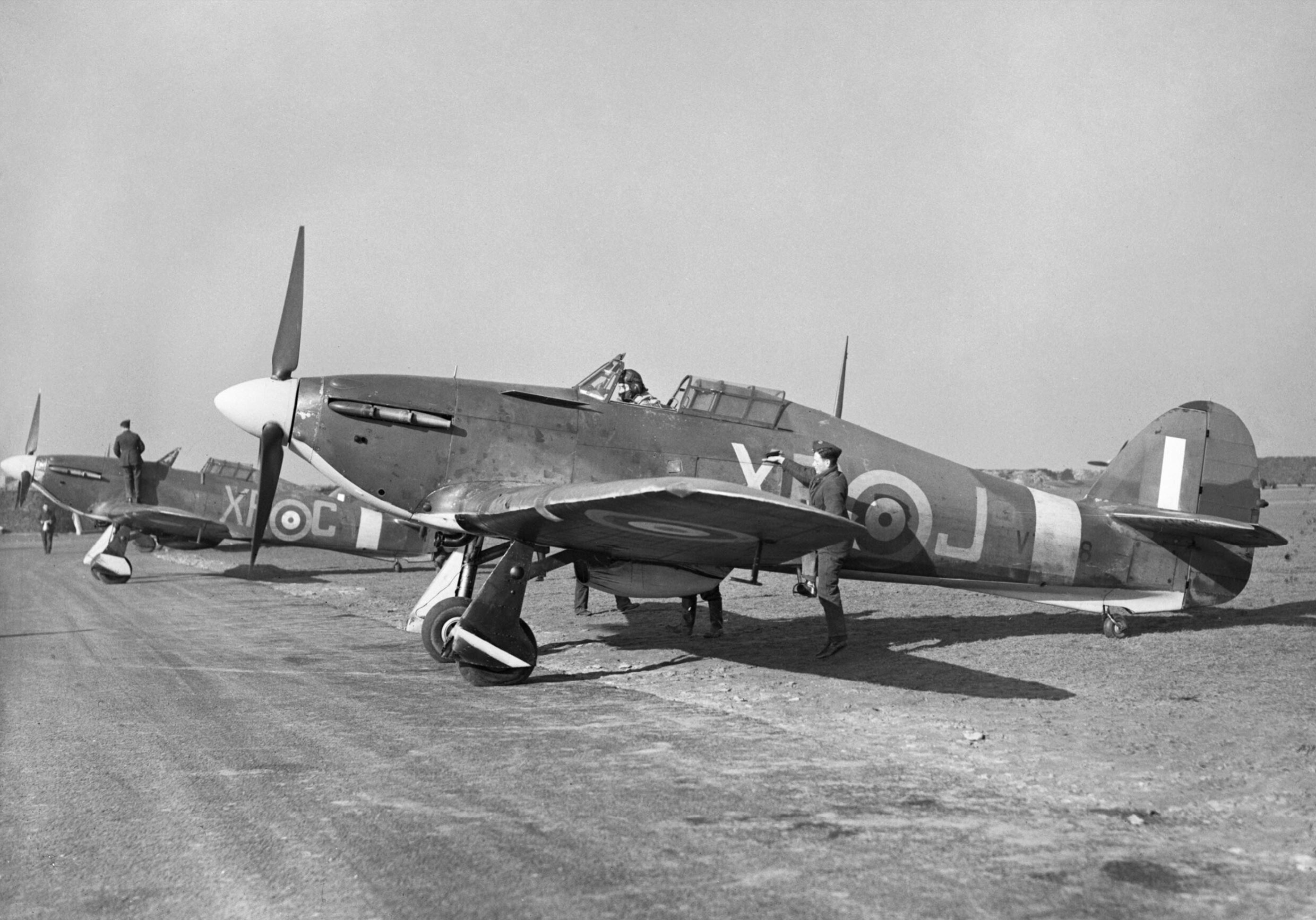
Caption: Hawker Hurricane I RAF 71Sqn XRJ V7608 at Kirton in Lindsey Lincolnshire England 1941 CH2412
Caption: Spitfire MkVb RAF 133Sqn Eagle MDL Spike Miley at Debden
No 71 (Eagle) Squadron
Motto: First from the eyries
Formed from a nucleus of Australian personnel on 27 March 1917 at Castle Bromwich, it was equipped with a variety of types for training and working up. Once this was complete the squadron received its operational equipment in te form of Camels, which it took to the Western Front in December 1917. However, on 19 January 1918 the squadron was redesignated No 4 Sqn, Australian Flying Corps and in this guise it operated until the Armistice before joining the Army of Occupation, being disbanded at Bruay on 28 February 1919.
During WW2 an number of Americans volunteered to fly in the RAF or RCAF and by late 1940 sufficient personnel were available to permit the formation of a separate unit. As such, No 71 became the first of the 'Eagle' squadrons when it was formed Church Fenton on 19 September 1940. Its first equipment was, ironically, American built Buffalos, but these were found to be completely unsuited to European conditions and in November Hurricanes arrived as the squadron's operational equipment. On 5 February 1941, the squadron became operational from Kirton-in-Lindsey but in April moved to Martlesham Heath. The squadron remained in the south for the rest of its time in the RAF, converting to Spitfires in August. 71 Squadron took part in the full range of offensive operations and defensive duties being carried out by Fighter Command at that time, but on 29 September 1942 the squadron, together with the other two (121 and 133) 'Eagle' squadrons were transferred to the US Army Air Force to become the 4th Fighter Group, with No 71 becoming the 334th Fighter Squadron.
A new No 71 Squadron, in the fighter-bomber role, was formed at Gutersloh on 16 September 1950. Equipped with Vampire FB Mk 5s, it replaced these with Sabre F Mk1 and 4s in October 1953 at the same reverting to the day fighter role. The Sabres began to be replaced with Hunters in April 1956, being fully equipped by the following month but a year later, on 30 April 1957, the squadron disbanded at Bruggen, to where they had moved in May 1956.
Squadron Codes used: - EL Allocated Apr 1939 - Sep 1939 | XR Nov 1940 - Sep 1942 (also used initially on transfer to USAAF) | L Sep 1950 - Oct 1953
No. 71 Squadron was a Royal Air Force aircraft squadron. The number has been used three times: once by the Royal Flying Corps for an Australian Flying Corps squadron; in the Second World War as the first of three Eagle Squadrons; and post-war as a fighter-bomber unit under the command of Royal Air Force Germany.
History
First World War
The first unit known by the British military as "No. 71 Squadron" was No. 4 Squadron, Australian Flying Corps (AFC), during the First World War. The squadron was formed at Point Cook, Victoria, Australia on 16 October 1916, after which it travelled to England. From 27 March 1917, while based at Castle Bromwich, it was designated "No. 71 Squadron" by the Royal Flying Corps, to avoid confusion with No. 4 Squadron, RFC. This name was never officially adopted by the Australian Imperial Force.
4 Sqn AFC arrived in France on 18 December 1917. With Sopwith Camels, it performed fighter sweeps, provided close air support and raided German airfields. In spite of its relatively short service during the First World War, 11 of its pilots became aces, including Captain Harry Cobby, the AFC's leading ace of the war, who was credited with destroying 29 aircraft and 13 observation balloons. Besides Cobby, Elwyn King, Edgar McCloughry (later an air vice-marshal), Herbert Watson, Thomas Baker, Leonard Taplin, Thomas Barkell, George Jones (later Chief of the Australian Air Force), Norman Trescowthick, and Garnet Malley served in the unit.
On 19 January 1918, British usage of "No. 71 Squadron" for this unit also ceased, and it became No. 4 AFC at every level. The squadron spent some time with the Army of Occupation in Germany after the Armistice and was disbanded there at Bickendorf on 28 February 1919.
American Eagles
A Hawker Hurricane fight of No. 71 Squadron at Kirton-in-Lindsey, 1941
At the start of the Second World War before the US entered the war, there were a large number of American volunteers offering their services. No. 71 was formed at RAF Church Fenton on 19 September 1940 as the first of the Eagle Squadrons with Brewster Buffalos. Appraisal by Royal Air Force acceptance personnel criticised the Brewster Buffalo on numerous points, including lack of armament and pilot armour, poor high-altitude performance, engine overheating, unreliability and cockpit controls, while it was praised for its handling, roomy cockpit and visibility.
The Buffaloes were deemed unsuitable for European conditions and Hawker Hurricanes replaced them from November 1940. The squadron became operational at RAF Kirton-in-Lindsey on 5 February 1941 and moved in April to RAF Martlesham Heath in Suffolk for operations over Europe. During May, it suffered its first loss when Mike Kolendorski was killed during a fighter sweep over the Netherlands. The intensity of operations stepped up with a move to No. 11 Group of Fighter Command, being based at RAF North Weald in Essex by June. On 2 July, William I. Hall became the first Eagle Squadron pilot to become a prisoner of war (POW) when he was shot down during an escort mission. The squadron's first confirmed victory came on 21 July during a bomber escort mission, when Pilot Officer William R. Dunn destroyed a Messerschmitt Bf 109F over Lille.
In August, the Spitfire Mk II replaced 71 Squadron's Hurricanes, before the squadron quickly re-equipped with the latest Spitfire Mk VB. The unit soon established a high reputation, and numerous air kill claims were made in RAF fighter sweeps over the continent during the remainder of the summer and into autumn. In December, the squadron was rested back at Martlesham Heath, before a move to Debden in May 1942. When informed of the attack on Pearl Harbor, most of the Eagle Squadron pilots wanted to immediately join the fight against Japan. Representatives from Nos. 71 and 121 Squadrons went to the American Embassy in London and offered their services to the United States. The pilots from No. 71 Squadron decided they wanted to go to Singapore to fight the Japanese and a proposal was put to RAF Fighter Command, but it was turned down. On 29 September the squadron, together with the other two Eagle squadrons, was transferred to the US Army Air Forces, becoming the 334th Fighter Squadron of the 4th Fighter Group.
Pilot Officer C W "Red" McColpin of No 71 (Eagle) Squadron RAF, standing by his Supermarine Spitfire Mark VB at North Weald, Essex
Into the jet age
On 16 September 1950 a new 71 Squadron was formed at RAF Gütersloh with de Havilland Vampire fighter-bombers, joining the Second Tactical Air Force. In October 1953 it became a "day fighter" unit with the North American Sabre. The Sabres were replaced by Hawker Hunters in April 1956. The squadron moved to RAF Bruggen in May 1956 and disbanded on 30 April 1957.
Aircraft Operated by RAF No. 71 Squadron Dates Aircraft Variant Notes June 1917 – October 1917 Various October 1917 – January 1918 Sopwith Camel 4 Sqn Australian Flying Corps (a.k.a. 71 Sqn RFC) October 1940 – November 1940 Brewster Buffalo I November 1940 – May 1941 Hawker Hurricane I April 1941 – August 1941 Hawker Hurricane IIB August 1941 – September 1941 Supermarine Spitfire IIA September 1941 – September 1942 Supermarine Spitfire VB October 1950 – October 1953 de Havilland Vampire FB.5 October 1953 – May 1956 North American Sabre F.4 April 1956 – April 1957 Hawker Hunter F.4





 Editor for Asisbiz: Matthew Laird Acred
If you love our website please subscribe to our YouTube video channel
Please donate so we can make this site even better !!