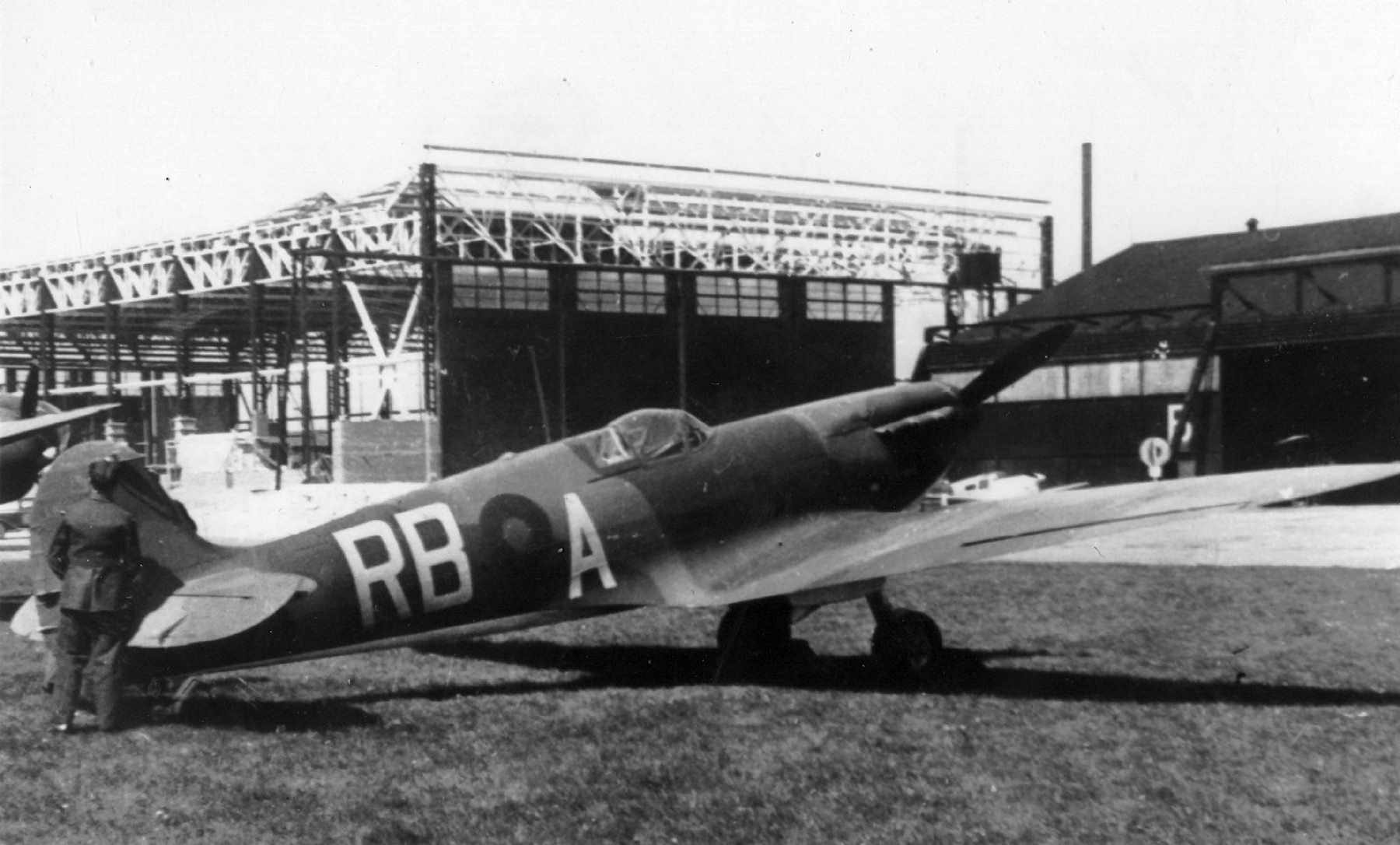
Caption: Spitfire MkI RAF 66Sqn RBA K9806 with twin blade propellor England 1940
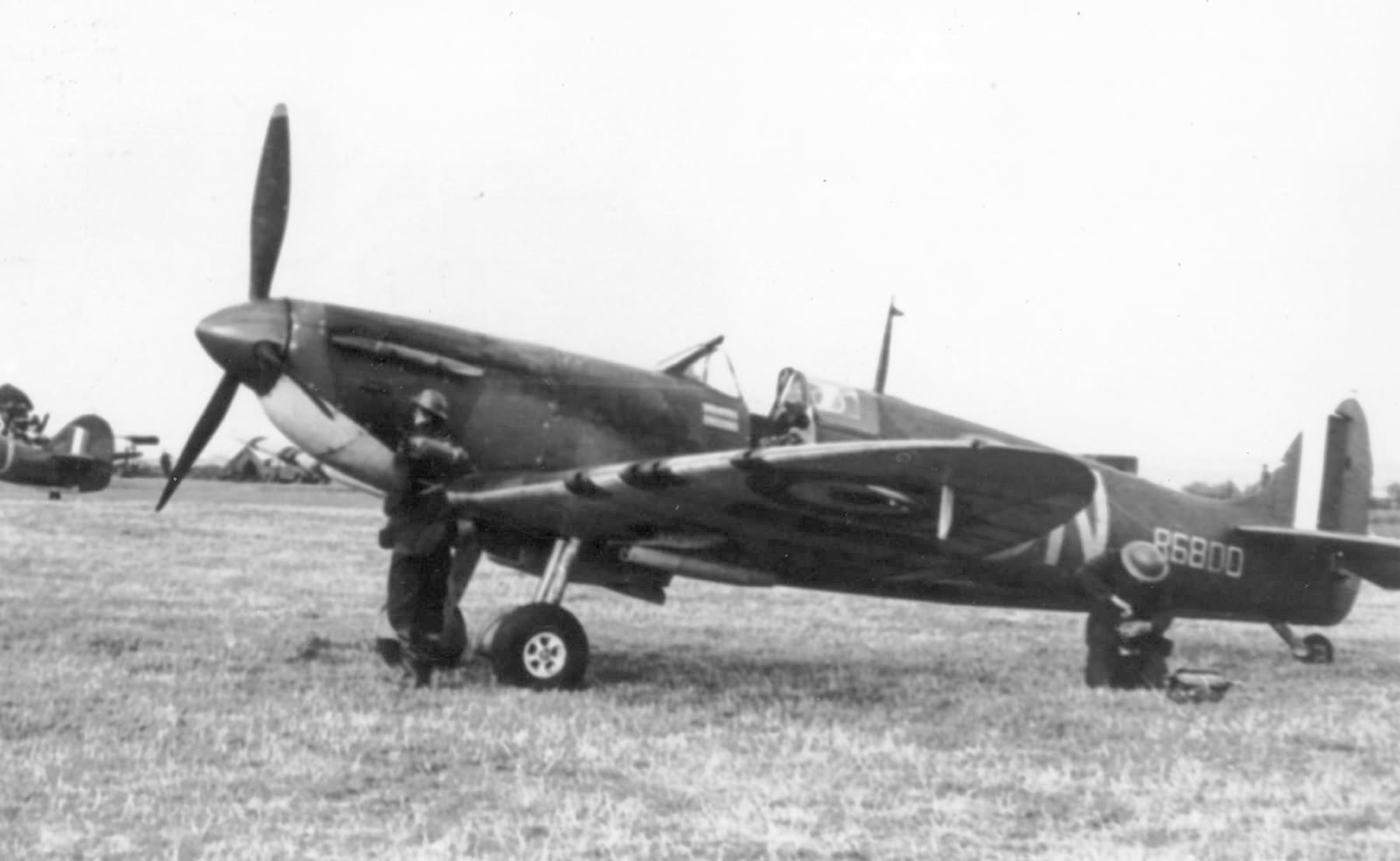
Caption: Spitfire MkIa RAF 66Sqn LZN Sqn Ldr Rupert Leigh R6800 LZN at Gravesend 1940
RAF No 66 Squadron
Motto: Cavete Praemonui (Beware, I have given warning)
Formed at Filton in the fighter role on 30 June 1916, the squadron took its Sopwith Pups to France in March 1917. Operating over the Western Front the squadron re-equipped with Camels in October 1917 and in November moved to Italy, where it remained until March 1919, when it returned to Leighterton, disbanding there on 25 October 1919.
The squadron was reformed at Duxford from 'C' Flight of No 19 Squadron on 20 July 1936. It was equipped with Gauntlets but in November 1938, it became the second unit to receive Spitfires, the first having been its sister squadron at Duxford, No 19. Being in No 12 Group, the squadron flew defensive operations in the early days of the war but in May and June it covered the Dunkirk Evacuation. Based at Coltishall from the end of May, it eventually joined No 11 Group when it moved to Kenley in early September, Gravesend eight days later and West Malling in October, where it remained until February 1941. From here it began offensive operations over France.
When it moved in February, it was to Exeter from where it carried out escort duties and coastal patrols. For the next two years it operated from a number of bases in the South-West and South-East but in February 1943 it moved north to the Orkneys. When it moved south again, the squadron joined the recently formed 2nd Tactical Air Force and prior to the Normandy landings, the squadron took on the fighter-bomber role. Within five days of the landings, the squadron was using advanced landing grounds in Normandy, returning to its UK base each evening, but in August it moved onto the continent as a unit. As the Allied armies advanced through France, and Belgium, the squadron followed close behind and by September it was operating from the Netherlands. In the later stages of the war, the squadron flew armed reconnaissance missions over Germany and the Netherlands, but on 30 April 1945 it was disbanded at Twente.
The squadron reformed once again at Duxford on 1 September 1946 in the fighter role, equipped with Spitfires. These were replaced by Meteors in 1947 and in October 1949, the unit moved to Linton-on-Ouse re-equipping with Sabres in December 1953. From 11 February 1949 until 1 November 1953, the squadron was linked with No 111 Squadron. Hunters, initially F Mk 4s, arrived in March 1956 being replaced by F Mk 6s in October and these remained the squadron's main equipment until disbanding at Acklington, to where it had moved in February 1957, on 30 September 1960.
The squadron's final incarnation began on 15 September 1961 when the Belvedere Trials Unit at Odiham was redesignated No 66 Squadron. In June 1962 it left the UK for Seletar in Singapore, where it provided heavy lift helicopter support for forces operating in Malaya, The squadron finally disbanded on 20 March 1969.
Standards Battle Honours*
Western Front, 1917: Arras 1917: Messines, 1917: Ypres, 1917: Italian Front & Adriatic, 1917-18: Channel & North Sea, 1939-44: Dunkerque: France & Low Countries, 1940: Battle of Britain 1940: Home Defence, 1940-44: Fortress Europe 1940-44: Dieppe: Normandy, 1944: France & Germany, 1944-45: Walcheren.
Squadron Codes used: - RB Allocated during the Munich Crisis | LZ Sep 1939 - 1945 | HI 1946 - 1949 | LZ 1949 - 1951
No. 66 Squadron was a Royal Flying Corps and eventually Royal Air Force aircraft squadron.
History
World War I
The squadron was first formed at RAF Filton, Bristol, on 30 June 1916 as a training squadron equipped with Royal Aircraft Factory BE2, BE12s and the Avro 504. The squadron received its first Sopwith Pup on 3 February 1917, and deployed to Vert Galant aerodrome (between Talmas and Beauval) in the Somme département, France on 12 March 1917. The Pups were exchanged for Sopwith Camels during October 1917 and the squadron moved to join No. 14 Wing on the Italian front.
During twelve months of fighting in Italy the squadron destroyed 172 enemy aircraft. On 13 March 1918 Lieutenant Alan Jerrard engaged nineteen enemy aircraft on his own; he managed to destroy three before he was forced to land and taken prisoner. He was awarded the squadron's only Victoria Cross for his efforts.
At the end of the war the squadron stayed on in Italy for a few months, returning to the United Kingdom in March 1919 and was disbanded on 25 October 1919.
Flying aces
RFC 66Sqn pilots who became aces with the squadron during the Great War 21 in total they were:
RFC 66Sqn pilots who became aces with the squadron during the Great War Name William George Barker VC Alan Jerrard VC Peter Carpenter Harry King Goode Francis S. Symondson Gerald Alfred Birks Charles M. Maud Gordon Apps Hilliard Brooke Bell Christopher McEvoy Harold Ross Eycott-Martin William Myron MacDonald Augustus Paget John Oliver Andrews Harold Koch Boysen William Carrall Hilborn Thomas Hunter James Lennox Walbanke Ashby Pritt Patrick Gordon Taylor John (Jack) Wallis Bishop Second World War
The squadron was reformed on 20 July 1936 from 'C' Flight, No. 19 Squadron RAF at RAF Duxford, initially being equipped with Gloster Gauntlets, before a slow conversion to Supermarine Spitfires from August 1938. The squadron was part of No. 12 Group RAF in Fighter Command and was on readiness from the start of the war in September 1939. The first contact with the enemy was an attack on a Heinkel He 111 of the Norfolk coast near Cromer, the German aircraft subsequently crashed in Denmark. The squadron moved to RAF Horsham St. Faith after Germany's invasion of Belgium and the Netherlands, the squadron destroyed its first enemy aircraft on 12 May 1940 over the Hague. At the end of August the squadron moved to the south of England as part of the Battle of Britain, it operated from RAF Kenley, RAF Gravesend, RAF West Malling and by November to RAF Biggin Hill. By the time the Germans had stopped daylight bombing the squadron had destroyed 20 aircraft with another 17 probables and also damaged another fifteen.
It conducted the first of the Rhubarb operations on 20 December 1940, with two Spitfires over Le Touquet.
On the 24th of February 1941 the squadron moved to RAF Exeter, before moving again in April to RAF Perranporth in Cornwall to operate fighter sweep missions over the Channel. It moved to Portreath in December 1941 and re-equipped with the Spitfire V. In April 1942 the squadron moved to RAF Ibsley and was involved in the support for the combined operations at Dieppe. By October 1942 the squadron was based at RAF Zeals in Wiltshire. It moved to RAF Sumburgh in the Shetland Isles in April 1943 to provide fighter cover for the British fleet based at Scapa Flow before returning to the West Country, firstly at RAF Church Stanton in Somerset and then back to Perranporth in Cornwall in October 1943.
In November 1943 the squadron moved to RAF Hornchurch and converted to the Spitfire IX and then moved to North Weald airfield in Essex at the end of February 1944. The squadron became part of the Second Tactical Air Force and provided air cover for the invasion forces in Normandy, being based in France from 22 June. After a break in South Wales the squadron continued to support the advancing allied forces being based at Abbeville in September 1944 and then on to Grimbergen in Belgium. In November the squadron converted to the Spitfire XVI before moving the Twente in the Netherlands where it disbanded on 30 April 1945.
Post-war
The squadron was reformed at Duxford on 1 September 1946, by renumbering No. 165 Squadron RAF, initially flying Spitfires. The following year, the squadron converted to Meteors, which it flew for six years before re-equipping with Canadair Sabres. At RAF Linton-on-Ouse in March 1956 it acquired Hawker Hunters, which it flew before being disbanded again on 30 September 1960 at RAF Acklington.
On helicopters
The squadron reformed at RAF Odiham on 15 September 1961, from the Belvedere Trials Unit equipped with Bristol Belvedere helicopters. In June 1962 it left the UK for Seletar in Singapore, where it provided heavy lift helicopter support for forces operating in Malaya. The squadron finally disbanded on 17 March 1969.




 Editor for Asisbiz: Matthew Laird Acred
If you love our website please subscribe to our YouTube video channel
Please donate so we can make this site even better !!