Caption: Spitfire MkIa RAF 609Sqn PRO R6915 at Drem 1940
Caption: Gun camera footage from RAF 609Sqn FL McArthur showing a He 111 being hit 1940 IWM CH1823
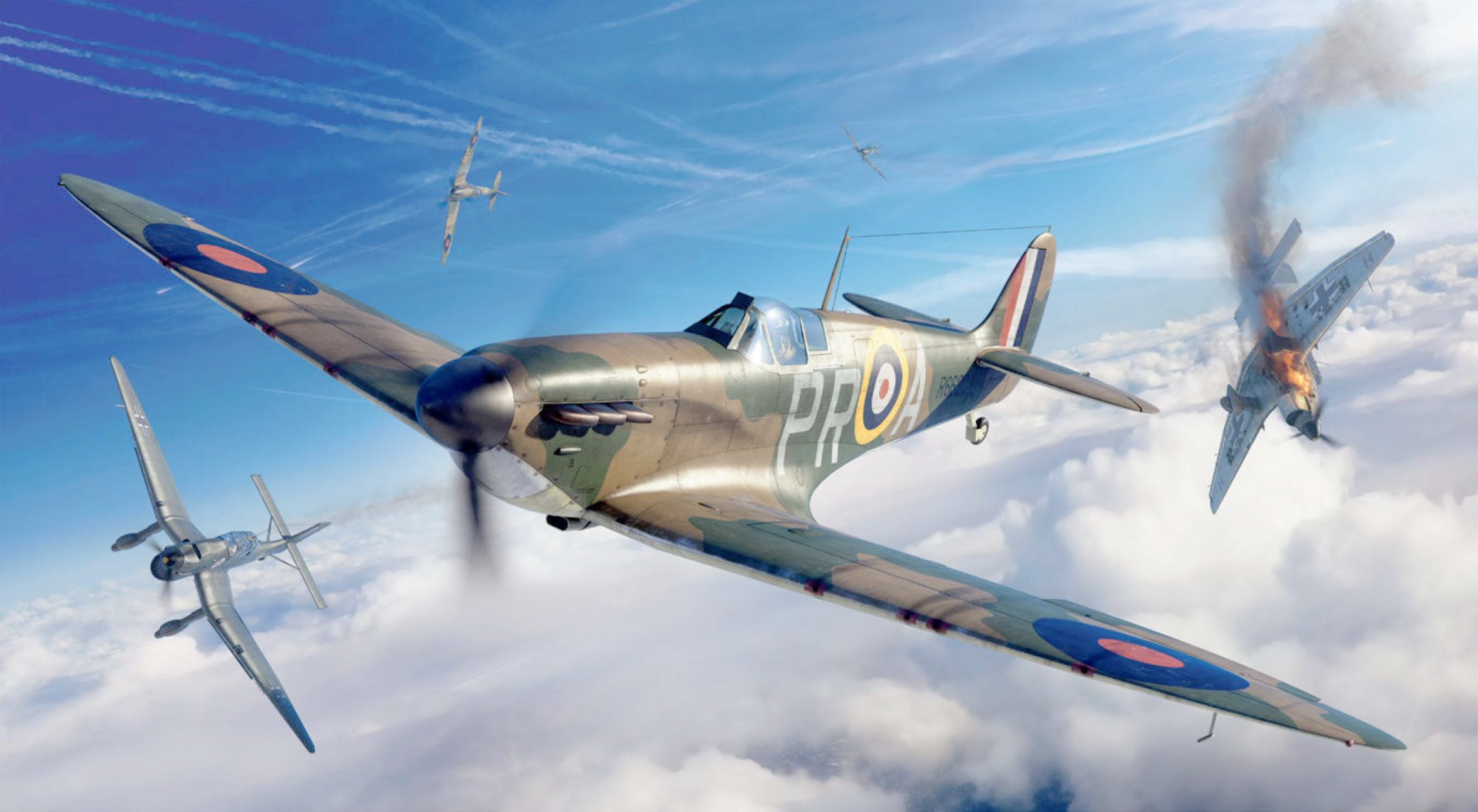
Caption: Spitfire MkIa RAF 609Sqn PRA PO John C Dundas R6690 Middle Wallop 13th Aug 1940 Eduard boxart
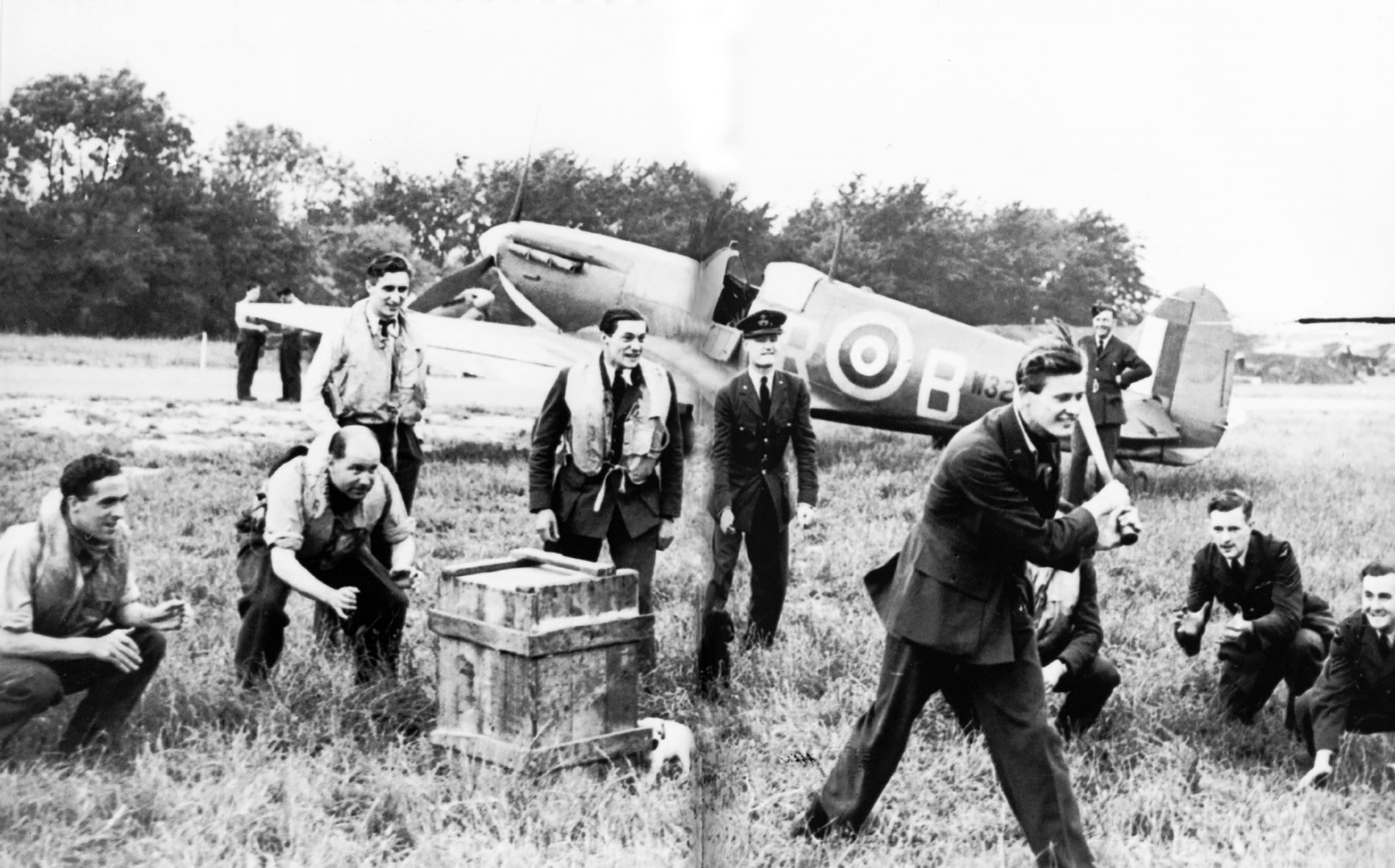
Caption: Spitfire MkVb RAF 609Sqn PRB SqnLdr Michael Robinson W3238 Biggin Hill England Jul 1941
RAuxAF No 609 (West Riding) SquadronRAuxAF No 609 (West Riding) Squadron
Motto: Tally Ho
Formed at Yeadon on 10 February 1936 as part of the Auxiliary Air Force, it was initially equipped with Harts, later receiving Hinds in December 1937. It was redesignated a fighter squadron on 8 December 1938 but did not receive its first Spitfire until August 1939.
It remained in the North of England and Scotland until it moved to Northolt in May 1940, from where it covered the Dunkirk evacuation. During the Battle of Britain it operated from Middle Wallop and later carried out sweeps over the continent from various bases.
In April 1942 it began to re-equip with the Typhoon and it carried out its first operation in June. Initially flying defensive patrols, it later undertook intruder operations, both day and night until joining 2nd TAF in March 1944. At this time it started to specialise in the use of a new weapon, the Rocket Projectile. It provided air support to 21st Army Group throughout its actions in France, the Low Countries and into Germany, where it disbanded on 15 September 1945.
With the reactivation of the Royal Auxiliary Air Force, 609 was reformed on 10 May 1946 at Church Fenton as a night fighter squadron. It was initially equipped with Mosquito NF 30s, until September 1948, however, Spitfire LF 16s had started to arrive the previous April and on completion of re-equipment, it was redesignated a day fighter squadron. These were remained until January 1951 when it converted to the Meteor F 8, although it had received some Vampires from November 1950 to January 1951. However, along with all the flying units of the RAuxAF, it was disbanded on 10 March 1957.
It was reformed in 2001 from The Air Defence Support Squadron of the RAuxAF based at Leeming and its personnel now support the Tornado F 3 units based on the station.
Squadron Codes used: -
BL Allocated Apr 1939 - Sep 1939
PR Sep 1939 - Sep 1945, 1949 - Apr 1951
RAP May 1946 - 1949No. 609 (West Riding) Squadron of the Royal Auxiliary Air Force, originally formed as a bomber squadron and in the Second World War active as fighter squadron, nowadays provides personnel to augment and support the operations of the Royal Air Force. The squadron is no longer a flying squadron, but instead has the role of Force Protection. It is currently based at RAF Leeming, North Yorkshire.
History
Formation and early history (1936–1939)
No. 609 Squadron was formed on 10 February 1936 at RAF Yeadon, now Leeds Bradford International Airport, as the ninth of the 21 flying squadrons of the Royal Auxiliary Air Force. In June of that year it received Hawker Hart light bomber aircraft, which gave way in December 1937 to Hawker Hinds. The first Commanding Officer of 609 Squadron was Squadron Leader Harald Peake, who later rose to the rank of Air Commodore. On 8 December 1938, 609 Squadron was transferred to RAF Fighter Command, but was not equipped with fighters until the introduction of the Supermarine Spitfire Mk.I in August 1939. At this point the squadron was still manned by part-time civilians. Fairey Battle light bombers were used as training aircraft to convert pilots from the fixed undercarriage biplane Hinds to much more modern monoplane Spitfire with its retractable undercarriage.
Second World War
Still from camera gun footage taken from a Spitfire of No. 609 Squadron showing a Heinkel He 111 taking hits in the port engine on 25 September 1940.
Gun camera film showing tracer ammunition from a Spitfire of 609 Squadron, hitting a Heinkel He 111
At the outbreak of war, the squadron was called up to full-time service and initially served on defensive duties in the North of England. In May 1940, the squadron moved to RAF Northolt and flew over the Battle of Dunkirk during Operation Dynamo. Around this period, one third of the squadron's pilots were lost over a period of three days.
During the Battle of Britain, 609 Squadron moved to RAF Middle Wallop as part of Fighter Command's efforts to defend the south coast of England, west of London. There was also an advanced flight based at RAF Warmwell. At this time, one third of the RAF's front-line squadrons were from the Royal Auxiliary Air Force. During August 1940 609 Squadron destroyed 46 enemy aircraft, however, by now almost all of the pre war auxiliary pilots were dead or missing. On 21 October 1940 the squadron became the first to achieve 100 confirmed enemy aircraft kills. Boasting 9 'aces', pilots F/L Frank Howell (8 confirmed kills), F/L John Dundas (9 confirmed kills), P/O David Moore Crook (6 confirmed kills) and P/O John Curchin (7 confirmed kills) were among several awarded the Distinguished Flying Cross for their efforts during the battle. A Spitfire that flew with 609 Squadron during this period, number X4590, is now preserved at the Royal Air Force Museum London, Hendon. Another 609 Squadron Spitfire, number R6915, is preserved in the Imperial War Museum, London. This aircraft scored victories while piloted both by John Dundas and another 609 Squadron ace, Noel Agazarian.
During February 1941 the squadron moved to RAF Biggin Hill. Almost all of the squadron's original pilots were now lost and replacements came from Belgium, Poland, Canada, Australia, France, United States, and New Zealand in addition to those from Britain. During the summer of 1941, 609 Squadron carried out fighter sweeps over France. In November 1941, the squadron was withdrawn from the front line, after 18 months continuous fighting and rested at RAF Digby in Lincolnshire.
While at Biggin Hill, the squadron acquired a goat, soon named William, which became their official mascot. He was awarded an honorary DSO and DFC, and the rank of Air Commodore.
Spitfire R6915, Imperial War Museum (2005)
In spring 1942 the squadron moved to RAF Duxford and re-equipped with the Spitfire Mk V. The squadron soon began to replace these with the Hawker Typhoon, which was introduced in an attempt to counter the Luftwaffe's Focke-Wulf Fw 190 fighter. It became apparent that the Typhoon was better suited for low level attacks against ground targets, such as airfields and armoured vehicles. Before this change of focus, 609 Squadron had become the top scoring squadron in the RAF for the period of early 1943. They were the first Typhoon squadron to achieve 200 kills. The squadron also gained new pilots, including the first German citizen to fly with the RAF, Film Production Designer Sir Ken Adam. He and his brother Dennis were the first German-born pilots in the RAF, Dennis joining No. 183 Squadron in 1944, as part of the same Wing (No. 123) that his elder brother was flying in with No. 609 (West Riding) Squadron.
Prior to the allied invasion of Europe in 1944, 609 Squadron was involved with destroying German radar stations on the French coast. In support of the invasion, the squadron's Typhoons were deployed against tanks and other targets using "60lb" RP-3 rockets. The Typhoon proved itself adept at the role of 'tankbuster' and went on to attack the German armoured breakthrough at the Falaise Gap in August 1944. In November 1944 the squadron moved to the Netherlands, followed in April 1945 by a move over the enemy border to Plantlunne, Germany. On some days the squadron flew up to 150 sorties. By the end of the war 603 pilots had claimed some 232 kills for 73 aircrew killed in action.
Post-war period (1945–1957)
After the war, 609 Squadron was stood down, and the name transferred back to the Royal Auxiliary Air Force. In 1946, the squadron reformed at RAF Church Fenton, then moved back to Yeadon. 609 was once again a squadron manned by part-time civilians using front line fighters, this time the Mosquito NF.30 night-fighter and later, when the squadron changed role to that of a daylight fighter squadron, the Spitfire LF.16. In 1951, 609 Squadron re-equipped with jet fighter aircraft, the Gloster Meteor, and moved back to Church Fenton in order to take advantage of the longer runway. At this time, 19 regular squadrons and 10 reserve squadrons of Meteors formed Britains main fighter defence. During the Korean War, 609 and other auxiliary squadrons were called up to full-time service for 3 months.
From 1947 to March 1957 (when all flying squadrons of the Royal Auxiliary Air Force were disbanded), Air Vice-Marshal Geoffrey Ambler, who commanded the squadron just before the Second World War, was the squadron's Honorary Air Commodore. An active 609 Squadron Association was formed after the War and for 21 years was organised by Charles 'Mac' McConnell who had served as an officer during the War. The Association played the lead role in establishing the squadron museum near York.
Aircraft Operated by RAF No. 609 Squadron From To Aircraft Version June 1936 January 1938 Hawker Hart January 1938 August 1939 Hawker Hind August 1939 May 1941 Supermarine Spitfire Mk.I February 1941 May 1941 Supermarine Spitfire Mk.IIa May 1941 May 1942 Supermarine Spitfire Mks.Vb, Vc April 1942 1942 Hawker Typhoon Mk.Ia May 1942 September 1945 Hawker Typhoon Mk.Ib July 1946 April 1948 de Havilland Mosquito NF.30 April 1948 February 1951 Supermarine Spitfire LF.16e November 1950 January 1951 de Havilland Vampire FB.5 January 1951 July 1951 Gloster Meteor F.4 June 1951 February 1957 Gloster Meteor F.8
Commanding officers of RAF No. 609 Squadron From To Name 10 February 1936 8 December 1938 Sqn Ldr H. Peake 8 December 1938 28 December 1939 S/Ldr. G.H. Ambler, AFC 28 December 1939 28 June 1940 S/Ldr. M.T. Avent 28 June 1940 4 October 1940 S/Ldr. H.S. Darley, DSO 4 October 1940 29 July 1941 S/Ldr. M.L. Robinson, DSO, DFC 29 July 1941 1 June 1942 S/Ldr. G.K. Gilroy, DSO, DFC & Bar 1 June 1942 30 October 1942 S/Ldr. P.H.M. Richey, DFC & Bar 30 October 1942 5 May 1943 S/Ldr. R.P. Beamont, DSO, DFC & Bar 5 May 1943 18 August 1943 S/Ldr. A. Ingle, DFC, AFC 18 August 1943 29 December 1943 S/Ldr. P.G. Thornton-Brown, DFC 29 December 1943 30 June 1944 S/Ldr. J.C. Wells, DFC 30 June 1944 14 August 1944 S/Ldr. L.E.J.M. Geerts, DFC 14 August 1944 17 September 1944 S/Ldr. R.A. Lallemant, DFC & Bar 17 September 1944 14 November 1944 S/Ldr. T.Y. Wallace, DFM 14 November 1944 6 December 1944 S/Ldr. C.J.G. "Windmill" Demoulin, DFC 6 December 1944 16 March 1945 S/Ldr. E.R.A. Roberts, DFC 16 March 1945 15 September 1945 S/Ldr. L.W.F. Stark, DFC & Bar, AFC 10 May 1946 January 1950 S/Ldr. P.H. Womersley, DFC & Bar January 1950 December 1953 S/Ldr. A. Hudson, DFC, AFC December 1953 January 1956 S/Ldr. E.T. Evans January 1956 10 March 1957 S/Ldr. D. Shaw






 Editor for Asisbiz: Matthew Laird Acred
If you love our website please subscribe to our YouTube video channel
Please donate so we can make this site even better !!