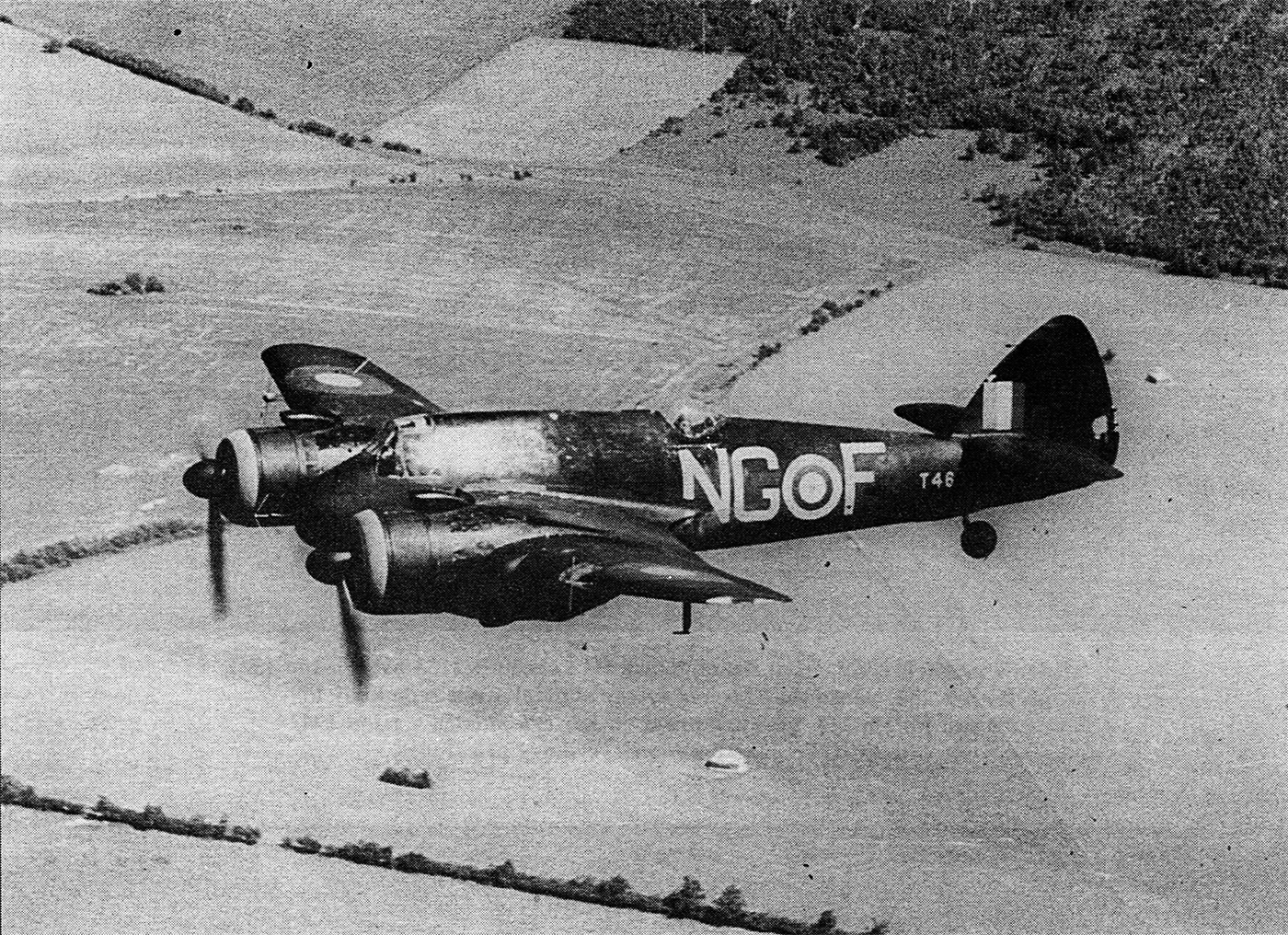
Caption: Beaufighter IF RAF 604Sqn NGF T4638 Middle Wallop July 1941
Caption: Beaufighter VIF RAF 604Sqn NGC MM856 WgCdr MH Constable Maxwell Scorton Aug 1943
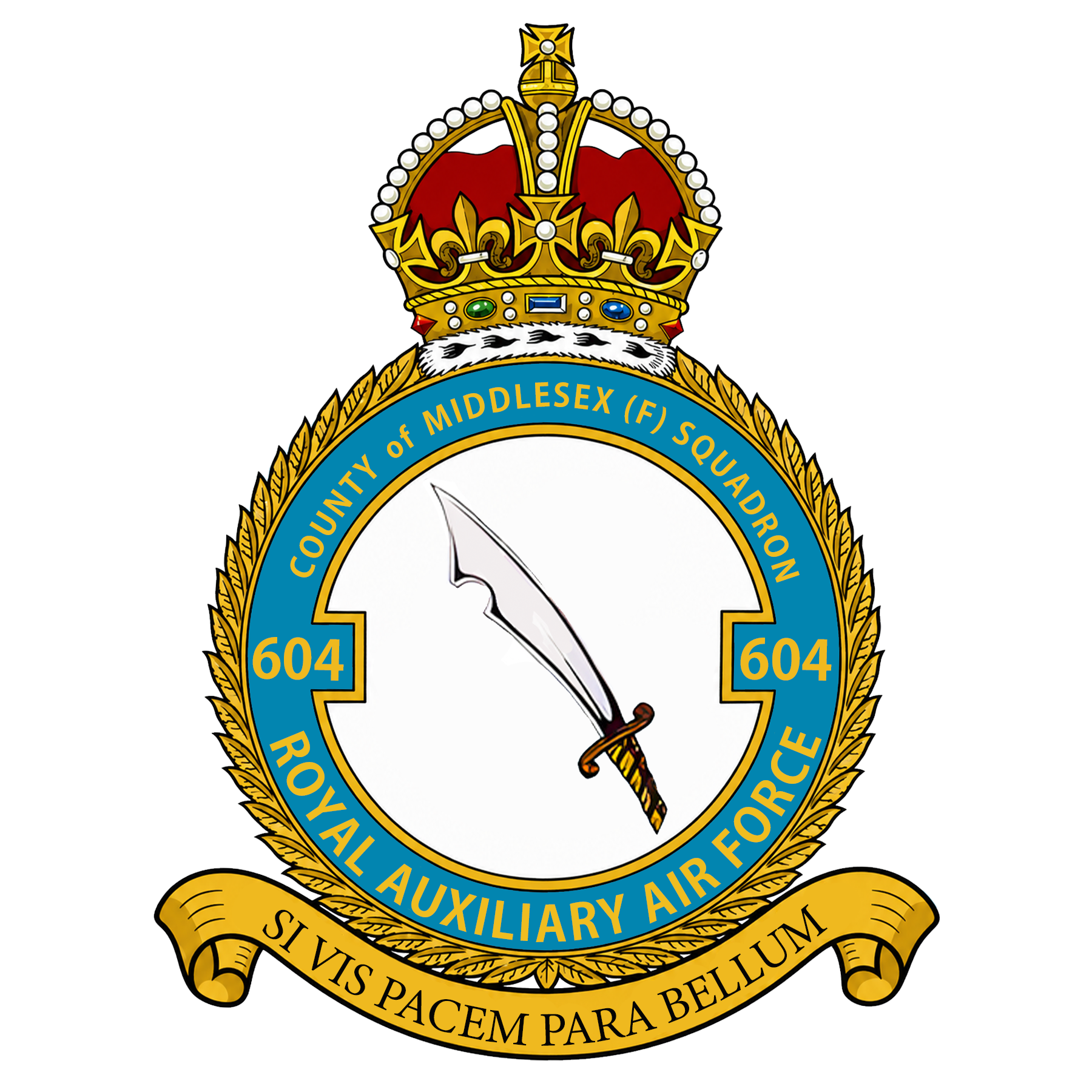
RAuxAF No 604 (County of Middlesex) SquadronRAuxAF No 604 (County of Middlesex) Squadron
Motto: Si vis pacem para bellum (If you want peace, prepare for war)
Formed at Hendon on 17 March 1930 as a light bomber squadron in the Auxiliary Air Force, although it's initial equipment of Wapiti's did not arrive until September, until when it used DH9As. It continued in this role until 23 July 1934 when it was redesignated a fighter squadron. Pending the arrival of Demons, which arrived in June 1935, it was equipped with Harts and in January 1939 it received the Blenheim IF.
It became one of the first units to have its aircraft equipped with airborne radar, but some of its early operations were daylight sweeps over the Low Countries. By the time the Battle of Britain started it had reverted to the night fighter role and in September 1940 its first Beaufighter had arrived.
It continued to provide night defence to the UK until early 1943 but with the reduction in German activity over Britain, it began to move over to night intruder operations. In February, the squadron was allocated to 2 TAF and at the same time began conversion to Mosquitos. Operations from Normandy began in August but the following month it returned to the UK, returning to the continent once again in January 1945, remaining there until disbanding on 18 April 1945.
With the reactivation of the Royal Auxiliary Air Force, 604 was reformed on 10 May 1946 at Hendon as a day fighter squadron. It was initially equipped with Spitfire LF 16s but converted to jets in November 1949 when Vampires arrived. These were replaced by Meteor F 8s in August 1952 but along with all the flying units of the RAuxAF, it was disbanded on 10 March 1957.
Squadron Codes used: - WQ Jan 1939 - Sep 1939; NG Sep 1939 - Apr 1945, 1949 - Apr 1951;RAK Jul 1946 - 1949
Standards: - Standard originally awarded on 15 Oct 1957 but presented:- ?
Battle Honours: - France & Low Countries, 1940: Dunkirk: Battle of Britain, 1940: Home Defence, 1940-44: Fortress Europe, 1943-45: Normandy, 1944: France & Germany, 1944-45
No. 604 Squadron RAF was a squadron of the Royal Air Force noted for its pioneering role the development of radar-controlled night-fighter operations. The squadron was established in March 1930 at RAF Hendon as a day-bomber squadron of the Royal Auxiliary Air Force. In July 1934, the squadron transitioned to two-seat fighters. Shortly after the commencement of World War II in 1939, the squadron was reassigned to a night-fighter role.
No. 604 Squadron was initially disbanded in April 1945 as part of a reduction of the British Armed Forces near the end of the war. It was reformed as an auxiliary single-seat fighter squadron in May 1946, again at RAF Hendon. Final disbandment occurred in March 1957 with the dissolution of the Auxiliary Air Force.
History
Formation and early years
No. 604 Squadron was established on 17 March 1930 at RAF Hendon as a squadron of the Royal Auxiliary Air Force. The squadron was initially assigned to the role of day-bombing and received its first aircraft (Airco DH.9As) in April 1930. The DH.9A was soon replaced by the Westland Wapiti in September 1930. Upon re-designation as a two-seat fighter squadron, No. 604 transitioned to the Hawker Hart on 23 July 1934. Hawker Demons replaced the Harts in June 1935.
World War II
In early 1939 the squadron transitioned to the long-range fighter variant of the Bristol Blenheim. No. 604 Squadron was activated on 24 August 1939 to operate long-range fighters from RAF North Weald. The squadron spent the first several months of World War II flying defensive patrols in support of coastal convoys.
The squadron was reassigned to a night-fighter role in late 1939 and was relocated to RAF Northolt in January 1940. By May 1940, the squadron had moved to RAF Manston. During the squadron's stay at RAF Manston that Flying Officer Alistair Hunter and Sergeant Gordon Thomas shot down a Luftwaffe Heinkel 115 floatplane shortly after midnight on 18 June 1940, during the first major night raid over the United Kingdom. Following the Dunkirk evacuation, the squadron was based at RAF Middle Wallop at the end of July 1940.
In early summer 1940, squadron aircraft were fitted with VHF radiotelephone equipment and Mark III aircraft interception (AI) radar. The former was part of RAF Fighter Command policy, and greatly improved air-to-air and air-to ground communication. The AI radar equipment was fitted to assist the night fighter crews in locating German bombers at night. A new technological development, AI was not particularly reliable at this stage, and needed a third crew member to operate. The external antennas slowed down aircraft that were already considered of low performance for their role. Most AI operators were inexperienced and were forced to learn on the job, translating the information provided on the AI screens into instructions to enable their pilot to get close enough to visually locate and shoot down an enemy bomber.
Late in September 1940 the squadron received its first Bristol Beaufighter, equipped with four 20-mm Hispano-Suiza HS.404 cannon under the nose and improved Mark IV AI radio-location equipment. As one of the few squadrons thus equipped, 604 Squadron provided night defence over the UK during the Blitz from late 1940 until mid May 1941, when most Luftwaffe bomber units departed for involvement in the invasion of Russia. By this time 50 air victories had been claimed by the squadron—fourteen by F/L John Cunningham.
In early 1943 the squadron began to switch over to night intruder operations. In February 1944, the squadron was allocated to the 2nd Tactical Air Force and began conversion to the de Havilland Mosquito. Operations from Normandy began in August but the following month the unit returned to the UK, returning to the continent once again in January 1945. They remained there until disbanding at B.51 at Vendeville, near Lille, France, on 18 April 1945. Some 127 air victories had been claimed by the Squadron during the war, 41 since May 1944. A notable member of the squadron, later awarded a posthumous George Cross, was John Quinton DFC.
Post-war
With the reactivation of the Royal Auxiliary Air Force, 604 Squadron was reformed on 10 May 1946 at RAF Hendon as a day fighter squadron. It was initially equipped with Spitfire LF.16s but converted to jets in November 1949 when de Havilland Vampires arrived. These were replaced by Gloster Meteors in August 1952 but this was only for a few years as the squadron was disbanded on 10 March 1957, along with all the flying units of the Royal Auxiliary Air Force.
Aircraft Operated by RAF No. 604 Squadron From To Aircraft Version April 1930 September 1930 Airco DH.9A June 1930 June 1935 Westland Wapiti Mk.IIa September 1934 June 1935 Hawker Hart June 1935 January 1939 Hawker Demon January 1939 January 1941 Bristol Blenheim Mk.If May 1940 May 1940 Gloster Gladiator Mk.I September 1940 April 1943 Bristol Beaufighter Mk.I April 1943 April 1944 Bristol Beaufighter Mk.VIf February 1944 September 1944 de Havilland Mosquito Mk.XII April 1944 April 1945 de Havilland Mosquito Mk.XIII October 1946 May 1950 Supermarine Spitfire LF.16e November 1949 September 1952 de Havilland Vampire F.3 August 1952 March 1957 Gloster Meteor F.8
Aircraft bases Operated by RAF No. 604 Squadron From To Base 17 March 1930 29 September 1938 RAF Hendon, Middlesex 29 September 1938 3 October 1938 RAF North Weald, Essex 3 October 1938 2 September 1939 RAF Hendon, Middlesex 2 September 1939 16 January 1940 RAF North Weald, Essex (det. at RAF Martlesham Heath, Suffolk) 16 January 1940 15 May 1940 RAF Northolt, Middlesex 15 May 1940 20 June 1940 RAF Manston, Kent 20 June 1940 3 July 1940 RAF Northolt, Middlesex 3 July 1940 27 July 1940 RAF Gravesend, Kent 27 July 1940 12 August 1942 RAF Middle Wallop, Hampshire (Det. at RAF Coltishall, Norfolk) 12 August 1942 23 August 1942 RAF Warmwell, Dorset 23 August 1942 7 December 1942 RAF Middle Wallop, Hampshire 7 December 1942 18 February 1943 RAF Predannack, Cornwall 18 February 1943 24 April 1943 RAF Ford, West Sussex 24 April 1943 25 April 1944 RAF Scorton, North Yorkshire 25 April 1944 3 May 1944 RAF Church Fenton, North Yorkshire 3 May 1944 13 July 1944 RAF Hurn, Dorset 13 July 1944 25 July 1944 RAF Colerne, Wiltshire 25 July 1944 28 July 1944 RAF Zeals, Wiltshire 28 July 1944 6 August 1944 RAF Colerne, Wiltshire (Det. at A.15/Maupertus, France) 6 August 1944 9 September 1944 A.8/Picauville, France 9 September 1944 24 September 1944 B.17/Carpiquet, France 24 September 1944 5 December 1944 RAF Predannack, Cornwall 5 December 1944 31 December 1944 RAF Odiham, Hampshire 31 December 1944 18 April 1945 B.51/Lille-Vendeville, France 10 May 1946 28 March 1949 RAF Hendon, Middlesex 28 March 1949 10 March 1957 RAF North Weald, Essex
Commanding officers of RAF No. 604 Squadron From To Name March 1930 March 1935 W/Cdr. A.S.W. Dore, DSO, TD March 1935 January 1939 S/Ldr. C.P. Gabriel January 1939 March 1940 S/Ldr. R.A. Budd March 1940 August 1941 S/Ldr. M.F. Anderson August 1941 August 1941 W/Cdr. Charles Henry Appleton (1906–1944) August 1941 July 1942 W/Cdr. J. Cunningham, DSO & Bar, DFC July 1942 April 1943 W/Cdr. Wood, AFC April 1943 July 1944 W/Cdr. M.H. Constable-Maxwell, DFC July 1944 18 April 1945 W/Cdr. F.D. Hughes, DFC & 2 Bars June 1946 January 1948 W/Cdr. J. Cunningham, DSO & 2 Bars, DFC & Bar January 1948 May 1951 S/Ldr. K.T. Lofts, DFC & Bar May 1951 September 1953 S/Ldr. A. Deytrikh September 1953 March 1957 S/Ldr. T.P. Turnbull, DFC





 Editor for Asisbiz: Matthew Laird Acred
If you love our website please subscribe to our YouTube video channel
Please donate so we can make this site even better !!