Caption: Hurricane I RAF 56Sqn USP BP2764 based at North Weald Essex IWM CH158
Caption: Early Mk Tempests RAF 56th Squadron US-Y US-A US-C US-X and US-H England 1944
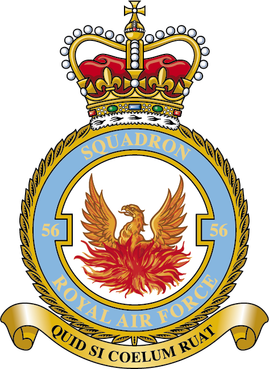
RAF 56 (Punjab) Squadron
Motto: Quid Si Coelum Ruat ( What if heaven falls?)
Number 56 Squadron, also known as No. 56 Test and Evaluation Squadron (TES), nicknamed the Firebirds for their ability to always reappear intact regardless of the odds, is one of the oldest and most successful squadrons of the Royal Air Force, with battle honours from many of the significant air campaigns of both the First and Second World Wars.
During the First World War, the squadron had many aces amongst its ranks such as James McCudden, Albert Ball, Reginald Hoidge and Arthur Rhys-Davids, developing a fierce reputation for the unit. In the Second World War, they fought in the Battle of Britain, and operated as a successful fighter-bomber unit for most of the war. In the 1960s, the squadron had their own aerobatic display team, 'The Firebirds', which consisted of nine English Electric Lightning F.1As, which participated at many airshows. From March 1976 to July 1992, No. 56 (Fighter) Squadron operated the McDonnell Douglas Phantom FGR.2, flying from RAF Wattisham, Suffolk, becoming the penultimate unit to fly the type. Until 18 April 2008, the squadron was the Operational Conversion Unit for the Panavia Tornado F.3 at RAF Leuchars, Fife.
Since 22 April 2008, the squadron has been based at RAF Waddington, Lincolnshire, and serves as the Air Command and Control Intelligence, Surveillance and Reconnaissance Operational Evaluation Unit (AIR C2ISR OEU) for the RAF.
History
First World War
No. 56 Squadron was formed on 8 June 1916 at Fort Rowner, Gosport, from members of No. 28 Squadron, as part of the Royal Flying Corps (RFC). On 14 July, the squadron relocated to London Colney. No. 56 Squadron received its first aircraft, a Royal Aircraft Factory B.E.2c on 7 August, which was followed by numerous other types. Captain Albert Ball joined No. 56 Squadron as a Flight Commander in February 1917. On 13 March 1917, the squadron became the first unit in the entire RFC to be equipped with the then brand new Royal Aircraft Factory S.E.5 fighter.
Albert Ball in a No. 56 Squadron S.E.5 in April 1917.
On 31 March, No. 56 Squadron received orders to relocate to the RFC HQ at Saint-Omer, France. By 8 April, the entire Squadron had made the move from London Colney, with the pilots having their photograph in their S.E.5s taken before they left on the 7 April. From Saint-Omer, the squadron relocated to Vert Galant on 20 April to support the Second Battle of Arras and flew their first mission on the 22 April. Its arrival at the front with the latest fighter, combined with the unusually high proportion of experienced pilots in its ranks, led to rumours among its German opponents that the squadron was an 'Anti-Richthofen Squadron', specifically dedicated to the removal of the Red Baron. The squadron did shoot down and kill Richthofen's nearest 1917 rival Leutnant Werner Voss in an epic dogfight, on 23 September 1917 by Lieutenant Arthur Rhys-Davids. Albert Ball scored No. 56 Squadron's first kill, his 32nd, on 23 April, when he shot down an Albatros D.III. The squadron suffered its first loss on 30 April when Lieutenant Maurice Alfred Kay was shot down. Ball himself was killed in action on 7 May, the same day as Lieutenant Roger Michael Chaworth-Musters.
No. 56 Squadron was sent north to Estrée-Blanche on 31 May 1917, to provide support for the upcoming Battle of Messines. From May 1917, the Germans began bombing London using their new Gotha G.IV bombers – with the first raid occurring on 25 May inflicting 290 casualties in London and Folkestone (due to diversion); the second raid was aborted and focused on Kent; the third was a daytime raid on 13 June in which there were 594 casualties, which went unanswered with the Germans losing no bombers. In response to this, No. 56 Squadron was recalled back to England and based at RFC Bekesbourne on 21 June.
The squadron participated in the Battle of Passchendaele, marking numerous victories throughout it. Captain James McCudden, eventual highest scoring pilot of the squadron, joined on 13 August. Rhys-Davids made his final sortie on 27 October 1917, taking off for a routine patrol he chased after a group of Albatros fighters after which he was never seen again. The Luftstreitkräfte credited Karl Gallwitz with the kill, word only reached the RFC on 29 December that Rhys-Davids had been killed. On 18 November, No. 56 Squadron was relocated to Laviéville in support of the Battle of Cambrai. In December 1917, McCudden scored 14 victories – including 4 on 23 December, a first for the RFC.
James McCudden's Royal Aircraft Factory S.E.5a, sporting the propeller spinner from one of his victims, 1918.
In January 1918, the squadron moved to Baizieux. McCudden was sent back to England on 5 March, where he was promoted to Major and received the Victoria Cross, he died on 9 July in an accident while on his way to take command of No. 60 Squadron. On 21 March, the Germans began their Spring Offensive, this forced No. 56 Squadron to pull back to Valheureux, where from they conducted air-to-air patrols for the next four months. The squadron supported the buildup to and provided support during the Battle of Amiens (beginning 8 August), which would later be known as the start of the Hundred Days Offensive. On 1 August, No. 56 Squadron, in tandem with No. 3 Squadron, attacked a German aerodrome in which 6 hangars and 16 enemy aircraft were destroyed.
By the end of the war, No. 56 Squadron had scored 427 victories, at a cost of 40 pilots killed, 20 wounded and 31 taken prisoner. A good impression of the demobilisation of the squadron is given in the final pages of Wind in the Wires by Duncan Grinnell-Milne, the squadron's last CO.
The squadron tune during the later stages of the war was The Darktown Strutters' Ball.
Interwar years
On 22 November 1918, No. 56 Squadron moved to Béthencourt, France. It stayed here until it moved back to Britain on 15 February 1919, arriving at RAF Narborough along with No. 60 Squadron and No. 64 Squadron.
No. 56 Squadron Armstrong Whitworth Siskin Mk.IIIa, at RAF North Weald.
Only days after being disbanded, No. 80 Squadron, based at RAF Aboukir, in Egypt, was renumbered on 1 February 1920 to No. 56 Squadron. From here they flew Sopwith Snipes. The squadron was disbanded again on 23 September 1922; however, one flight was hastily reformed on 26 September and sent to Turkey for the Chanak Crisis. This flight was officially attached to No. 208 Squadron and remained in Turkey until August 1923. However it continued to use the 56 numberplate, even though No. 56 Squadron had reformed officially in November 1922 at RAF Hawkinge. This flight returned and rejoined the rest of the squadron at RAF Biggin Hill. In September 1924, No. 56 Squadron was assigned a red and white checker pattern as a means of squadron identification, something which the squadron would actively use up until 2008. The same month saw the squadron convert to the Gloster Grebe Mk.II, flying them until they were exchanged for Armstrong Whitworth Siskin Mk.IIIas in September 1927.
The squadron finally settled at RAF North Weald in October 1927, where it remained until the end of 1939 and the start of the Second World War. On 14 November 1928, the No. 56 Squadron was allowed to use a phoenix for its crest along with the motto Quid si coelum ruat. The squadron converted to the Bristol Bulldog Mk.IIa in October 1932, these were kept until May 1936 when the squadron received Gloster Gauntlet Mk.IIs. No. 56 Squadron's crest and motto were officially approved by King Edward VIII in July 1936.
No. 56 Squadron converted to their last biplane, the Gloster Gladiator Mk.I, in July 1937. The Gladiators were flown up until May 1938 when the squadron acquired Hawker Hurricane Mk.Is. The squadron would operate the Hurricane in the opening stages of WW2.
Second World War
No. 56 Squadron's introduction to the Second World War came on 6 September 1939. The Firebirds, then based at RAF North Weald, were the victims of a friendly fire incident by No. 74 Squadron known as the Battle of Barking Creek. Two pilots of the squadron were shot down and one, P/O Montague Hulton-Harrop, was killed, becoming the RAF's first casualty in the defence of the UK.
Pilots and Hawker Hurricane Mk.IIbs of No. 56 'Punjab' Squadron at RAF Duxford, 2 January 1942.
The squadron entered the Second World War equipped with the Hawker Hurricane Mk.I and first saw action during the Battle of France, although they remained based in England and sent flights to France for short periods. The Firebirds ended the campaign by covering the Dunkirk evacuation. As part of No. 11 Group, No. 56 Squadron was based at RAF North Weald at the beginning of the Battle of Britain. From there the squadron first engaged German aircraft on 31 July 1940. It was heavily involved in the fighting in the south of England during August, although the squadron moved to RAF Boscombe Down on the 1 September. It was one of the few fighter squadrons to remain based in the south of England continuously through the battle, scoring 59 kills by the end.
No. 56 Squadron Hawker Tempest Mk.V undergoing servicing while at Volkel, circa 1944-45.
The squadron relocated away from RAF Boscombe Down on 29 November to RAF Middle Wallop where they stayed until 17 December when the Firebirds returned to RAF North Weald in Essex. It was while based here that No. 56 Squadron upgraded to the Hurricane Mk.IIb in February 1941. In April 1941, No. 56 Squadron gained its 'Punjab' nickname after the Indian province of Punjab raised money to have their name attached to a fighter, thus becoming an Indian 'gift' squadron. The Firebirds then relocated for a brief stay at RAF Martlesham Heath, Suffolk on 23 July before settling at RAF Duxford on 26 July.
In September 1941, No. 56 Squadron became the first unit to receive the Hawker Typhoon Mk.Ia which, although troublesome to begin with, the squadron helped turn into a usable fighter. Before leaving RAF Duxford, the squadron upgraded to the Typhoon Mk.Ib in March 1942, moving to RAF Snailwell on 30 March. From 24 August 1942 to 22 July 1943, the unit was based with No. 12 Group at RAF Matlaske in Norfolk. During this time, No. 56 Squadron's role changed from that of low-level defence against Focke-Wulf Fw 190 and Messerschmitt Bf 109 fighter-bomber attacks into becoming fighter bombers themselves, attacking ground and sea targets. With the Firebirds using bombs from November 1943 and rockets from February 1944. No. 56 Squadron was to score one confirmed victory while flying Typhoons. After moving around multiple bases in the UK, the squadron moved up to RAF Scorton, Yorkshire on 7 April 1944, where they converted to the Supermarine Spitfire Mk.IX. From here the squadron flew escort and reconnaissance missions.
On 28 April 1944, No. 56 Squadron moved to RAF Newchurch, Kent where the squadron converted to the Hawker Tempest Mk.V in June. Squadron Leader Frederick Higginson left the squadron at this time, being posted to No. 83 Group. Due to his knowledge of the pilot escape routes in France; his total victory count, all with No. 56 Squadron, was 15.
As a unit of No. 150 Wing, under the command of Wing Commander Roland Beamont, No. 56 Squadron became an air defence squadron. It was tasked with defending Britain from V-1 flying bombs – of which between 70 and 77+1⁄2 were shot down by the squadron. No. 56 Squadron transferred to advance landing ground B.60 at Grimbergen in Belgium on 28 September 1944, becoming part of No. 122 Wing, Second Tactical Air Force. During subsequent operations No. 56 Squadron was to become the equal highest scoring Tempest unit, with No. 486 (NZ) Squadron, totalling 59 confirmed victories. In the latter months of the war, the Firebirds were deployed to several airfields in Europe: including Volkel, in the Netherlands; Copenhagen; and numerous bases in Germany. During the Second World War, the No. 56 Squadron claimed a total of 149 aircraft shot down.
No 56 reformed the next day at Bentwaters, when No 124 Squadron was renumbered. It was now flying Meteor F Mk 3s, which were replaced by Mk 4s in August 1948 and Mk 8s in December 1950. From 11 February 1949 to 31 December 1951, the squadron was linked to No 87 Squadron. The squadron became the first to introduce another new type in February 1954, when the Swift F Mk 1 arrived, followed by some F Mk 2s in August,. however, the Swift failed to meet its expectations as an interceptor fighter and they were replaced by Hunters in May 1955, which the squadron operated until January 1961. In that month the first Lightnings for the squadron arrived and these remained its main equipment until June 1976. F Mk 1As were operated until 1965, when the F Mk 3 arrived, the final model to be used being the F Mk 6 from September 1971. In 1967, the squadron re-located to Akrotiri in Cyprus, where it formed the fighter element of Near East Air Force, the squadron returning to the Wattisham on 21 January 1975.
In March 1976 No 56 (Designate) Squadron began forming at Coningsby on the Phantom FGR Mk 2. When this unit had worked up on the new type it moved to Wattisham, where on 29 June 1976 it replaced the Lightning unit. It continued to operate from Wattisham as part of the UK Air Defence Region until 1 July 1992 when it disbanded. On the same day the Tornado F Mk 3 OCU at Coningsby adopted the numberplate as No 56 (Reserve) Squadron, moving to Leuchars in April 2003 where it remained until disbanding on 22 April 2008. The same day the numberplate was transferred to the Intelligence Surveillance, Target Acquisition and Reconnaissance (ISTAR) Operational Evaluation Unit (OEU) at RAF Waddington. In its new role it became responsible for the operational testing and evaluation of the Sentry AEW Mk 1, Sentinel R Mk 1 and all versions of the Nimrod as well as associated ground based equipment.
Standards Battle Honours*
Award of Standard originally announced on 7 Sep 1943, effective from 1 Apr 1943 but presented:-
1st - 27 April 1956 HRH Princess Marina, Duchess of Kent
2nd - 23 October 1986 ACM Sir John Rogers.Western Front, 1917-1918:
Arras: Ypres, 1917:
Cambrai, 1917:
Somme, 1918: Amiens:
Hindenburg Line: France & Low Countries, 1940:
Dunkirk: Battle of Britain, 1940:
Fortress Europe, 1942-1944:
Dieppe: France & Germany, 1944-1945:
Normandy, 1944:
Home Defence, 1942-1945: Arnhem:Squadron Codes used: -
LR Sep 1939
US Sep 1939 - Apr 1946
ON Apr 1946 - 1947 (Codes taken over from No 124 Sqn)
US 1947 - Dec 1950
B Carried on Phantoms
A Carried on Tornados






 Editor for Asisbiz: Matthew Laird Acred
If you love our website please subscribe to our YouTube video channel
Please donate so we can make this site even better !!