Caption: Hawker Hurricane I RAF 3Sqn OPR L1940 before the war South Africa
Caption: Hawker Hurricane IIc RAF 3Sqn QOF QOT QOR QOP QOZ QOY based at Stapleford Tawney 1941 IWM CH3497
Caption: Hawker Hurricane IIc RAF 3Sqn QOY BD867 based at RAF Hundson Hertfordshire 1941 IWM CH3507
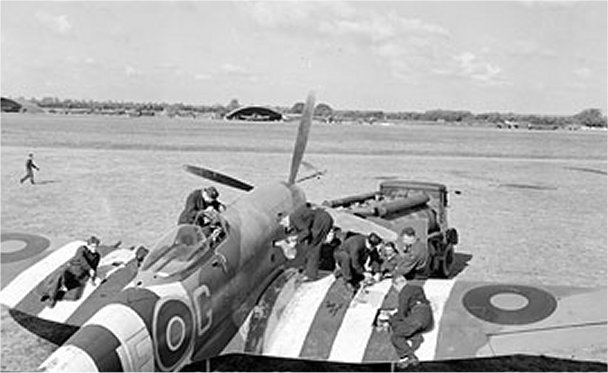
Caption: Hawker Tempest MkV 2TAF RAF 3Sqn JF-G Newchurch Kent 12th June 1940
No. 3 Squadron RAF
Number 3 Squadron, also known as No. 3 (Fighter) Squadron, of the Royal Air Force operates the Eurofighter Typhoon FGR4 from RAF Coningsby, Lincolnshire, since reforming on 1 April 2006. It was first formed on 13 May 1912 as one of the first squadrons of the Royal Flying Corps – being the first to fly heavier than air aircraft.
Foundation and First World War (1912–1919)
No. 3 Squadron, Royal Flying Corps (RFC) was formed at Larkhill on 13 May 1912 by the renaming of No. 2 (Aeroplane) Company of the Air Battalion Royal Engineers, under the command of Major Robert Brooke-Popham. Being already equipped with aeroplanes and manned by pilots and air mechanics, No. 2 (Aeroplane) Company was thus the first British, Empire or Commonwealth independent military unit to operate heavier-than-air flying machines, hence the squadron motto Tertius primus erit (Latin for 'The third shall be the first').
On 5 July 1912, two members of the squadron, Captain Eustace Loraine and Staff Sergeant Wilson were killed in an aircraft crash, making them the first RFC fatalities. In 1913, the squadron deployed to Halton in Buckinghamshire to support the land manoeuvres of the Household Division. A temporary airfield was set up on what later became RAF Halton's Maitland Parade Square. During the exercise, the squadron flew a number of reconnaissance sorties and staged the first confrontation between an airship and an aeroplane.
As well as training and reconnaissance duties, No. 3 Squadron spent much of its time carrying out experimental work and working out tactics, including how to direct artillery fire from the air. In late 1913, the squadron carried out trials in the use of machine guns from aircraft, which eventually resulted in the selection of the Lewis gun for use by the RFC and from early in 1914 carried out trials in airborne photography, helping to develop the cameras that would be used by the RFC in the First World War. Other trials included the first night flights carried by the RFC.
The squadron was sent to France on the outbreak of the First World War, arriving at Amiens on 13 August 1914, carrying out its first reconnaissance mission, piloted by Captain Philip Joubert de la Ferté on 19 August. The squadron initially operated primarily in the reconnaissance role using a variety of aircraft types. In December 1914, the squadron started to receive Morane-Saulnier L parasol-wing aircraft, and was almost solely equipped with the Morane Parasol by April 1915. It started to replace its Morane-Saulnier L with the improved Morane-Saulnier LA, which had ailerons instead of the wing warping of the earlier aircraft, in September 1915, and all its Parasols were Type LAs by December 1915. In 1916 it supplemented its Parasols with a flight of four Morane-Saulnier BB biplanes, and from the middle of 1916 replaced its Morane-Saulnier LAs with Morane-Saulnier P parasols.
The English ace James McCudden served as a mechanic and occasional observer with 3 Squadron in the early part of the war, leaving the squadron in January 1916 for flying training. Cecil Lewis, author of Sagittarius Rising joined the squadron in May 1915 and flew Morane Parasols with the squadron during the Somme offensive. Later in October 1917, with the introduction of Sopwith Camels, a fighter/scout role was taken on, with 59 enemy aircraft being claimed by the end of the war. The squadron disbanded on 27 October 1919.
There were nine flying aces among its ranks, including Douglas John Bell, George R. Riley, Will Hubbard, Adrian Franklyn, Hazel LeRoy Wallace, Lloyd Hamilton, David Hughes, Neil Smuts and William H Maxted.
Interwar period (1920–1938)
No. 3 Squadron reformed in India on 1 April 1920 as a fighter squadron equipped with Sopwith Snipes, being disbanded again 30 September 1921. It was immediately reformed the next day at RAF Leuchars, Scotland, as a naval observation squadron equipped with the Airco DH.9A, receiving the Westland Walrus and Avro Bison. The squadron moved to RAF Gosport on 8 November 1922, before being disbanded to form three independent flights on 1 April 1923.
It reformed as a fighter squadron with Snipes a year later on 1 April 1924, operating a succession of different types, based in the UK, including the Gloster Gladiator. The only highlight of these years was the 1935 deployment to the Sudan during the Italian invasion of Abyssinia.
Second World War (1939–1945)
At the start of the Second World War No. 3 Squadron was posted as part of Fighter Command to RAF Biggin Hill equipped with the Hawker Hurricane. It briefly deployed to France in support of the British Expeditionary Force following the German attack on the West in 1940, being forced to withdraw after ten days, having claimed 60 German aircraft for the loss of 21 of its own. On 21 July 1940, "B" flight was detached to form the nucleus of the newly formed No. 232 Squadron. Once back up to strength, No. 3 Squadron was used as air defence for the Royal Naval base at Scapa Flow, remaining in Scotland until April 1941, based at the RAF Wick in the north of Scotland. In June 1941, the squadron moved from RAF Martlesham Heath to RAF Stapleford Tawney operating the four-cannon Hurricane II in 'Rhubarb' attacks on defended ground targets and shipping in northern France and Belgium.
The squadron then co-operated with "Turbinlite" searchlight equipped Douglas Havocs in the night fighter role.
In February 1943, it re-equipped with the Hawker Typhoon for fighter-bomber and anti-shipping strikes. It re-equipped in March 1944 with the new Hawker Tempest fighter, operating over the Normandy beach-head and against German V1 flying bombs, claiming 288 V-1s shot down.
It then deployed across the Channel, flying as part of the Second Tactical Air Force fighting through the low countries and into Germany. Amongst its pilots was Flight Lieutenant Pierre Clostermann, who flew with the squadron from March 1945 until the end of the war in Europe.
Post-war and Cold War (1946–1968)
No. 3 Squadron converted to jet aircraft with the de Havilland Vampire F.1 during 1948, in Germany, where it had remained after moving there in the latter stages of the war. The Canadair Sabre F.4 and Hawker Hunter F.4 replaced the Vampire during the 1950s. This was followed by the Gloster Javelin FAW.4 and then a conversion to the English Electric Canberra B(I).8 bomber. Most of its time operating Canberras was spent at RAF Geilenkirchen, moving to RAF Laarbruch in January 1968.
Harrier (1972–2005)
No. 3 Squadron's association with the Hawker Siddeley Harrier began in the early 1970s with the Harrier GR.1 at RAF Wildenrath where it reformed from Canberras to Harriers and they joined No. 4 Squadron and No. 20 Squadron equipped with the Harrier GR.1 and were already operational at Wildenrath. The squadron received the later GR.3 and GR.5 model Harriers successively at RAF Gütersloh, finally receiving the GR.7 and relocating to RAF Laarbruch in 1992. In 1999, with the drawdown of the RAF in Germany, the squadron moved back to the UK along with its sister squadron No. 4 Squadron. The two squadrons operated at RAF Cottesmore, being joined by the other Harrier operator, No. 1 Squadron, in summer 2000.
As part of Joint Force Harrier, No. 3 Squadron operated alongside the British Aerospace Sea Harrier FA2 operated by the Fleet Air Arm and was capable of deployment from the Royal Navy aircraft carriers. Operations included Operation Allied Force in Kosovo in 1999, Operation Palliser in Sierra Leone in 2000 and Operation Telic in Iraq in 2003. In August 2004, it was announced that six Harriers would be deployed to Afghanistan in support of NATO forces.
Eurofighter Typhoon (2006–present)
After the Harrier GR7 had been passed to the Fleet Air Arm to be used by the recommissioned No. 800 Naval Air Squadron, No. 3 Squadron moved to RAF Coningsby on 1 April 2006 where it re-equipped with the Eurofighter Typhoon and became the first operational front line RAF Typhoon squadron in July 2007. The squadron began to take over Quick Reaction Alert responsibilities from the Panavia Tornado F3 on 29 June 2007.
In March 2011, the squadron deployed to Southern Italy to take part in Operation Ellamy in Libya in support of UN Security Council Resolution 1973.
In May 2012, four Typhoons were deployed to RAF Northolt in an air defence role covering the duration of the London 2012 Summer Olympics, the first time RAF fighters had been stationed at the station since the Second World War.
Between April and August 2017, four of the squadron's Typhoons were deployed to Mihail Kogălniceanu Air Base, Romania as part of Operation Biloxi. During this deployment, the squadron fighters flew on over 280 training sorties and one sortie in response to Russian Air Force activity over the Black Sea.
During March 2018, six Typhoons from No. 3 Squadron deployed to Andravida Air Base in Greece for Exercise Iniochos 18. It was the first time that RAF Typhoons had participated in the annual NATO exercise.
On 3 September 2019, No. 3 Squadron deployed to Oman for two weeks to participate in Exercise Magic Carpet.
Aircraft Operated by No.3 Squadron RAF Aircraft Period Sopwith Camel September 1917 – February 1919 Sopwith Snipe April 1920 – October 1921; April 1924 – October 1925 Airco DH.9A October 1921 – October 1922 Westland Walrus January 1922 – April 1923 Hawker Woodcock II July 1925 – September 1928 Gloster Gamecock I August 1928 – July 1929 Bristol Bulldog II / IIA 1929 – 1937 Gloster Gladiator I 1937 – 1939 Hawker Hurricane I / II 1938 – 1943 Hawker Typhoon IB February 1943 – April 1944 Hawker Tempest V February 1944 – April 1948 de Havilland Vampire 1948 – 1953 Canadair Sabre F.2/F.4 1953 – 1956 Hawker Hunter F.4 1956 – 1957 Gloster Javelin FAW.4 1959 – 1960 English Electric Canberra B(I).8 1961 – 1972 Hawker Siddeley Harrier GR.1 / GR.3 / GR.5 / GR.7 1972 – 2006 Eurofighter Typhoon FGR4 / T3 2006 – present
Commanding Officer sof No.3 Squadron RAF Commanding Officer Date of Appointment Major H R M Brooke-Popham 13 May 1912 Major J M Salmond 12 August 1914 Major D S Lewis April 1915 Major E R Ludlow-Hewitt 1 November 1915 Major H D Harvey-Kelly January 1916 Major D E Stodart September 1916 Major E D Horsfall May 1917 Major J A De Courcy Jun 1917 Major R Raymond-Barker Sep 1917 Major R St Clair-McClintock April 1918 Squadron Leader G G A Williams December 1920 Squadron Leader D G Donald June 1922 Squadron Leader C C Miles February 1923 Squadron Leader J C Russel April 1924 Squadron Leader J M Robb April 1926 Squadron Leader E D Johnson September 1927 Squadron Leader C A Stevens August 1930 Squadron Leader G Martyn March 1934 Squadron Leader H L P Lester March 1936 Squadron Leader H H Chapman August 1938 Squadron Leader P Gifford November 1939 Squadron Leader W M Churchill May 1940 Squadron Leader S F Godden June 1940 Squadron Leader G F Chater September 1940 Squadron Leader A W Cole November 1940 Squadron Leader R E Barnett January 1941 Squadron Leader E P P Gibbs January 1941 Squadron Leader R F Aitken April 1941 Squadron Leader A E Berry April 1942 Squadron Leader L F De Soomer August 1942 Squadron Leader S R Thomas August 1943 Squadron Leader R Hawkins September 1943 Squadron Leader A C Dredge October 1943 Squadron Leader K A Wigglesworth August 1944 Squadron Leader H N Sweetman September 1944 Squadron Leader K F Thiele January 1945 Squadron Leader R B Cole February 1945 Squadron Leader C H Macfie May 1947 Squadron Leader D R Griffiths November 1949 Squadron Leader W J S Sutherland June 1952 Squadron Leader D C H Simmons December 1953 Squadron Leader T H Hutchinson December 1954 Wing Commander D W B Farrar January 1959 Wing Commander A F Peers May 1960 Wing Commander D G Walker January 1961 Wing Commander D F C Ross January 1961 Wing Commander J L Field July 1963 Wing Commander L E H Scotchmer July 1965 Wing Commander R Hollingworth May 1967 Wing Commander M R T Chandler December 1969 Heritage
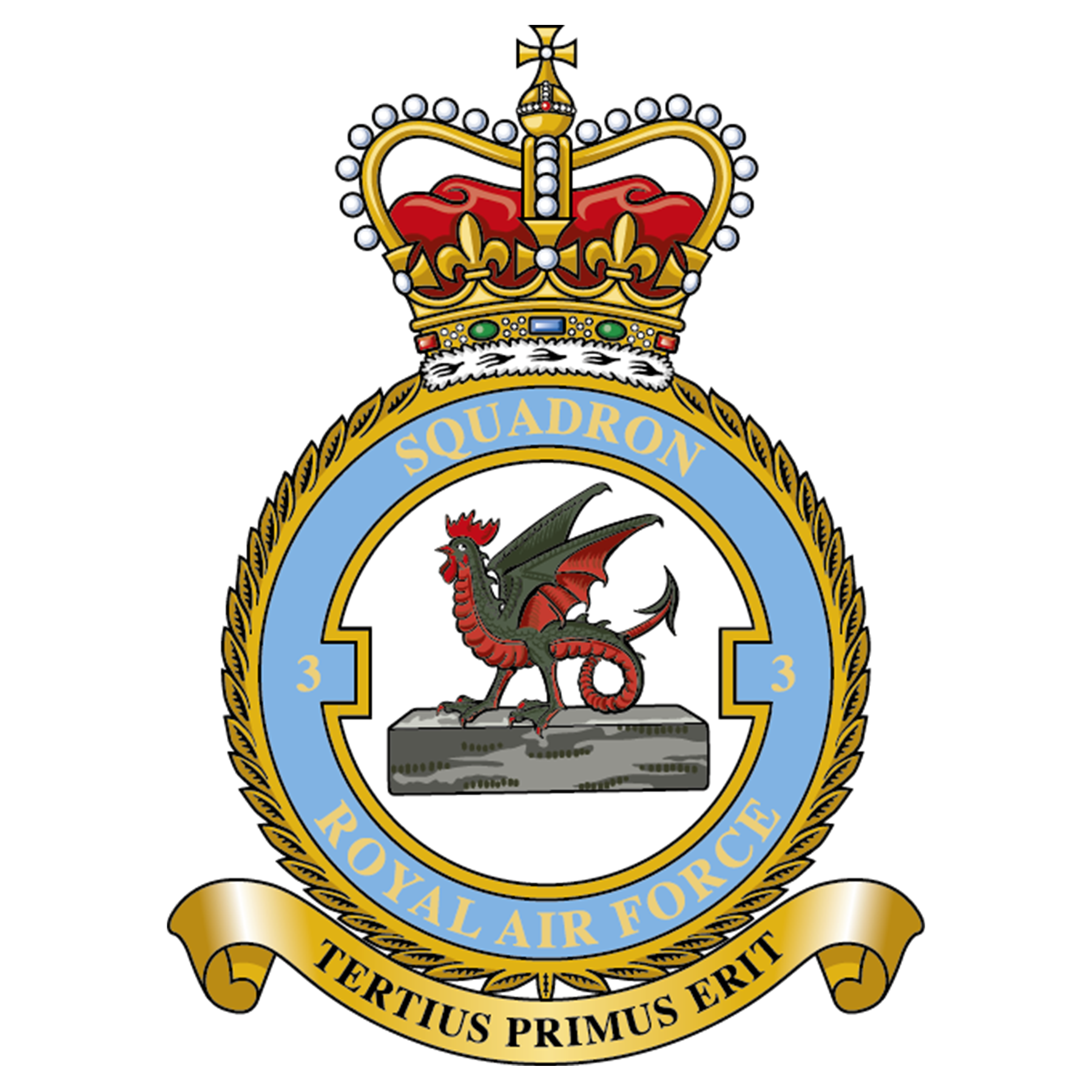
The squadron badge features a cockatrice on a monolith against a yellow and green background. The monolith relates to Stonehenge near Larkhill where the squadron was first formed. The cockatrice reflects the squadron being the first to operate heavier-than-air aircraft. The motto is Tertius primus erit – The third shall be the first.
Call Signs
As of March 2025, aircraft operated by No. 3 Squadron use the following peacetime call signs: Brutal, Chaos, Hulk, Nightmare, and Rampage.
Battle Honours
Western Front, Mons, Neuve Chapelle, Loos, Somme, Cambrai, Hindenburg Line, France and Low Countries, Battle of Britain, Home Defence, Fortress Europe, Channel and North Sea, Normandy, Arnhem, Rhine, France and Germany, Iraq, Libya.






 Editor for Asisbiz: Matthew Laird Acred
If you love our website please subscribe to our YouTube video channel
Please donate so we can make this site even better !!