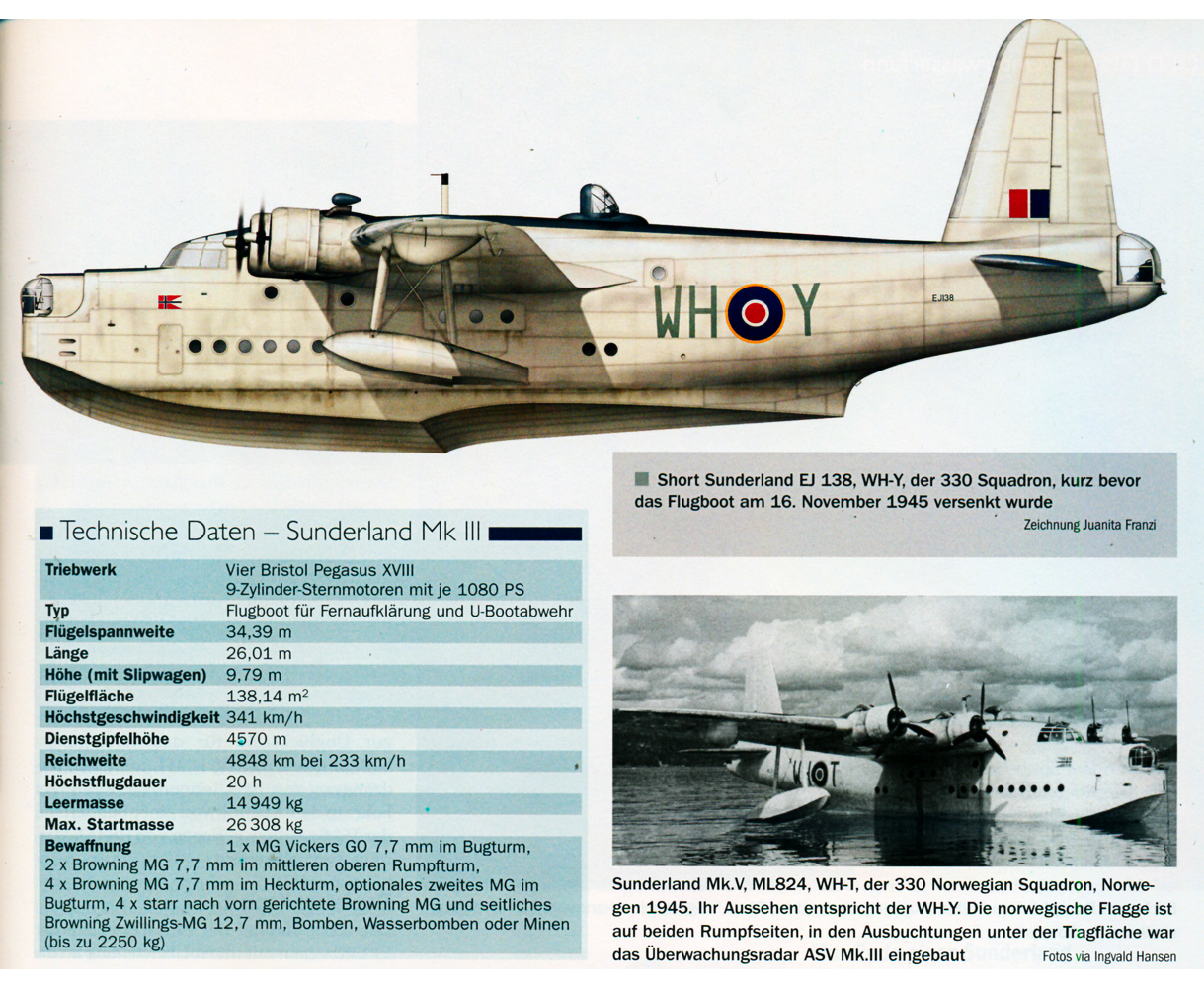
Caption: Short Sunderland MkV RAF 330Sqn Norwegian WHY EJ138 and WH T ML824 Norway 1945
RAF No 330 (Norwegian) Squadron
RAF No 330 (Norwegian) Squadron
Motto: Trygg havet (Guarding the seas)
Squadron numbers in the 300 series were allocated to units manned by personnel who had escaped from occupied Europe. This page shows details of the squadrons manned by Norwegian, Greek, Belgian and Jugoslav personnel.
Formed at Reykjavik on 25 April 1941 from Norwegian personnel, who had managed to escape from Norway and then undergone training in Canada. They initially flew with RAF Sunderland crews but in May the aircraft ordered by the Norwegian government arrived in the form of Northrop N-3PB seaplanes.
Anti-submarine operations began on 23 June and from July a detachment was operated from Akureyi. In June 1942, some Catalinas were received and the squadron continued to operate both types until December 1943 when the squadron moved to Oban in Scotland, where the following month, both types were replaced by Sunderlands.
Sunderland operations began on 20 April from Oban and these consisted of the standard range of anti-submarine patrols and convoy escort duties. The following month a detachment was sent to Sullom Voe and in July 1943 the squadron moved there in order to cover Russian convoys and the Norwegian coast. The squadron finally returned to Norway (Stavanger)in May 1945 and on 21 November it was transferred to the control of the Royal Norwegian Air Force.
Squadron Codes used: - KE Allocated Apr - Sep 1939 | GS May 1941 - Mar 1943 | WH 1944 - Nov 1945
No. 330 Squadron RNoAF (Norwegian: 330 skvadron) is a helicopter unit of the Royal Norwegian Air Force (RNoAF) and is Norway's military search and rescue service. The squadron operates sixteen AugustaWestland AW101 helicopters based at six airbases along the coast. Headquartered at Sola Air Station, the squadron has detachments at Rygge, Florø, Ørland, Bodø and Banak. The unit's primary duty is search and rescue (SAR), with secondary duties consisting of air ambulance and disaster relief.
The squadron has its roots in the No. 330 Squadron RAF, which conducted maritime surveillance, Arctic convoy escort and anti-submarine warfare during the Second World War. It was established on Iceland on 25 April 1941, where it operated Northrop N-3PB and Consolidated PBY Catalina seaplanes. It relocated to RAF Oban in Scotland on 23 January 1943 and adopted Short Sunderland flying boats in the same role. It relocated to Sola in June 1945, where it operated mostly as an airline until December, when it was deactivated.
The unit was reactivated between 20 July 1953 and 5 July 1958 to operate the Republic F-84G Thunderjet fighters, first based at Gardermoen Air Station and from 1956 at Rygge. It was again reactivated from 1 March 1962 to 1 October 1968 to carry out maritime surveillance and anti-submarine operations from Sola, using the Grumman HU-16 Albatross. In its current role the squadron became operational in 1973, using ten, later twelve Sea Kings. These have been replaced with the AgustaWestland AW101.
The Royal Norwegian Navy Air Service ordered twelve Northrop N-3PB Nomads on 12 March 1940. This was the first-ever order for Northrop Corporation. By the time the first aircraft was finished in December 1940, Germany had invaded Norway. The aircraft were therefore transferred to Little Norway in Toronto, Ontario, Canada. During late fall the Norwegian Nygaardsvold's Cabinet agreed with the Royal Air Force that the exiled Norwegian forces could use the Northrops to operate reconnaissance and escort services around Iceland.
The 330 (Norwegian) Squadron was activated on 25 April 1941 and based at RAF Reykjavik, also known as Corbett Camp, in the vicinity of Reykjavík on Iceland. The squadron originally consisted of 128 men, all Norwegian. These had various backgrounds: 80 were trained at Little Norway; most of the rest were sailors from sunken ships or men brought in from Lofoten during the Operation Claymore raid. These lacked military training, forcing the squadron to establish a recruit school. The base consisted of a dozen Nissen huts. The facilities were primitive and the soldiers forced to sleep on the muddy ground.
Northrop N-3PB being used to transport a seriously ill woman to hospital in Reykjavik in Iceland, May 1942
The squadron was under RAF Coastal Command in Reykjavík. The eighteen Northrop N-3PB aircraft arrived by ship on 22 May. After final assembly they were operational on 23 June. The squadron was originally set to carry out Arctic convoy escorts. The squadron's A-flight and headquarters were located at Corbett Camp, the B-flight was located at Valhall in Akureyri and the C-flight at Camp Norse in Búðareyri. The latter two were established on 20 June and 14 September, respectively.
It was quickly established that the aircraft were poorly suited for their role. Due to the high latitude their compasses did not work properly, often leaving them without proper navigation. Two aircraft were subject to crashes after misnavigation. They participated in anti-submarine patrols and were part of the capture of U-570. From late 1941 the missions changed focus and the squadron instead took up a role as an air ambulance in Iceland.
No. 330 Squadron RNoAF is located in Iceland
Locations of 330 Squadron bases in Iceland
Both Norwegian and British authorities discussed converting the 330 Sqn to use the Lockheed Hudson, but the fighter role was instead placed on two new Norwegian squadrons, 331 and 332. No. 330 was instead issued the Consolidated PBY-5A Catalina in June 1942. However, they were unsuitable for Búðareyri and the Northrops were not needed in Reykjavík, so the squadron ended up with six each of the Catalina and the Northrop. An operating challenge was a lack of spare parts, but the Norwegians were helped both with parts and training by a nearby United States Air Force squadron.
The Catalinas retained the same roles as the Northrops: anti-submarine sweeping, patrol and convoy escort. The aircraft rotated between being based at Reykjavík and at Akureyri. They successfully hit U-592 on 30 June and U-580 on 25 August 1942. In December the Norwegian authorities decided to relocate the 330 Sqn. The Akureyri base was immediately ordered to move its aircraft to Reykjavík. Operations of the Catalina had commenced in November and of the Northrops in December. The C-flight continued to operate out of Búðareyri until 11 June 1943. During its period on Iceland the squadron flew 4379 hours, of which 3524 with the Northrops and 855 with Catalinas. Twenty-one soldiers were killed.
Scotland
The A- and B-flights departed Iceland for RAF Oban in Scotland on 23 January 1943. This involved a switch to the Short Sunderland flying boat. These were expensive aircraft which the Norwegian government-in-exile could not afford. The RAF therefore agreed to lend the aircraft to the squadron, while operating costs were still paid for by the Norwegians. The squadron was set up with six Mk II and six Mk III, the latter having somewhat longer range. There were technical challenges with the Bristol Pegasus engines, which were underpowered and often stopped mid-air. The situation was often aggravated when the feathering malfunctioned.
Short Sunderland of the 330 Sqn
The squadron became operative on 20 April 1943. Three days later a detachment was sent to RAF Scatsta in Shetland. The role continued as before, with submarine sweeping, patrol and reconnaissance, as well as meteorological surveys. They regularly patrolled the areas between Shetland past the Faeroe Islands to Iceland. Also active in the area was the Norwegian 333 Squadron and other RAF squadrons. The Sunderlands would on occasion partake in aerial combat with German fighters. Following the Allied Invasion of Normandy in June 1944, German submarines increasingly moved northwards and the 330 Sqn intensified its sweeping. From August the German tactics changed and the 330 Sqn's patrols moved steadily closer to Norway.
During the period in Scotland the squadron flew 12,000 hours, carrying out 655 sweeps and patrols, 50 convoy escorts and 22 search and rescue missions. Five submarines were attacked, sinking one and badly damaging another. No ships escorted by the 330 Sqn were sunk. Six Sunderlands were lost during the war, both due to engine failure and due to enemy action. All but one resulted in loss of life.
In April 1945 the Mk II and III Sunderlands were replaced with Mk V, which had more reliable Pratt & Whitney Twin Wasp. At the End of World War II in Europe in May 1945, the 330 Sqn had eleven operational Sunderlands. While the fighter squadrons were without work, the amount of work for the 330 and 333 Sqn intensified. There was a massive need for air transport, both from the United Kingdom to Norway and within Norway. Both squadrons were transferred to Norway in June, with the 330 Sqn being based at the water aerodrome at Sola Air Station. These were used on a daily coastal route from there to Bergen Airport, Sandviken and Trondheim, often onwards to Tromsø Airport, Skattøra. Both squadrons were soon operating more as airlines than as military units.
Command of the squadron was given to the newly formed Royal Norwegian Air Force on 21 November 1945, when RAF withdrew from Norway. The 330 Sqn was officially deactivated on 15 December 1945. The aircraft were still owned by the RAF, but were not returned until early 1946. Most of the personnel transferred to 333, which had just been relocated to Sola.
Web Reference: https://en.wikipedia.org/wiki/No._330_Squadron_RNoAF
Aircraft Operated by RAF No. 330 Squadron WWII Dates Aircraft Variant Notes 25 April 1941 Northrop N-3PB Nomad Single-engined floatplane patrol bomber/torpedo bomber built to a Norwegian specification. Jul 1942 Consolidated PBY Catalina Twin-engined flying boat patrol bomber. February 1943
March 1943
April 1945Short S.25 Sunderland II
III
VFour-engined flying boat patrol bomber.
Aircraft Fleet of RAF No. 330 Squadron WWII Aircraft Qty Period Northrop N-3PB 18 1941–43 Consolidated PBY Catalina 6 1942–43 Short Sunderland II 6 1943–45 Short Sunderland III 6 1943–45 Short Sunderland V 12 1945 Republic F-84G Thunderjet 27 1953–58 Grumman HU-16 Albatross 18 1962–68 Westland Sea King 12 1973–2023 AgustaWestland AW101 16 2020–Present




 Editor for Asisbiz: Matthew Laird Acred
If you love our website please subscribe to our YouTube video channel
Please donate so we can make this site even better !!