
 |
 |
 |
 |
 |
 |
 |
 |
 |
 |
 |
 |
 |
 |
 |
 |
 |
 |
 |
 |
 |
RCAF No 401 Squadron 'The Lynx'
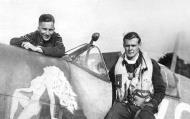
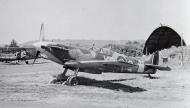
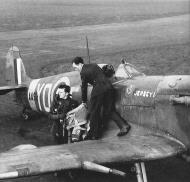
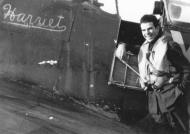
RCAF No 401 Squadron 'The Lynx' Spitfire photographs
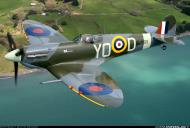
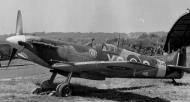
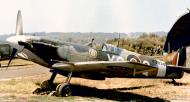
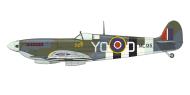
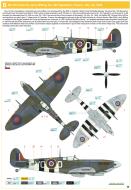
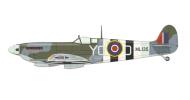
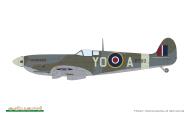
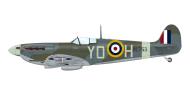
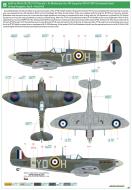
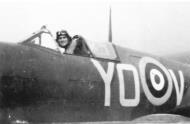
Artwork Spitfire LFIXc RCAF 401Sqn YO-D ML135 flown by Jerry Billing Tangmere AB England June 7, 1944
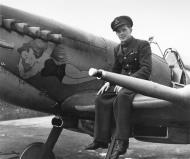
Spitfire LFMk.IXc, ML135, flown by Jerry Billing, No. 401 Squadron, Tangmere AB, June 7, 1944. One of many Canadians in the RAF was Jerry Billing. He volunteered for the RAF in October 1942 to help the Malta defense. He joined No. 185 Squadron and fought over the island until March 1943, when he was downed by a Bf 109 pilot. In 1944, Jerry Billing was sent to No. 401 Squadron. He downed a Ju 88 bomber and damaged two Fw 190s on June 7, 1944, the second day of the invasion of Normandy. On July 1, 1944, his Spitfire, ML135, was hit by AA fire and landed in no-man's land in France. He managed to get back to the UK with the help of a French family. After WWII, Jerry Billing re-enlisted in the Royal Canadian Air Force and became an instructor. In 1951, he joined the Blue Devils – a Canadian aerobatics team that flew Vampire jets. In 1964, he left the RCAF and took a job at DeHaviland as a test pilot. ML135 LFIX CBAF M66 33MU 19-3-44 401S 22-6-44 Damaged by flak and crash-landed 7m S of Carentan CE 1-7-44
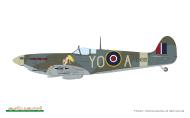
Artwork Spitfire LFIXc RCAF 401Sqn YO-D ML135 flown by Jerry Billing France 1st July 1944
Jerry Billing was shot down at the controls of ML135 on July 1, 1944 and crash landed 7 miles south of Carentan, France. The D-Day stripes were left on the undersides only and the female name 'Dorothy' appeared under the windscreen.
Additional Information Eduard plastic models - http://www.eduard.com/
Spitfire MkVbLFCLP RCAF 401Sqn YO-Q F/L T. K. 'Ibby' Ibbotson W3834 Redhill 1943
W3834 Vb 2033 EA M45 FF 2-9-41 38MU 5-9-41 266S 'UO-P' 13-9-41 154S 23-2-42 FAAC 12-4-42 ASTE M45M install 5USAAF 6-8-42 421S 10-3-43 416S 23-5-43 401S 1-6-43 126S 10-8-43 HAL 12-11-43 1659CU 5-1-45 SOC 17-9-45
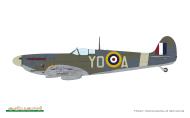
Spitfire MkVb RAF 401Sqn YO A P8783 Sgt Donald R Morrison RAF Biggin Hill England Nov-1941 to Feb 1942
profile by EduardInfo Eduard: Donald Morrison was born on June 2, 1921, in Toronto, Ontario and joined the RCAF in October 1940. In July 1941, he completed his training and left for Great Britain. He was assigned to No. 122 Squadron and two months later to No. 401 Squadron RCAF, where he quickly began to make a name for himself. By the end of February 1942, he had achieved three confirmed kills. On August 19, 1942, he was shot down during a dogfight with an Fw 190, bailed out of his damaged aircraft, and parachuted into the English Channel, from where he was rescued. During the rescue operation, he operated machine guns on the boat and fired at attacking enemy aircraft. On November 8, he was shot down again, captured and seriously wounded by shrapnel. German doctors were forced to amputate his leg. Due to his disability, he was repatriated back to Great Britain and returned to Canada in November. In May 1944, Morrison became an instructor with No. 20 EFTS. He left the RCAF on March 14, 1945. In 1947, he returned to Great Britain and joined the RAF, where he served until 1951. He later worked for Trans Canadian Airways. In total, he had seven confirmed kills during his wartime career, including three shared kills, four probable kills, and five damaged aircraft. Sgt Don Morrison had the character Jiggs, created by cartoonist George McManus, drawn on every aircraft he regularly flew with No. 401 Squadron. The first Spitfire on which this character was drawn was Spitfire P8783.
Spitfire LFIX RCAF 401Sqn YO W Rod Smith MJ448 de Rips Nederlands Oct 1944
MJ448 LFIX CBAF M66 9MU 7-11-43 83GSU 29-8-44 401S 21-9-44 CB ops 1-3-45 ASTH sold Turkey 2-5-47
Spitfire LFVb RCAF 401Sqn YO A FO Jackson E Sheppard EN921 RAF Biggin Hill Oct 1943
profile by Eduard 0AInfo Eduard: “Jack” Sheppard, who worked as a dock labourer before the war, enlisted in the RCAF in 1939 and served with No. 120 Squadron until August 1940. He completed pilot training at No. 53 OTU in August 1941 and was posted to No. 43 Squadron in November. In December he volunteered for convoy escort duties. On 10 February 1942 he was catapulted from a transport ship in Hurricane Z4569 and crashed into the sea. In July 1943 he became A Flight leader with No. 401 Squadron, and in April 1944 he took command of a flight in No. 412 Squadron. He led the unit until 2 August 1944, when he was shot down by German fighters over Normandy. He successfully evaded capture and returned to his squadron. On 22 August he was awarded the DFC, and in October he returned to Canada. He finally left the service in February 1946. Jackson Sheppard regularly flew Spitfire EN921 from July to October 1943. Although he scored none of his five confirmed kills in this aircraft, he piloted it on numerous offensive sweeps, including during the mock invasion Operation Starkey on 9 September 1943.
Spitfire MkIX RAF 401Sqn YO A BS119 PO Donald R Morrison RAF Biggin Hill England Aug 1942
profile by Eduard 0AInfo Eduard: Donald Morrison was born on June 2, 1921, in Toronto and joined the Royal Canadian Air Force in October 1940. After completing his training in July 1941, he departed for Great Britain and was assigned first to No. 122 Squadron RAF before transferring two months later to No. 401 Squadron RCAF, where he quickly established a reputation as a skilled fighter pilot. By the end of February 1942, Morrison had achieved three confirmed aerial victories. On August 19, 1942, he was shot down during a dogfight with a Focke-Wulf Fw 190 and was forced to bail out into the English Channel, where he was later rescued. During the rescue, he manned the boat’s machine guns and fired at attacking enemy aircraft.
On November 8, Morrison was shot down again, captured, and severely wounded by shrapnel, leading German doctors to amputate one of his legs. Because of his disability, he was eventually repatriated to Great Britain before returning to Canada in November. In May 1944, he became an instructor with No. 20 Elementary Flying Training School and remained there until leaving the RCAF on March 14, 1945. In 1947, Morrison returned to Great Britain and joined the Royal Air Force, serving until 1951 before later working for Trans-Canada Air Lines. Over the course of the war, he was credited with seven confirmed victories, including three shared kills, as well as four probable victories and five damaged enemy aircraft. Morrison also had the cartoon character Jiggs, created by George McManus, painted on every aircraft he regularly flew with No. 401 Squadron.
 RCAF No 401 Squadron 'The Lynx'
Jackson Eddie 'Jack' Sheppard RCAF DFC
Two Toronto Fliers Get Hun Each
London, March 15, 1944 - (CP) - Spitfire pilots of a Canadian squadron escorting two-engined American bombers on an attack on Northern France today destroyed four German aircraft and damaged a fifth.Four enemy fighters were shot out of the air and a bomber was attacked on the runway of an airfield near Cambrai.
The victors were Flt. Lts. Alec Foch Halcrow, 26, of Penticton, B.C.; Henry Kemp Hamilton, 21, of 1 Clarendon Ave., Toronto; Jack Sheppard, 23, of Dollarton, B.C., and FO. David Douglas Ashley, 24, of 1097 St. Clarens Ave., Toronto.
Their victims were four Focke-Wulf 190's, shot down over an airfield where a Messerschmitt 410 was damaged on the runway by FO. Robert Kitchener Hayward, 27, of St. Charles, Nfld.Home in Dollarton B.C.
Trained at No.1 ITS, No.10 EFTS and No.9 SFTS.
Arrived overseas in August 1941.
Served in No.43 Squadron and with a Merchant Ship Fighter Unit.In the latter role he was launched from a ship on 10 February 1942 but had to circle the vessel with controls jammed; port wing struck sea and was torn off; he was picked up unhurt.
Posted to No.401 Squadron, February 1943 and to
No.412 Squadron as Commanding Officer in April 1944.
Shot down on 2 August 1944 but evaded capture.
Repatriated to Canada in October 1944;
released in February 1946.DOUBLE BLOWS FROM AIR FALL ACROSS EUROPE
London, May 10, 1944 - (AP) - Some 3,500 Allied planes from both Britain and Italy dropped more than, 4,500 tons of explosives on Hitler’s Europe today, with British-based R.A.F. and R.C.A.F. bombers along raining down 2,500 tons in night time attacks on 10 high-priority targets.American heavyweight bombers from Italy marked the 26th straight day of aerial battering with attacks on Wiener Neustadt in Austria and Knin in Yugoslavia.
Allied medium, light and fighter bombers from Britain spent the day in methodical blows at rail centers and airfields in France and Belgium.
After darkness fell radio stations in Germany and occupied territory warned of approaching planes, and several stations went off the air.
The latest phase of the onslaught started with overnight and predawn attacks by 750 R.A.F. and Canadian heavies and Mosquito bombers on targets including French Channel coast defenses and the Paris and Berlin areas. Seven R.A.F. planes were lost.
Canadians Over Channel
Canadian planes hammered unspecified French coastal objectives without loss.
American British-based heavy bombers remained on the ground during daylight for the first time in 17 days.The Italy-based American four-engined craft hit the Messerschmitt factory and nearby airfield at Wiener Neustadt, 27 miles south of Vienna for the sixth time. Antiaircraft fire was heavy, and enemy fighters intercepted the raiders. Several Nazi planes were shot down but no figures were available for losses of either side.
Another Italy-based formation dealt a new blow to Knin, Yugoslav rail junction 40 miles north of Split and 30 miles northeast of Sibenik in an apparent 'assist' to hard-fighting Yugoslav Partisans.
Lose .5 Per Cent of Armada
The Air Ministry broke a precedent by announcing officially that 4,000 British and American bombers and fighters of all types made Tuesday's attacks. This was the first time that the total number of planes engaged in a single day's operations ever has been stated officially. From that huge force losses were six heavy bombers, two light bombers, three fighter-bombers and 10 fighters — a total of 21 planes out of 4,000, or one-half of 1 per cent.The Tuesday night attack by R.A.F. and Canadian planes on German installations directly across the Channel in France caused explosions both before and after midnight so heavy that they broke windows in Britain.
Seven separate aerial task forces hit the French coast, apparently concentrating on the six-inch-to 15-inch guns the Germans have set up there. Others raided the aircraft foundry and stamping plant at Genevilliers, a Paris suburb; and the ballbearing factory at Annecy, in the French Alps, while Mosquitos attacked Berlin with 4,000-pound blockbusters.
One Target Disappeared
The Snowy Owl, Bluenose, Moose and Bison Squadrons of the Canadian bomber group took part in the smash at Nazi defenses in Northern France. One unidentified target was blasted 'out of existence,' returning airmen said. F/O John Collyer of Winnipeg, a Canadian in the R.A.F., said he and his crew saw an explosion which lit up the countryside 'for at least 30 miles' after hitting one objective.Sqdn. Ldr. Dell Kenney, D.F.C., A.F.C., of Fredericton, Bison Squadron flight commander, flew his Squadron's l,000th sortie during the night. Wing Cmdr. Bill Pleasance, D.F.C., Calgary, led Canadian-built Lancasters of the Moose Squadron to one of the unnamed targets. Others on the attack included Ross Thompson, Montreal, and PO. Jimmy James, 67 Cameron Cres., Toronto.
As dawn broke across the Channel R.A.F., American and Allied medium and light bombers, fighter-bombers, and fighters flew in formation to drop more than 450 tons of bombs on the railway yards at Criel, 25 miles northeast of Paris; the Tournai yards in Belgium, 15 miles east of Lille, the Mons yards 130 miles southwest of Brussels, the Poix airfield near Amiens, France, a railway bridge at Mantes-Gassicourt and a railway yard, and power plant at Valenciennes.
Rouen Bridge Bombed
Later in the day mediums bombed a railbridge near Rouen, railway yards at Douai and Tourcoing and unidentified objectives in the Pas de-Calais region, while fighter bombers attacked another bridge and yards in Northern France and other airfields and rail facilities in France and Belgium.Fighter and dive bombers of the R.A.F. 2nd Tactical Air Force flew many sorties against invasion-coast batteries, railways, bridges and ammunition dumps. Two bombers failed to return from all these operations.
R.C.A.F. Spitfires shot down two FW190s during offensive patrol between Reims and Paris and damaged an ME109 as it was taxiing along a runway. They also escorted American light bombers in raids on French and Belgian railway yards.
Three Canadian Planes Lost
Sqdn. Ldr. Jack Sheppard, Dollarton, B.C., shot down one Nazi and another was credited to the squadron as a whole. Fliers under command of Sqdn. Ldr. L. M. Cameron, Roland, Man., damaged the Messerschmitt.Three Canadian fighters were reported missing from the daylight operations.
For the second straight day the 9th United States Air Force sent a fleet of 800 fighters and fighter-bombers against the Continent. They crossed the Channel in 18 separate waves, and dive-bombed railyards and airfields in Northern France and Belgium. Two of the planes did not return.Approximately 14,500 individual sorties have been flown from all Allied bases since Sunday and more than 23,500 tons of bombs have been dropped. Communiqués show that this period of operations cost 146 planes, most of them heavy bombers, while the Germans lost at least 158 aircraft.
Sir Archibald Sinclair, Secretary of State for Air, announced in the House of Commons that 1,041 British and 1,117 United States bombers operating from Britain were lost over Germany and Northern Europe in the first four months of this year.
City Pilots Wreck Hun Planes in Sunday's Smashing Raids
An R.C.A.F. Airfield in France, July 3, 1944 - (CP) - R.CA.F. Spitfire pilots gave more details today of Sunday's successes in which 19 German planes were destroyed.
Most of the combats took place immediately ahead of the British Army fighting zone, where earlier in the day ground-strafing aircraft destroyed a large number of Nazi military vehicles.
Among Canadian fighters turning in claims Sunday were Sqdn. Ldr. Jack Sheppard of Dollarton, B.C., who destroyed one, and PO. D. R. Jamieson of 1407 Symington Ave. Toronto, who got a destroyed and a damaged. PO. Goldie Goldberg of 1133A Avenue Rd., Toronto, damaged one.Fifth Victory
Sheppard, by the destruction of a FW-190, chalked up his fifth victory. He gave the Hun plane a short burst of cannon and machine-gun fire and it burst into flames and blew up. 'I had to pull to starboard to avoid the aircraft and its pieces,' he said.
FO. R. J. Lake of Langstaff, and Flt. Lt. J. Moore, Philadelphia, each bagged two Germans and shared another, and Flt. Lt. D. C. Laubman, Edmonton, destroyed two.Quick Succession
Laubman's two victories came in quick succession when his squadron, on a dive-bombing sortie, met two dozen German planes. He followed one Focke Wulf into a cloud and gave it a two-second burst as it emerged on the other side.
'There was an explosion and the Focke WuIf was enveloped in flames” Laubman said. “The pilot bailed out.'
Later, with two squadron mates, he sighted 15 enemy aircraft. He chased one and saw strikes on its engine and wing. 'White smoke poured from him and his engines stopped,' said Laubman. 'I made a new attack and blew his port tail plane and rudder off with machine-gun fire. The aircraft blew up.”SHEPPARD, S/L Jackson Eddie (J6289) - Distinguished Flying Cross - No.412 Sq. Award effective 11 August 1944 as per London Gazette dated 22 August 1944 and AFRO 2231/44 dated 13 October 1944.
Squadron Leader Sheppard has taken part in many varied operational sorties including escorts to bombers, fighter sorties and defensive patrols. An excellent leader, he has et a splendid example by his fine fighting spirit. This officer has himself destroyed four enemy aircraft.
Victories Include :
26 November 1943 one FW.190 destroyed (MJ146)*
07 March 1944 one FW.190 destroyed (MJ246);
15 March 1944 one FW.190 destroyed (MJ246);
10 May 1944 one FW.190 destroyed (MH826)
02 July 1944 one FW.190 destroyed (MJ304)* part of the combat report for 26 Nov. - 'I then chased the e/a down the railway towards Albert, giving him another short burst and observing strikes. Hopping over trees and hedges the pilot was taking such violent evasive action that he hit the ground three times with his propeller, sending up dust. He then led us over Albert, at roof height. Turning starboard. I gave him a long burst from 200 to 75 yards and observed strikes in the fuselage and wings. The cockpit cover came off in two jagged pieces. I swung into line astern, then over to port side of e/a, seeing flames surrounding the pilot's cockpit. A few seconds later he flew into the deck and blew up.'
Web References: http://www.acesofww2.com/Canada/aces/sheppard_JE.htm
Magazine References: +
- Airfix Magazines (English) - http://www.airfix.com/
- Avions (French) - http://www.aerostories.org/~aerobiblio/rubrique10.html
- EDUARD - https://www.eduard.com/
- EDUARD - Are in my opinion are what modelers are looking for loads of pictures and diagrams and have become a leading historical information source. *****
- FlyPast (English) - http://www.flypast.com/
- Flugzeug Publikations GmbH (German) - http://vdmedien.com/flugzeug-publikations-gmbh-hersteller_verlag-vdm-heinz-nickel-33.html
- Flugzeug Classic (German) - http://www.flugzeugclassic.de/
- Klassiker (German) - http://shop.flugrevue.de/abo/klassiker-der-luftfahrt
- Luftwaffe IM Focus (German) - https://www.luftfahrtverlag-start.de/
- Embleme der Luftwaffe Band-1 (German) - https://www.luftfahrtverlag-start.de/
- Le Fana de L'Aviation (French) - http://boutique.editions-lariviere.fr/site/abonnement-le-fana-de-l-aviation-626-4-6.html
- Le Fana de L'Aviation (French) - http://www.pdfmagazines.org/tags/Le+Fana+De+L+Aviation/
- Osprey (English) - http://www.ospreypublishing.com/
- model airplane international magazine - https://adhpublishing.com/shop/store/magazine-backissues/model-airplane-international-backissues/
- Revi Magazines (Czech) - http://www.revi.cz/
Web References: +
- eBay - https://picclick.de/ or https://www.ebay.com
- Pinterest - https://www.pinterest.com
- History of RAF Organisation: http://www.rafweb.org
- History of RAAF: http://www.airpages.ru/eng/ot/raaf_01.shtml
- Wikipedia, the free encyclopedia: http://en.wikipedia.org/
 Editor for Asisbiz: Matthew Laird Acred
If you love our website please subscribe to our YouTube video channel
Please donate so we can make this site even better !!