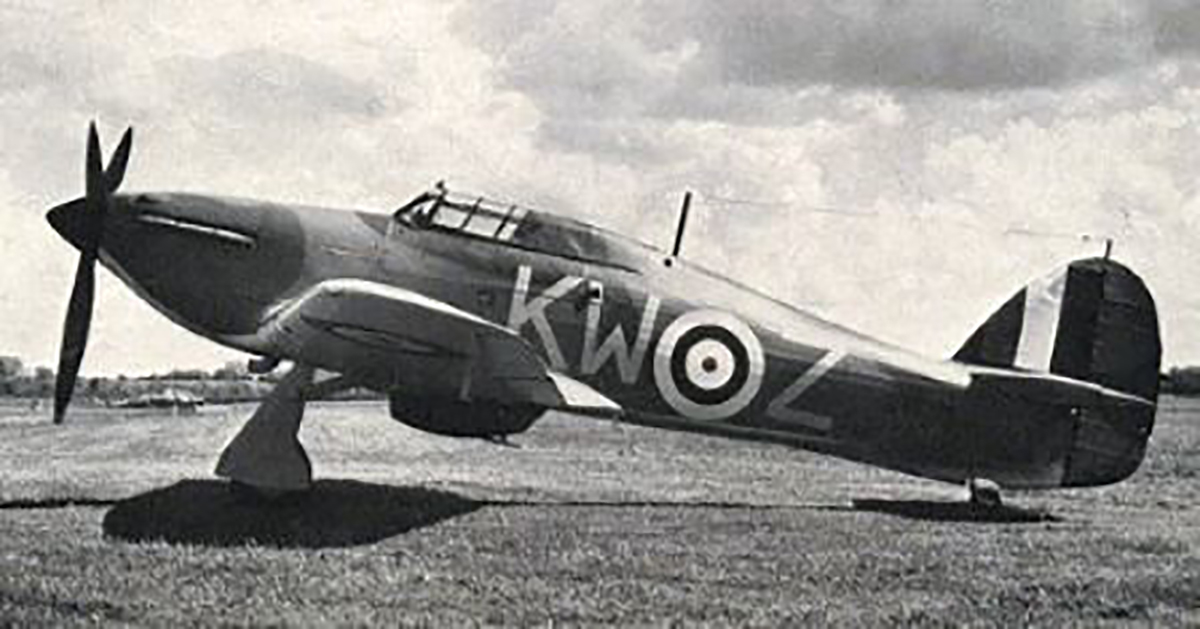
Caption: Hawker Hurricane IIa RAF 615Sqn KWZ England 1940
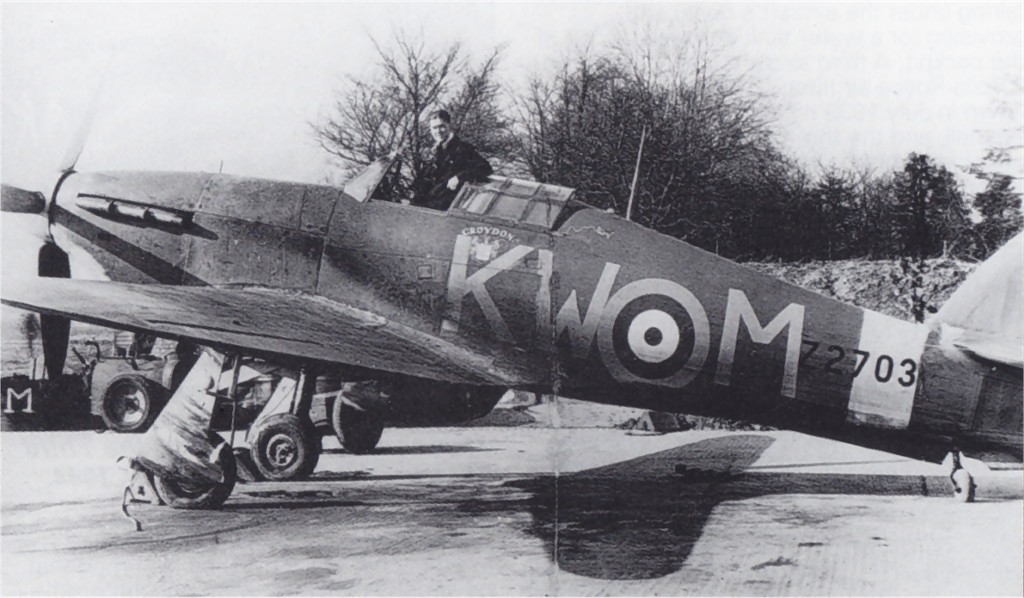
Caption: Hawker Hurricane IIa RAF 615Sqn KWM Croydon Z2703 England 1941
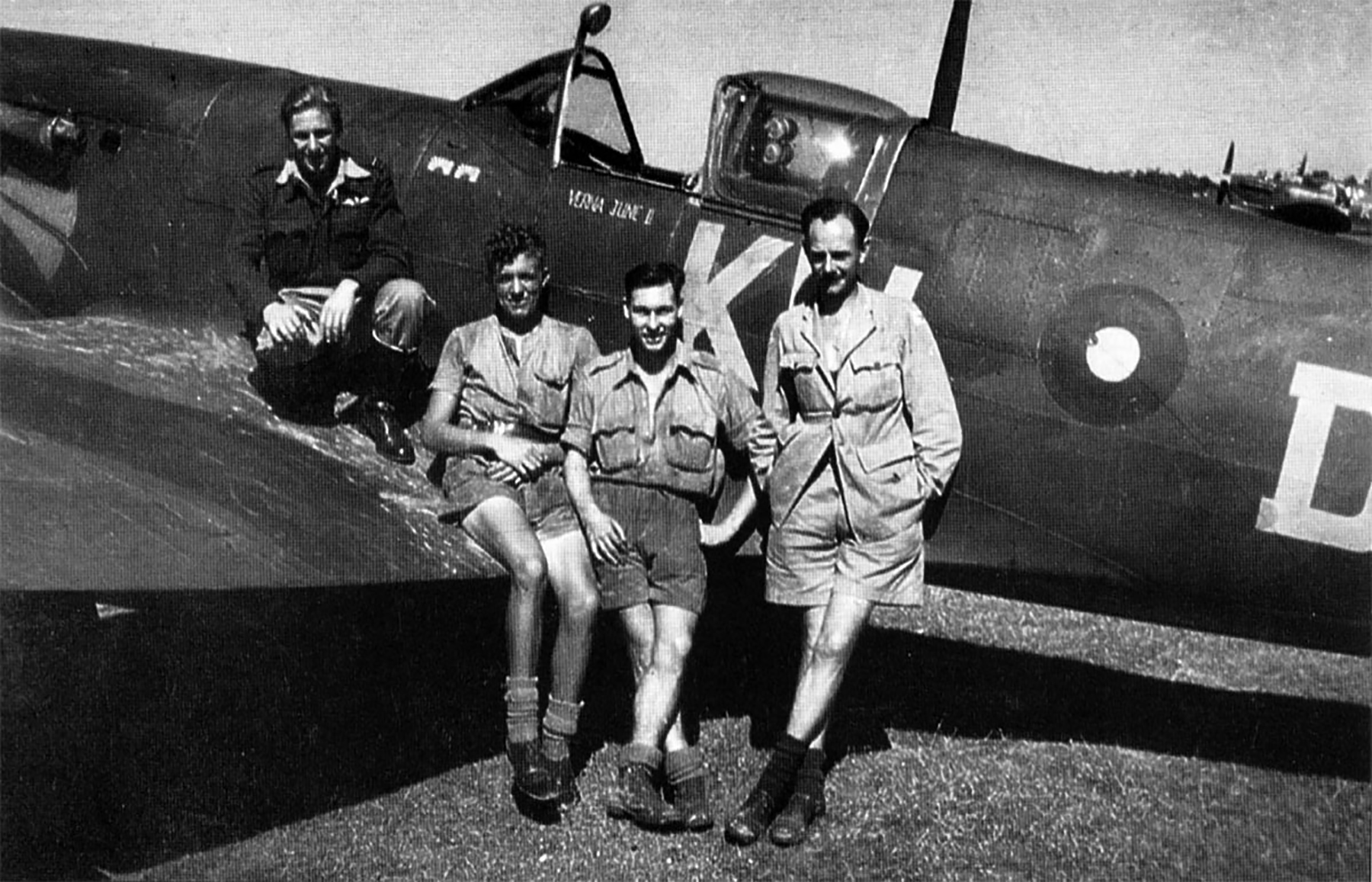
Caption: Spitfire MkVcTrop RAF 615Sqn KWD Lawrence Weggery MA292 Bengal India 1943
Caption: Spitfire MkVcTrop RAF 615Sqn KWD Lawrence Weggery MA292 Bengal India 1943
Caption: Spitfire F21 RAF 615Sqn LA195 RAVE Biggin Hill 1946
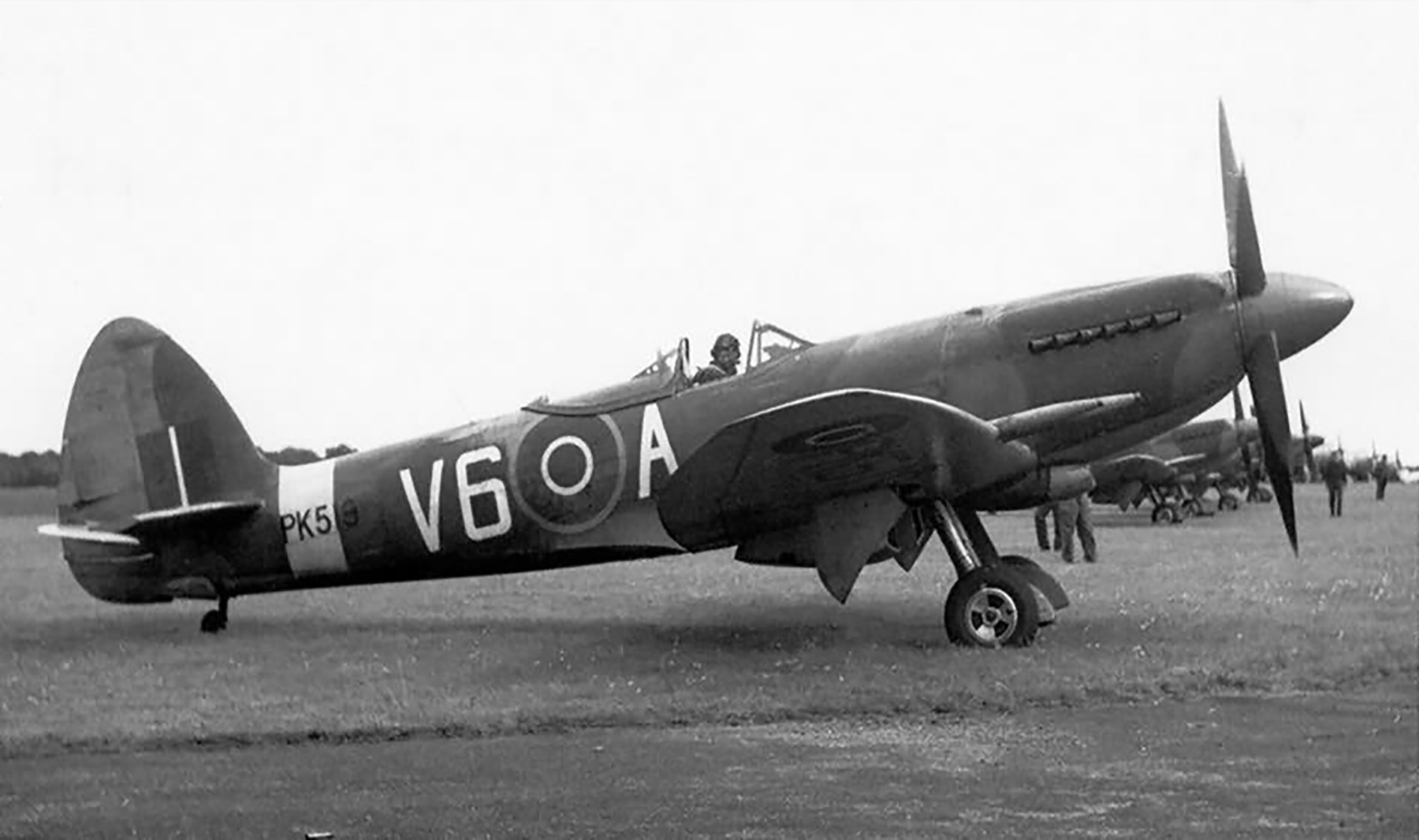
Caption: Spitfire F22 RAF 615Sqn V6A PK519 1947
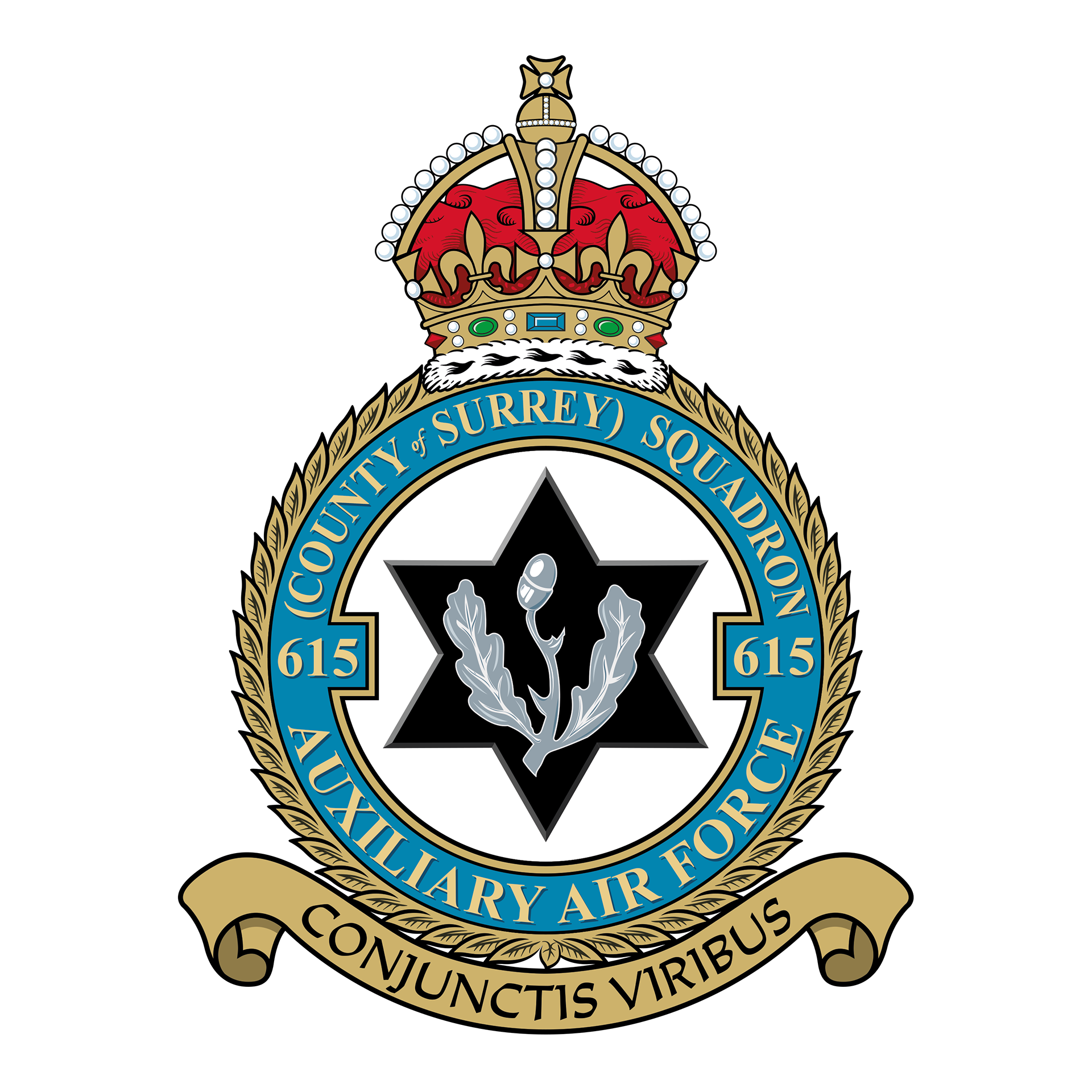
RAF No 615 (County of Surrey) SquadronRAF No 615 (County of Surrey) Squadron
Motto: Conjunctis Viribus (By our united force)
Formed at Kenley as part of the Auxiliary Air Force on 1 June 1937, it was initially equipped with the Audax. By the end of the year it had received Hectors which it flew until November 1938 when it received Gauntlets and became a fighter squadron at the same time.
It went to France as part of the Air Component of the BEF in November 1939 having re-equipped with Gladiators in May. Conversion to Hurricanes took place just prior to the German invasion of France but by 20 May 1940, the squadron was back at Kenley.
It took part in the early actions of the Battle of Britain but then moved to Scotland to rest. It later took part in offensive sweeps over Europe and defence duties in Wales before moving to India in April 1942. It moved to Burma in December 1942, returned to India to re-equip in May 1943 receiving Spitfires in October. It returned to operations on the Burma front in November but was recalled to India again, for defensive duties in August 1944, before returning to Burma in February 1945, disbanding on 10 June.
No 135 Squadron, equipped with Thunderbolts was renumbered 615 on the same day and began training for the invasion of Malaya. However, the Japanese surrender ended these plans and the squadron disbanded on 25 September 1945.
With the reactivation of the Royal Auxiliary Air Force, 615 was reformed on 10 May 1946 at Biggin Hill as a day fighter squadron equipped with Spitfire 14s. Spitfire F 21s were received in 1947 and F 22s in 1948, both marks being flown until 1950, when the squadron re-equipped with Metoer F 4s. Meteor F 8s were received in September 1951 but along with all the flying units of the RAuxAF it was disbanded on 10 March 1957.
Squadron Codes used: RR Nov 1938 - Sep 1939; KW Sep 1939 - Sep 1945; RAV Jul 1946 - 1949; V6 1949 - Apr 1951
No. 615 (County of Surrey) Squadron was a unit of the British Auxiliary Air Force and later the Royal Auxiliary Air Force between 1937 and 1957.
History
Members of the squadron meeting Winston Churchill in 1941
Formation and early years
No. 615 squadron was formed at RAF Kenley as part of the Auxiliary Air Force on 1 June 1937 and was initially equipped with the Hawker Audax in the army-cooperation role. By the end of the year it had received Hawker Hectors which it flew until November 1938, when it became a fighter squadron and received Gloster Gauntlets.
Second World War
1939–1942
The squadron re-equipped with Gloster Gladiators in May 1939, taking them to France as part of the Air Component of the British Expeditionary Force in November 1939. Pilot conversion to the Hawker Hurricane took place in the early months of 1940, with the aircraft themselves finally arriving in May 1940 as the German invasion of France got under way. The next couple of weeks were marked by chaos and constant shuffling between bases that included Vitry-en-Artois, Saint-Inglevert, Poix, Abbeville & Moorsele (Belgium). On 20 May 1940 whilst some ground crew & equipment were already making their way towards evacuation via Boulogne, patrols were still being carried out, with an He-111 shot down by PO Petrus Hugo. Finally the last nine serviceable Hurricanes flew home to RAF Kenley, whilst non-flying crew returned to England in the steamer Biarritz from Boulogne, arriving at Dover on 21 May 1940.
615 squadron took part in the early actions of the Battle of Britain, but then moved to Scotland to rest. It later took part in offensive sweeps over Europe and defence duties in Wales.
1942–45
In April 1942 the squadron was transferred to the South East Asian theatre, initially to India, before moving closer to the front lines in Burma, during December 1942. but returned to India to re-equip in May 1943, receiving Supermarine Spitfires in October. It returned to operations on the Burma front in November but was recalled to India again, for defensive duties in August 1944. The transfer, from Palel to Biagachi, near Calcutta was scheduled for 10 August. Despite a favourable weather forecast, the squadron encountered a violent monsoon storm en route. Eight of the 16 aircraft, including that of the commanding officer, Squadron Leader Dave McCormack, DFC, were lost.
1945
The squadron returned to Burma in February 1945. On 10 June 1945, the 615 Squadron was officially disbanded – although No. 135 Squadron RAF was renamed 615 Squadron that same day, at RAF Cuttack, Orissa. The new 615 Squadron was equipped with Republic Thunderbolts and began training for proposed landings in Malaya. Air support was not required, however, following the surrender of Japan and the squadron disbanded on 25 September at RAF Vizagapatam, Andhra Pradesh.
Post-war
With the reactivation of the Royal Auxiliary Air Force, No. 615 Squadron was reformed on 10 May 1946 at RAF Biggin Hill as a day fighter squadron equipped with Spitfire F.14s. Spitfire F.21s were received in 1947 and these were replaced by F.22s in 1948, both marks being flown until 1950.
600 and 615 squadron were great rivals. No 600 had the Queen Mother as Honorary Air Commodore and 615 had Sir Winston Churchill. When the Queen Mother first flew in the pilot's seat of a Comet she caused a telegram to be sent saying: "Today I have flown higher and faster than any of the pilots at Biggin Hill." On another occasion when Sir Winston Churchill was at Biggin he called over the CO of the rival squadron and asked him to send a telegram to the Queen Mother saying:"I have today presented to my squadron the Esher Trophy." Later he wrote: 'It was a great joy to me to be made an honorary member of 615. They were equally good at work or play. I remember visiting them at summer camp at Horsham St Faith. After the day's flying the squadron funds were raided and launches hired on the Norfolk Broads. At one or two selected stopping-places the adjutant went into the nearest hostelry and to the consternation of the locals ordered 86 pints and four lemonades'.
The squadron re-equipped with Gloster Meteor F.4 jet fighters starting in September 1950. Meteor F.8s were received in September 1951 and these were flown in the annual UK air defence exercises and at annual summer training camps. Along with all other flying units of the RAuxAF, No. 615 was disbanded on 10 March 1957.
Aircraft Operated by RAF No. 615 Squadron From To Aircraft Version June 1937 March 1938 Hawker Audax December 1937 November 1938 Hawker Hector Mk.I November 1938 September 1939 Gloster Gauntlet Mk.II June 1939 October 1939 Gloster Gladiator Mk.I October 1939 May 1940 Gloster Gladiator Mk.II April 1940 February 1941 Hawker Hurricane Mk.I February 1941 April 1941 Hawker Hurricane Mk.IIa April 1941 July 1941 Hawker Hurricane Mk.I July 1941 March 1942 Hawker Hurricane Mk.IIb September 1941 October 1943 Hawker Hurricane Mk.IIc October 1943 August 1944 Supermarine Spitfire Mk.Vc June 1944 June 1945 Supermarine Spitfire Mk.VIII June 1945 September 1945 Republic Thunderbolt Mk.II October 1946 January 1949 Supermarine Spitfire F.14 January 1947 June 1950 Supermarine Spitfire F.21 July 1948 September 1950 Supermarine Spitfire F.22 September 1950 September 1951 Gloster Meteor F.4 September 1951 March 1957 Gloster Meteor F.8 Notes on Aircraft Types
Although only introduced in 1935, within two years the RAF began to procure even more advanced fighters for front-line squadrons, allowing Gauntlets to be transferred to freshly-formed or reserve units, serving as their first or interim equipment for training in advance of receiving newer aircraft.
Whilst 615 Squadron were re-equipping with Hawker Hurricanes towards the end of this period, "B" flight were still equipped with Gladiators, and it was 12 aircraft of this type that served in France until joined by 9 Hurricanes in mid May 1940. With the fall of Dunkirk, 615 sqdn returned to England, posting a detachment of Gladiators ("G" flight) to RAF Manston for the final days of May 1940.
Squadron bases Operated by RAF No. 615 Squadron From To Base 1 June 1937 29 August 1938 RAF Kenley, Surrey 29 August 1938 4 September 1938 RAF Old Sarum, Wiltshire 4 September 1938 2 September 1939 RAF Kenley, Surrey 2 September 1939 15 November 1939 RAF Croydon, Surrey 15 November 1939 13 December 1939 Merville, France 13 December 1939 12 April 1940 Vitry-en-Artois, France 12 April 1940 27 April 1940 Poix, France 27 April 1940 16 May 1940 Abbeville, France 16 May 1940 20 May 1940 Morsele, Belgium 20 May 1940 29 August 1940 RAF Kenley, Surrey 29 August 1940 10 October 1940 RAF Prestwick, Ayrshire, Scotland 10 October 1940 17 December 1940 RAF Northolt, Middlesex 17 December 1940 21 April 1941 RAF Kenley, Surrey 21 April 1941 11 September 1941 RAF Valley, Anglesey, Wales 11 September 1941 27 November 1941 RAF Manston, Kent 27 November 1941 24 January 1942 RAF Angle, Pembrokeshire, Wales 24 January 1942 17 March 1942 RAF Fairwood Common, Swansea, Wales 17 March 1942 17 June 1942 en route to British India 17 June 1942 5 December 1942 RAF Jessore, Bengal 5 December 1942 6 May 1943 RAF Feni, Bengal 6 May 1943 1 November 1943 RAF Alipore, Bengal 1 November 1943 13 December 1943 RAF Chittagong, Bengal 13 December 1943 25 February 1944 RAF Dohazari, Bengal 25 February 1944 19 March 1944 RAF Nazir 19 March 1944 5 May 1944 RAF Silchar West, Assam 5 May 1944 23 May 1944 RAF Dergaon, Assam 23 May 1944 10 August 1944 RAF Palel, Manipur 10 August 1944 23 February 1945 RAF Baigachi 23 February 1945 15 April 1945 RAF Nidania 15 April 1945 22 May 1945 RAF Chharra, United Province 22 May 1945 29 May 1945 RAF Chakulia, Bihar 29 May 1945 10 June 1945 RAF Cuttack, Orissa 10 June 1945 8 July 1945 RAF Akyab, Burma 8 July 1945 25 September 1945 RAF Vizagapatam, Andhra Pradesh 10 May 1946 10 March 1957 RAF Biggin Hill, Kent
Commanding officers of RAF No. 615 Squadron From To Name June 1937 March 1940 S/Ldr. A.V. Harvey March 1940 December 1940 S/Ldr. J.R. Kyall, DSO, DFC December 1940 February 1941 S/Ldr. Holmwood February 1941 April 1941 S/Ldr. Anthony Eyre, DFC April 1941 July 1941 S/Ldr. G.F. Powell-Shedden July 1941 February 1942 S/Ldr. D.E. Gillam, DSO, DFC & Bar, AFC February 1942 December 1942 S/Ldr. B.L. Duckenfield, DFC January 1943 March 1943 S/Ldr. W.D. Williams, DFC March 1943 January 1944 S/Ldr. R.H. Holland, DFC January 1944 August 1944 S/Ldr. D.W. McCormack, DFC & Bar August 1944 September 1944 F/Lt. K.F. Gannon September 1944 June 1945 S/Ldr. T.H. Meyer June 1945 September 1945 S/Ldr. P.J. Anson July 1946 1949 S/Ldr. R.G. Kellett, DSO, DFC 1949 1950 S/Ldr. P.K. Devitt 1950 1951 S/Ldr. N.F. Duke, DSO, DFC & Two Bars, AFC 1951 January 1954 S/Ldr. F.B Sowrey, AFC January 1954 March 1957 S/Ldr. R.A. Eeles






 Editor for Asisbiz: Matthew Laird Acred
If you love our website please subscribe to our YouTube video channel
Please donate so we can make this site even better !!