 |
 |
 |
 |
 |
 |
 |
 |
 |
 |
 |
 |
 |
 |
 |
 |
 |
 |
 |
 |
 |
 |
 |
 |
 |
 |
 |
 |
 |
 |
 |
 |
 |
 |
 |
 |
 |
 |
 |
 |
 |
 |
 |
 |
 |
 |
 |
 |
Pyin Oo Lwin ပြင်ဦးလွင် Myanmar (Burma)
ピンウールイン(メイミョー) Pyin Oo Lwin
ミャンマーは19世紀後半にイギリスの植民地となり植民地経営のために多数のイギリス人がやってきました。暑い国ミャンマーでどこか過ごしやすい場所はな いかと聞かれたら高原の町ピンウールインが一番いいという答えが返ってきます。マンダレーの約70キロ東にあり、海抜は1,100メートルほど。ピンウー ルインは気候が良く涼しい町です。その昔植民地時代にはイギリス人の別荘地でした。ミャンマー人の旅行先として人気があります。Pyin Oo Lwin was formerly known as May Myo. It is a resort town in Mandalay Division in Myanmar, located some 67 kilometers east of Mandalay, and at an altitude of 1070 meters (3510 feet). It was initially a Shan village situated between Naungcho and Mandalay on the Lashio-Mandalay road.
During the British colonial occupation, the British, in 1896, developed it as a hill station because of its cool alpine climate, especially during the hot season. The colonial government of Myanmar would move to May Myo during the hot season to escape from the high heat and humidity of Yangon. The name May Myo means May Town in Burmese, and comes from the town's first administrator, Colonel May. As a legacy of the colonial period, the town has approximately 10,000 Indian and 5,000 Nepali inhabitants, who served in the British Indian Army and settled in May Myo after the British left, and granting independence to Burma. May Myo was also an important educational centre during colonial times, with the Government English High Schools, such as St. Mary's, St. Michael's, St. Albert's, and Colgate, all based in the town. It is also home to the Myanmar Defence Services Academy (DSA).
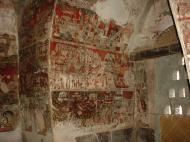
Peik Chin Myaung - This is a large Buddhist shrine cave about 27km from the town. About 600 meter path leads through the cave. Inside the cave are several Buddha images donated by locals.
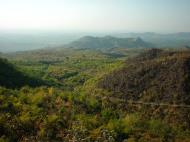
Pyin U Lwin or Pyin Oo Lwin, formerly Maymyo (22° 2'4.38'N 96°27'31.49'E), is a scenic hill town in Mandalay Division in Myanmar, located some 67 kilometers (42 miles) east of Mandalay, and at an altitude of 1070 meters (3510 ft).
History
The town began as a military outpost established near a small Shan village with two dozen households situated on the Lashio-Mandalay trail between Nawnghkio and Mandalay. In 1896, a permanent military post was established in the town and later, because of its climate, it became a hill station and the summer capital of British Burma. The establishment in Burma (civil, commercial and military) would move to Maymyo during the hot season to escape from the high heat and humidity of Rangoon. The British named the location Maymyo, literally May Town in Burmese, after Colonel May, a veteran of the Indian Mutiny and commander of the Bengal Regiment temporarily stationed at the location of the town in 1887. The military government of Burma renamed the town Pyin U Lwin.Demographics
The town has approximately 10,000 Indian and 5,000 Nepali inhabitants who settled in Maymyo during British rule. Today, Pyin U Lwin has a thriving Eurasian community, consisting mostly of Anglo-Burmese and Anglo-Indians.Educational institutions
Maymyo was an important educational centre during colonial times, with the GEHSs (Government English High Schools), such as St. Mary's, St. Michael's, St. Albert's, St. Joseph's Convent, and Colgate, all based in the town. British settlers and colonial administrators sent their children to be educated here, both European and Anglo-Burmese children. The town was also the location of the various schools of military education open to all ethnicities.It is today home to the Defence Services Academy (DSA) and the Defence Services Institute of Technology (DSIT). There is a large military presence in the town.
Economy
Unique horse carriages and British colonial houses make Pyin U Lwin stand out from the rest of the towns in Myanmar.Sweater knitting, flower and vegetable gardens, strawberry and pineapple orchards, coffee plantations and cow rearing are the main local businesses. There has been an influx of Chinese immigrants (especially from Yunnan) in recent years. The city is a resort town for visitors from Myanmar's major cities during the summertime and a popular stop for foreign tourists during the winter season.
Established in 1915, the National Botanical Gardens and the adjacent Pyin Oo Lwin Nursery are famous attractions of Pyin U Lwin. The beautifully created national garden and the new National Landmarks Gardens are unique. A 4-acre (16,000 m2) orchid garden is planned for 2007.
Today, Pyin Oo Lwin is particularly noted for four centres of national economic importance. It is the centre of sericulture (silkworm rearing). The Sericulture Research Centre, near the National Kandawgyi Botanical Gardens, conducts three distinct roles: the intensive planting and harvesting of mulberry trees (leaves for the silk worms, bark for hand made paper), the rearing of the actual silkworms, and the reeling of the silk from the cocoons. It has a large research centre for indigenous medicinal plants. And it has one of the country's few pharmaceutical production facilities.
In addition, Pyin Oo Lwin is the centre of the country's principal flower and vegetable production. The most important flowers grown intensively are chrysanthemum, aster and gladiolus, which are exported to every corner of Myanmar throughout the year. Lastly, Pyin Oo Lwin is the centre of Myanmar's rapidly growing coffee industry. A number of factories in the town process coffee beans for country-wide distribution, with a growing amount now prepared for export.
http://www.myanmars.net/
Mandalay Division
Mandalay Division is an administrative division of Myanmar. It is located in the center of the country, bordering Sagaing Division and Magway Division to the west, Shan State to the east, and Bago Division and Kayin State to the south. The regional capital is Mandalay. In the south of the division lies the national capital of Naypyidaw. The division consists of seven districts, which are subdivided into 30 townships and 2,320 wards and village-tracts.
Mandalay Division is important in Burma's economy, accounting for 15% of the national economy.
History
The Tibeto-Burman speaking Pyu were the first historical people to dominate the dry zone in central Myanmar that includes Mandalay Division as early as the 1st century AD. By the early 9th century, the Pyu were decimated in a series of wars with the Nanzhao kingdom from Yunnan. The Burmans, who had been migrating into the region from Yunnan since 7th century, founded a city of their own, Pagan, in 849. The Pagan dynasty slowly came to dominate the central zone over the next two centuries, and by the late 11th century, all of present day Myanmar. The Burmese language and script came to prominence with royal patronage of Pagan kings.After the fall of Pagan to the Mongols in 1287, parts of central Myanmar came to be controlled by a series of rulers: the Mongols (1287-c.1303), Myinsaing (1298-1312), Pinya (1312-1364), and Sagaing (1315-1364). In 1364, Ava kingdom led by Burmanized Shan kings reunified all of central Myanmar. Central Myanmar was under Ava's control until 1527, and under the Shans of Monhyin (1527-1555). Burmese literature and culture came into its own during this era.
Central Myanmar was part of the Taungoo kingdom from 1555 to 1752. Parts of the region fell briefly to the Mons of Pegu (Bago) (1752-1753). Konbaung Dynasty ruled the region until December 1885 when it lost all of Upper Myanmar in the Third Anglo-Burmese War. The British rule in Upper Myanmar lasted until May 1942 when the Japanese forces captured Mandalay during World War II. The British returned after the war and granted independence the country in January 1948. Upon independence, Mandalay Division ceded Myitkyina and Bhamo districts to the newly formed Kachin State.
Demographics
The majority of the population in Mandalay Division are Bamar (Burmans). In the Mandalay metropolitan area, however, a large community of Chinese, most of whom are recent immigrants from Yunnan, now nearly rival the Bamar population. A large community of Indians also reside in Mandalay. A dwindling community of Anglo-Burmese still exists in both Pyinoolwin and Mandalay. A number of Shan people live along the eastern border of the division.Burmese is the primary language of the division. However, Mandarin Chinese is increasingly spoken in Mandalay and the northern gem mining town of Mogok.
Economy
Agriculture is the primary economical source of livelihood. Primary crops grown within Mandalay Division are rice, wheat, maise, peanut, sesame, cotton, legumes, tobacco, chilli, and vegetables. Industry, including alcoholic breweries, textile factories, sugar mills, and gem mines also exists. Tourism now forms a substantial part of Mandalay Division's economy, as it contains many historical sites including Mandalay, Amarapura, Bagan, Pyin U Lwin, Mount Popa, and Ava. Hardwoods such as teak and thanaka are also harvested.Education
Educational opportunities in Myanmar are extremely limited outside the main cities of Yangon and Mandalay. According to official statistics, whose accuracy is highly doubtful at best, over 1 million students were enrolled in the division's 4467 primary and secondary schools in 2005. Although the statistics claim a 15% primary school dropout rate, the real rate is certainly far higher. Indeed, of the nearly 4500 schools, almost 4000 were primary or post-primary schools, while only 234 were middle schools and 227 were high schools.Still the division has some of the best institutions of higher education in Myanmar. As medical, engineering and computer studies are the most sought after in Myanmar, the University of Medicine, Mandalay, the University of Dental Medicine, Mandalay, Mandalay Technological University, and the University of Computer Studies, Mandalay are among the most selective universities in Myanmar. Other highly selective schools are Myanmar Aerospace Engineering University and military academies in Pyinoolwin: Defence Services Academy and Defence Services Technological Academy.
Health care
The general state of health care in Myanmar is poor. The military government spends anywhere from 0.5% to 3% of the country's GDP on health care, consistently ranking among the lowest in the world. Although health care is nominally free, in reality, patients have to pay for medicine and treatment, even in public clinics and hospitals. Public hospitals lack many of the basic facilities and equipment.In 2005, Mandalay Division's public health care system had slightly over 1000 doctors and about 2000 nurses working in 44 hospitals and 44 health clinics. Over 30 of the so-called hospitals had less than 100 beds. Almost all of large public hospitals and private hospitals as well as doctors are in Mandalay. (These dismal numbers are believed to have improved by the advent of Naypyidaw as the nation's capital in 2006 although the level of improvement remains unreported.) The well-to-do bypass the public health system and go to private clinics in Mandalay or Yangon in order to 'get quick medical attention and high-quality service'. The wealthy routinely go abroad (usually Bangkok or Singapore) for treatment.
Web References:
https://en.wikipedia.org/wiki/Bagan
https://en.wikipedia.org/wiki/Mandalay_Division
Pyin Oo Lwin ပြင်ဦးလွင် Myanmar (Burma) Map
 Editor for Asisbiz: Matthew Laird Acred
If you love our website Please donate so we can make this site even better !!
Please donate so we can make this site even better !!
