
 |
 |
-Leyte-Gulf-25th-Oct-1944-NH-71524.jpg) |
-off-Truk-circa-30th-April-1944-80-G-366985.jpg) |
-off-Truk-circa-30th-April-1944-80-G-366987.jpg) |
-off-Truk-circa-30th-April-1944-80-G-366988.jpg) |
-off-Truk-circa-30th-April-1944-80-G-366989.jpg) |
-after-being-shot-down-11th-Nov-1943-80-G-206615.jpg) |
-seen-by-USS-White-Plains-(CVE-66)-off-Leyte-Gulf-25th-Oct-1944-80-G-384160.jpg) |
-off-Japan-on-19th-Mar-1945-80-G-310112.jpg) |
-off-Okinawa-16th-April-1945-80-G-339259.jpg) |
-off-Okinawa-16th-April-1945-80-G-339260.jpg) |
-off-Okinawa-16th-April-1945-80-G-339261.jpg) |
-off-Okinawa-16th-April-1945-80-G-339262.jpg) |
-in-the-South-China-Sea-5th-Jan-1945-80-G-273177.jpg) |
-25th-Nov-1944-NH-58029.jpg) |
-off-Okinawa-14th-May-1945-80-G-324120.jpg) |
-off-Okinawa-14th-May-1945-80-G-324121.jpg) |
-off-Leyte-25th-Oct-1944-80-G-288882x.jpg) |
-01.jpg) |
-seen-from-USS-Sangamon-(CVE-26)-off-Samar-on-26th-Oct-1944-80-G-270617.jpg) |
 |
-25th-Nov-1944-NH-62604.jpg) |
 |
 |
 |
 |
 |
 |
 |
 |
 |
 |
 |
 |
 |
 |
-after-she-was-hit-by-a-Kamikaze-off-the-Philippines-on-30th-Oct-1944-80-G-342020.jpg) |
-being-hit-by-a-Japanese-Judy-during-Kamikaze-attacks-off-Luzon-25th-Nov-1944-80-G-270738.jpg) |
-being-hit-by-a-Japanese-Judy-during-Kamikaze-attacks-off-Luzon-25th-Nov-1944-80-G-270740.jpg) |
-being-hit-by-a-Japanese-Judy-during-Kamikaze-attacks-off-Luzon-25th-Nov-1944-80-G-273032.jpg) |
-being-hit-by-a-Japanese-Judy-during-Kamikaze-attacks-off-Luzon-25th-Nov-1944-UA47812.jpg) |
-right-and-USS-Belleau-Wood-(CVL-24)-hit-by-Kamikaze-planes-off-Philippines-30th-Oct-1944-80-G-326798.jpg) |
-during-a-Kamikarze-attack-seen-from-USS-Gambier-Bay-(CVE-73)-during-the-Battle-of-Leyte-Gulf-25th-Oct-1944-ASC2.jpg) |
-during-an-attack-by-Japanese-kamikaze-which-crashes-astern-18th-June-1944-80-G-243432.jpg) |
-being-attacked-by-Japanese-aircraft-off-Kwajalein-Atoll-Marshall-Island-4th-Dec-1943-80-G-476250.jpg) |
-taken-just-after-she-was-hit-by-a-Kamikaze-on-the-5th-Jan-1945-01.jpg) |
-taken-just-after-she-was-hit-by-a-Kamikaze-on-the-5th-Jan-1945-02.jpg) |
-taken-just-after-she-was-hit-by-a-Kamikaze-on-the-5th-Jan-1945-03.jpg) |
-burning-after-she-was-hit-by-a-Japanese-air-attack-off-Leyte-Gulf-24th-Oct-1944-80-G-287974.jpg) |
-kamikaze-attack-24th-Oct-1944-01.jpg) |
-after-she-was-hit-be-a-Kamikaze-of-Samar-Battle-of-Leyte-Gulf-on-25th-Oct-1944-80-G-270516.jpg) |
Mitsubishi A6M Zero and its involvement in Philippines
Suicide Weapon
Kamikaze
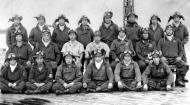
On 25th October, at 7.25am, nine planes rose from Mabalacat and headed east over the vast and lonely Pacific. Five of the planes were suicide craft - the Shikishima unit of the newly formed Special Attack Corps; the other four were escorts. Lieutenant Seki commanded the formation.
Seki had been the first officer volunteer, and he was to draw the first blood in the new wave of suicidal strikes. All five pilots were hoping to die for their Emperor, and all wore the traditional hachimaki around their foreheads. For four consecutive days prior to the 25th they had worn the hachimaki, and taken off expecting their next mission would be from Yasukuni. On each occasion they had returned to their base frustrated if not actually disappointed.
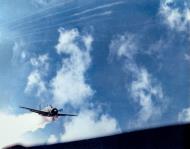
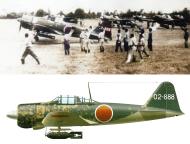
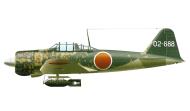
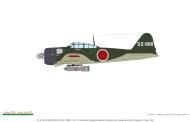
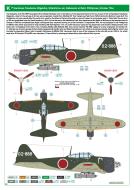
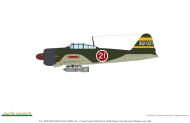
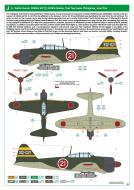
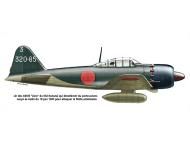
Mitsubishi A6M2 21 Zero JNAF 301 Hikotai 201 Kokutai pilot Yukio Seki 02-888 based at Mabalacat Philippines Oct 1944
An American task force was known to be operating west of the Philippines, but whenever a suicide sortie was made the US ships evaded location. One reason for this was the lack of reconnaissance due to the loss of reconnaissance aircraft in the American raids on the Philippine airfields. But the weather was also to blame. Without radar the Japanese were rarely able to locate American ships in the rain squalls which frequently descended on the area at this time of the year. Seki, who was determined to be the first successful kamikaze, was said to have expressed bitter disappointment when he returned from these abortive sorties. And Lieutenant Kuno, who was equally determined to be the first Special Attack pilot to die, announced his intention of flying off on his own to Leyte Gulf if no US ships were sighted on his official mission. At Leyte, he said, ‘there were sure to be many targets’. In the event, what happened to Kuno will never be known. He failed to return on 21st October, but as no American ships were sunk or damaged by suicide attacks that day it is presumed he ran out of fuel somewhere over the Pacific.
Seki’s planes reached Leyte Gulf about 10.40am, and on this occasion there was no rain squall to obscure the unsuspecting US warships. Seki had arrived at the perfect psychological moment. For hours the American fleet had been running before the brute power of Admiral Kurita's force, which had burst out of the San Bernardino Straits and turned south to destroy the fleet off Leyte. The carriers and destroyers had fought a tremendous delaying action against Kurita. It was only within the hour that the Japanese had turned and gone back, fearing a trap by other American units somewhere in the general area. On board the St Lo and her sister carriers the crews were relaxing after their close rendezvous with extinction. Thus when Seki sighted them, the Americans had their guard down.
The Japanese flew in low. At 1050, a warning went out to the carriers: ‘Enemy aircraft coming in fast from overlying haze At 1053, a plane roared in over the St Lo's ramp, then went into a steep dive and crashed on the flight deck near the centre line. At 1056, the gas below decks ignited. Two minutes later a violent explosion rocked the ship. A huge section of the flight deck was gone. Flames roared up 1,000 feet. By 1100 the St Lo was a mass of flames and she sank twenty one minutes later.
USS ST Lo (CVE 63) after she was hit be a Kamikaze of Samar Battle of Leyte Gulf on 25th Oct 1944
Kamikaze attack on USS White Plains (CVE-66) off Leyte 25th Oct 1944
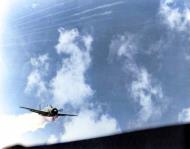
Japanese Mitsubishi Zeke crashed into USS Suwannee (CVE 27) Leyte Gulf 25th Oct 1944
Grumman F6F Hellcat pulls out after chasing Zeke which crashed into USS Suwannee (CVE 27) Leyte Gulf 25th Oct 1944
While the St Lo burned, the other suicide planes banked and screamed straight into their targets. Not one missed. The Kitkun Bay, the Kalinin Bay and the White Plains were torn by explosions as steel smashed into steel at hundreds of miles per hour. Five planes had hit four ships. One carrier was sunk, the others badly damaged. Seki’s success dispelled the one fear that had existed in the minds of those responsible for directing the kamikaze attacks - that when a plane dived the pilot might instinctively close his eyes before crashing and so miss his objective.
That night Tokyo radio broadcast a momentous communique from Imperial Headquarters: ‘The Shikishima Unit of the Kamikaze Special Attack Corps made a successful surprise attack on an enemy task force containing four aircraft carriers at a point thirty miles northeast of Suluan Island at 1045 hours. Two planes hit one carrier, which was definitely sunk. A third plane hit another carrier setting it aflame. A fourth hit a cruiser which sank instantly.’
Elated by the first success of his new suicide corps, Ohnishi ordered the aerial attacks to be pressed home. It was now the turn of the Yamato section, and on the morning of 26th October eight Zeros took off from Cebu. They left in two groups; the first, of two kamikazes and one escort, departing at 1015, and the second, of three kamikazes and two escorts at 1230. As only one of the escorts of the second group survived, there is no record of which plane struck which target. But it appears that the kamikazes caught the American ships off guard in Leyte Gulf, just as Seki had done the previous day. The US carriers were in the midst of recovering planes which had been just returning from an attack on Admiral Kurita’s fleet.
USS Santee (CVE-29) Kamikaze attack 25th Oct 1944
Some of these aircraft were landing, some were on deck being refuelled and rearmed, and some were in the process of being launched when the suicide squadron discovered them. Without further ado the first Japanese pilot put his Zero into a dive on the escort carrier Santee. Machine guns blazing, he swept down on his target, crashed into the flight deck and penetrated to the hangar deck before his bomb exploded. A fire started but was quickly brought under control. Forty-three men were injured, however, a third of them fatally, and a huge hole was smashed in the forward deck. (A few minutes later the submarine 1-56, one of several Japanese undersea craft operating in the area, put a torpedo into Santee’s starboard side. This might have been fatal, but Santee was sturdily built and survived the torpedo and continued in action.) Barely a moment after the kamikaze struck Santee the escort carriers Suwanee and Petrol Bay each downed an attacking suicide plane. Still another fell to Suwanee’s gunners before the last kamikaze hit and smoking plunged into the carrier and exploded between the flight and hangar decks. Damage was extensive and casualties numerous, although Suwanee was back in action in another two hours.
The cost of disabling the Santee was high. Seki’s attacks, however, were considered to have been relatively successful. Indeed when compared with Japanese conventional air assaults, the kamikaze strikes of 25th October did remarkably well. According to plan, General Tominaga’s Fourth Air Army planes were over the invasion beaches at Leyte in greater numbers that day, but could not do much damage. Scores of Japanese land-based naval planes were also out in strength searching for American warships. But either because of bad weather or lack of skill on the part of the inexperienced pilots, they were unable to find their targets. Thus, as two survivors of the kamikaze corps later put it: ‘The superiority of special attacks was manifest . . . Hundreds of planes making orthodox attacks could not inflict as much damage on the enemy as a mere handful of kamikazes.’
Admiral Ohnishi had never been in doubt about the success of his suicide venture. A message from the Emperor praising the ‘magnificent efforts of the Shikishima units’, queried whether it was ‘necessary to go to this extreme . . . ?’ In Hirohito’s language this was tantamount to a rebuke. Ohnishi was upset by it but undeterred, and when the Japanese high command in the Philippines conferred on 26th October, he pressed for an extension of the Special Corps’ organisation. Those who had been reluctant to support Ohnishi’s original proposals for suicide squadrons now began to revise their ideas.
By this time it was patently clear that the Imperial Navy had just suffered a catastrophic defeat. Whatever success had attended Operation Sho could be attributed to the unorthodox tactics which Ohnishi had initiated. Admiral Fukudome, commander of the Japanese Second Air Fleet based on Clark Field had opposed the introduction of suicide attacks. Indeed, he still favoured conventional mass-formation bombing and was uneasy about the possible effects on morale if his pilots were to be ordered to become kamikazes. But he could not deny the evidence of the effectiveness of Onishi’s tactics and so, reluctantly, he agreed to an amalgamation of the two air fleets in which the main offensive element would be kamikaze units.
The ‘Combined Land-Based Air Force’, under the command of Admiral Fukudome with Ohnishi as his chief of staff, came into being on the evening of 26th October. There was no shortage of volunteers for the new strike force, and within twenty-four hours seven new Special Attack units had been formed. And as they were thrown into battle more volunteers came forward to take their place. Thus the limitation was not men but machines. As anticipated the results of the attacks went far beyond those possible by orthodox methods. To begin with the main kamikaze weapon was the Zero, but as time passed Val and Judy dive bombers and Frances twin-engined bombers were added to the kamikaze armoury. Stimulated by Ohnishi’s successes the Japanese Army’s air force units in the Philippines asked if they also might participate in the new offensive.
Soon the Navy groups were joined by Army pilots and air crews in the increasing suicide bomb attacks. Yet, despite the high rates of strikes against the US warships and transports the Japanese could not stop the American invasion. The initial US carrier-borne attacks on the Japanese airfields in the Philippines had accomplished their purpose; in consequence Fukudome and Ohnishi just did not have enough aircraft to thwart the American operations.
During October 1944 a typical kamikaze sortie was usually composed of three suicide planes with two escorts. The idea was to keep the attack formation small and a flight of five was considered the optimum number - big enough to ensure the annihilation of a single capital ship, yet small enough to evade interception and keep together in cloud and bad weather.
The ratio of three kamikazes to two escorts was not a rigid one. But escorts were considered to be essential, to ward off American fighters while the kamikazes completed their fateful dives. To do so they had to stay at the side of the kamikazes and shield the suicide planes even if it meant their own sacrifice. Because the escort duty demanded superior flying skill and ability the best pilots were appointed as escort fliers, and their requests to volunteer for suicide missions were invariably turned down.
Damage was extensive and casualties numerous; USS Suwanee's hangar deck aftera suicide attack Admiral Kurita’s defeat in the battle of Leyte Gulf was more than the failure of Operation Sho. Losses amounting to 3 battleships, 4 aircraft carriers, 9 cruisers, 13 destroyers and 5 submarines spelled the death warrant of the Imperial Japanese Navy.
Officers and men aboard the remaining ships were still reported to be ‘full of fighting spirit’. But more than fighting spirit was needed at this stage. For this reason it was decided to extend the operations of the Special Attack Corps, and Ohnishi’s kamikazes were given a new objective.
The naval planes would cooperate with the army in an attempt to smash the US beach head on Leyte. And to stop the Americans reinforcing the troops that had already been landed, the kamikazes would now attack troop transports as well as aircraft carriers.
By early November, however, the ‘Combined Land Based Air Force’ had exhausted most of its planes in suicide operations, and the trickle of reinforcements from Japan could not match the heavy losses. With Fukudome’s approval, Ohnishi flew back to Japan to demand 300 planes specially for kamikaze operations in the Philippines. Imperial Headquarters in Tokyo, aware of the critical situation at Leyte, was willing enough to give Ohnishi all the aircraft he wanted.
The trouble was that 300 planes were just not available. Only by depleting the training centres at Ohmura, Genzan, Tsukuba and Koh-no-Ike was it possible to muster even 150. And these planes would have to be flown by instructors and young pilots, few of whom had had more than a hundred hours flying training. It was a disappointing response, but Ohnishi was happy to grab what he could get.
The planes were promptly organised with a new Special Attack Corps and transferred to Formosa for a week’s training before being transferred to the Philippines.
In a week little could be done to improve the standard of training of the young pilots who suddenly found themselves committed to a suicide role. There was time only for the essentials. So two days were spent practising take-offs, two days to formation flying, and the last three days were given over to study and practice of the tactics that the kamikazes would employ in their attacks.
Experience in the operations over Leyte Gulf had shown that certain methods of attack were more certain of success than others, and the new recruits concentrated on the newly accepted procedures.
Two methods of attack had been approved for the fast and manoeuvrable Zero fighter, and the ‘Judy’ bomber. The planes would approach their target flying either very high or at ground level. Both approaches restricted navigational accuracy and visibility, but more planes had got through to their targets this way than had the ones which flew in at a medium altitude.
At 18,000 to 20,000 feet it was completely easy to evade American fighters. Their presence could be expected to show up on the American’s radar screens, of course. But it took time for the US fighters to climb to that altitude and they could be seen coming. Thus, the rule was the higher the altitude the greater the difficulty of interception.
The advantage of the alternative low-level approach accrued from the inability of US radar to detect the kamikazes until they were something less than ten miles from their target. Visual detection of aircraft skimming the wave tops was also difficult for American fighters screening their ships by routine patrols. At low level therefore the chance of interception was reduced to the minimum. When more than one attack unit was available, the ideal solution was to combine high and low level approaches in simultaneous convergent attacks, but the opportunities for doing this had been limited by the planes available.
For the final phase of their attack kamikaze pilots were taught not to make too steep a dive. Attacks made from a high altitude demanded a long, shallow controlled dive, and those making a low-altitude approach were told to climb to 1,000 feet when they spotted their target. This would enable them to start their dive about five miles away, giving a 45 degree angle of attack. Provided the kamikaze actually hit the target a near perpendicular dive was believed likely to be more effective. The trouble was that in a steep dive as speed increased control of the aircraft became progressively more difficult. Moreover the target would undoubtedly be frantically trying to evade the approaching hazard.
Other factors which had to be considered during the brief training session on Formosa were the point of aim - whereabouts the kamikaze should try to strike his target – and what tactics to adopt if the kamikaze formation were attacked during its flight to the combat area. Navigational training was also of extreme concern and most of the new pilots had only rudimentary grasp of what navigation really meant. In the normal course of events one trained pilot in an escort Zero could shepherd his suicides right up to the point where they headed for Yasukuni. But on numerous occasions kamikaze flights lost their leader in bad weather, or were separated from him in a dog fight.
Nervous excitement and emotional tension are factors which can be overcome only by repetitive drill. And there was no time on Formosa to reduce every action to a perfect drill. In consequence there were occasions when kamikazes were reported as having been seen to achieve direct hits on their targets, but failing in their missions because the bombs they carried did not explode. The simple explanation was that the pilots concerned had failed to arm their bombs before making the final plunge. This meant the loss of pilot and plane usually for an unprofitable return. In concentrating on making sure that he did hit the target in a vulnerable spot the pilot had omitted a vital step in the process of his self-immolation. It was possible of course to instruct the fliers to arm their bombs as soon as they took off, and were clear of the base airfields. But if they were unable to find their targets or their missions were aborted for some other reason, the bombs would have to be jettisoned before they could land safely. The solution, ultimately, was to order the bomb safety to be released as soon as the targets were sighted and as they flew in, the flight commander would try to check that this had been done. Even so there were still some pilots who forgot.
A damaged dive bomber plunges into USS Kitkun Bay. Photo description: The USS Kitkun Bay (CVE-71) during a Kamikarze attack seen from USS Gambier Bay (CVE-73) during the Battle of Leyte Gulf 25th Oct 1944
The 150 planes and the embryo kamikazes were collected and despatched to Formosa surprisingly quickly. (Surprising because most things in Japan were in a chaotic state by this time.) Even more surprising most of the planes and pilots actually arrived. With skilled pilots and aircraft in good condition, a thirty per cent casualty rate was accepted en route, when reinforcements were sent to the Philippines, so the loss of only ten aircraft during the concentration at Formosa may be regarded as something of a miracle. In the event the seven day training programme was completed by the middle of December and the new corps was rushed to the Philippines.
It arrived shortly after the Americans had landed on Mindoro Island. By this time also Fukudome and Ohnishi had moved their headquarters out of Manila to Clark Field, and were preparing for the imminent battle which would decide possession of Luzon. As the planes arrived kamikaze sorties were mounted, and the US ships in Leyte were constantly under attack until Fukudome ordered the shattered remnants of his two Air Fleets to withdraw to Formosa. By this time the entire Japanese air strength in the Philippines had been reduced to fewer than a hundred planes, and more than half of the new kamikazes had flown to their doom.
As the Americans consolidated their grip on Leyte and prepared for an assault landing on Luzon, they bombed the Japanese installations incessantly.
In the course of these raids, some of the kamikazes based on Clark Field became casualties. The comment of one survivor of such a bombing is worth recording, if only to illustrate the attitude of the would-be suicides. ‘We are lucky’, he is reported to have said. ‘Until we hit the enemy our lives are very dear. We can’t afford to squander them by getting killed carelessly.’ Morale, it seems, was not a problem among the kamikazes.
The last kamikaze attacks to be made in the Philippines were on 5th January, 1945, when a reconnaissance plane reported a group of 300 US vessels west of Mindoro Island and Ohnishi decided to attack them.
When the same plane reported having sighted 700 other ships behind the first group, he called for the maximum effort by every pilot under his command. By throwing every plane he had at the Americans he hoped to deter them sufficiently to postpone what was clearly an assault landing operation. Only forty serviceable aircraft could be mustered. And when these were bombed up, the ground crews were marched off to join the Japanese army, vainly attempting to stem the tide of US might by stubborn suicidal resistance.
During the morning of 5th January, fifteen bomb-laden kamikazes escorted by two Zeros took off from Mabalacat; eight kamikazes with the same number of escorts from Echague; and five unescorted kamikazes from Angelo. All were ordered to select targets from the convoys in Lingayen Gulf. Which particular kamikaze hit which particular ship will never be known. But seven US naval vessels in the Luzon area were damaged by suicide attacks that day. None was destroyed, although one or two of the escorting Zeros which survived the attacks and returned to base reported that some ships were sunk.
That afternoon, and again the following day, the diminishing number of planes which returned to the Japanese airfields were refuelled, re-armed, and re-dispatched on other suicide missions. In the end nothing remained; not even a single Zero escort. In the Philippines the kamikazes were finished. In less than three months they had made 424 sorties and used 249 planes - of which 238 were Zeros - as piloted bombs. In terms of men and materiel they had exacted a terrible toll from the Americans. Not so great as they believed at the time, but nonetheless formidable. Nothing like this had ever been known before, and although the Americans were not daunted, they were shocked by such savage sub-human tactics. They knew that their own ultimate objective was Tokyo, and by the way the Japanese resistance was mounting they could look forward to nothing less than a suicidal blood bath.

-after-she-was-hit-be-a-Kamikaze-of-Samar-Battle-of-Leyte-Gulf-on-25th-Oct-1944-80-G-270516.jpg)
-off-Leyte-25th-Oct-1944-80-G-288881.jpg)
-off-Leyte-25th-Oct-1944-80-G-288882x.jpg)


-Leyte-Gulf-25th-Oct-1944-NH-71524.jpg)
-Kamikaze-attack-25th-Oct-1944-01.jpg)
-during-a-Kamikarze-attack-seen-from-USS-Gambier-Bay-(CVE-73)-during-the-Battle-of-Leyte-Gulf-25th-Oct-1944-ASC2.jpg)



Admiral Isoroku Yamamoto Japanese Aces by Full Name A6M Operators Japanese Aces by Surname Imperial Japanese Naval air units Japanese Aces by service and highest number of Kills




Bibliography:
- Bueschel, Richard M. Mitsubishi A6M1/2/-2N Zero-Sen in Imperial Japanese Naval Air Service. Canterbury, Kent, UK: Osprey Publications Ltd., 1970. ISBN 0-85045-018-7.
- Francillon, René J. The Mitsubishi A6M2 Zero-Sen (Aircraft in Profile number 129). Leatherhead, Surrey, UK: Profile Publications Ltd., 1966.
- Francillon, René J. The Mitsubishi A6M3 Zero-Sen ("Hamp") (Aircraft in Profile number 190). Leatherhead, Surrey, UK: Profile Publications Ltd., 1967.
- Green, William and Swanborough, Gordon. The Great Book of Fighters. St. Paul, Minnesota: MBI Publishing, 2001. ISBN 0-7603-1194-3.
- Jackson, Robert. Combat Legend: Mitsubishi Zero. Ramsbury, Marlborough, Wiltshire, UK: Airlife Publishing, 2003. ISBN 1-84037-398-9.
- Juszczak, Artur. Mitsubishi A6M Zero. Tarnobrzeg, Poland/Redbourn, UK: Mushrom Model Publications, 2001. ISBN 83-7300-085-2.
- Marchand, Patrick and Takamori, Junko. (Illustrator) A6M Zero (Les Ailes de Gloire 2) (in French). Le Muy, France: Editions d’Along, 2000. ISBN 2-914403-02-X.
- Mikesh, Robert C. Warbird History: Zero, Combat & Development History of Japan's Legendary Mitsubishi A6M Zero Fighter. Osceola, Wisconsin: Motorbooks International, 1994. ISBN 0-87938-915-X.
- Mikesh, Robert C. and Watanabe, Rikyu. (Illustrator) Zero Fighter. London: Jane's Publishing Company Ltd., 1981. ISBN 0-7106-0037-2.
- Nohara, Shigeru. A6M Zero in Action(Aircraft #59). Carrollton, Texas: Squadron/Signal Publications, Inc., 1983. ISBN 0-89747-141-5.
- Nohara, Shigeru. Mitsubishi A6M Zero Fighter (Aero Detail 7) (in Japanese with English captions). Tokyo, Japan: Dai Nippon Kaiga Company Ltd., 1993. ISBN 4-499 22608-2.
- Okumiya, Masatake and Hiroikoski, Jiro (with Caidin, Martin). Zero! The Story of Japan's Air War in the Pacific: 1941-45. New York: Ballantine Books, 1956. No ISBN.
- Richards, M.C. and Smith Donald S. Mitsubishi A6M5 to A6M8 'Zero-Sen' ('Zeke 52')(Aircraft in Profile number 236). Windsor, Berkshire, UK: Profile Publications Ltd., 1972.
- Sakaida, Henry. Imperial Japanese Navy Aces, 1937–45. Botley, Oxford, UK: Osprey Publishing Ltd., 1998. ISBN 1-85532-727-9.
- Sakaida, Henry. The Siege of Rabaul. St. Paul, Minnesota: Phalanx Publishing, 1996. ISBN 1-883809-09-6.
- Sheftall, M.G. Blossoms in the Wind: Human Legacies of the Kamikaze. New York: NAL Caliber, 2005. ISBN 0-451-21487-0.
- Willmott, H.P. Zero A6M. London: Bison Books, 1980. ISBN 0-89009-322-9.
- Wilson, Stewart. Zero, Hurricane & P-38, The Story of Three Classic Fighters of WW2 (Legends of the Air 4). Fyshwick, Australia: Aerospace Publications Pty Ltd., 1996. ISBN 1-875671-24-2.
Magazine References: +
- Airfix Magazines (English) - http://www.airfix.com/
- Avions (French) - http://www.aerostories.org/~aerobiblio/rubrique10.html
- FlyPast (English) - http://www.flypast.com/
- Flugzeug Publikations GmbH (German) - http://vdmedien.com/flugzeug-publikations-gmbh-hersteller_verlag-vdm-heinz-nickel-33.html
- Flugzeug Classic (German) - http://www.flugzeugclassic.de/
- Klassiker (German) - http://shop.flugrevue.de/abo/klassiker-der-luftfahrt
- Le Fana de L'Aviation (French) - http://boutique.editions-lariviere.fr/site/abonnement-le-fana-de-l-aviation-626-4-6.html
- Le Fana de L'Aviation (French) - http://www.pdfmagazines.org/tags/Le+Fana+De+L+Aviation/
- Osprey (English) - http://www.ospreypublishing.com/
- Revi Magazines (Czech) - http://www.revi.cz/
Web References: +
- Wikipedia, the free encyclopedia: https://en.wikipedia.org/wiki/List_of_air_groups_of_the_Imperial_Japanese_Navy
- Wikipedia, the free encyclopedia: https://en.wikipedia.org/wiki/Mitsubishi_A6M_Zero
- Wikipedia, the free encyclopedia: https://en.wikipedia.org/wiki/Imperial_Japanese_Navy_Air_Service
- Wikipedia, the free encyclopedia: https://en.wikipedia.org/wiki/List_of_Mitsubishi_A6M_Zero_operators
- Wikipedia, the free encyclopedia: https://en.wikipedia.org/wiki/Kamikaze
- Wikipedia, the free encyclopedia: https://en.wikipedia.org/wiki/Tetsuz%C5%8D_Iwamoto
- http://mitsubishi_zero.tripod.com/
- http://ww2db.com/aircraft_spec.php?aircraft_model_id=3
- http://www.combinedfleet.com/ijna/a6m.htm
- http://www.combinedfleet.com/ijna/a6m-k.htm
- http://www.combinedfleet.com/ijna/a6m-n.htm
- http://www.j-aircraft.com/research/WarPrizes.htm
 Editor for Asisbiz: Matthew Laird Acred
If you love our website please donate so we can make this site even better !!
