
 |
 |
 |
-and-VMF-512-operations-0A.jpg) |
-USS-Siboney-(CVE-112)-and-USS-Gilbert-Island-(CVE-107).jpg) |
-Oct-1945-01.jpg) |
 |
 |
 |
 |
 |
 |
-Rocket-Raiders-and-VMF-512-Pirates-patch-emblems-0A.jpg) |
-and-aircraft-from-VS-36-during-its-1954-cruise-01.jpg) |
-from-her-commissioning-booklet-Feb-1945-01.jpg) |
-moored-off-New-York-City-10th-Nov-1953-01.jpg) |
-underway-in-the-early-1950s-with-AF-Guardian-aircraft-from-VS-24-squadron-on-deck-01.jpg) |
 |
-after-colliding-with-USS-Gilbert-Islands-(CVE-107)-in-1945-01.jpg) |
 |
 |
 |
 |
 |
 |
 |
 |
 |
-01.jpg) |
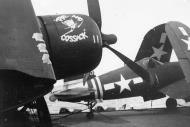 |
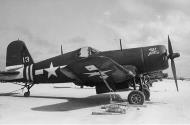 |
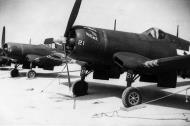 |
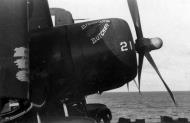 |
 |
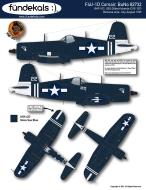 |
 |
 |
 |
 |
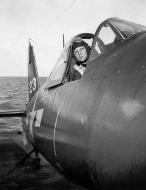 |
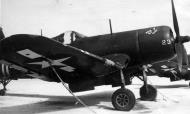 |
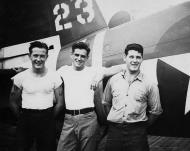 |
 |
-01.jpg) |
 |
 |
 |
 |
 |
-01.jpg) |
 |
 |
 |
-512-White-WF2-BuNo-122184-Feb-57-later-Honduran-AF-as-FAH-605-01.jpg) |
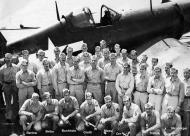
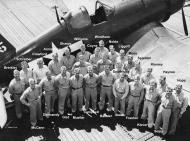
 USN Marine Fighting Squadron VMF-512
Gilbert Islands (CVE-107) - 1945-1961
USS Gilbert Islands (CVE-107) from her commissioning booklet Feb 1945
USS Gilbert Islands (CVE-107) underway in the early 1950s with AF Guardian aircraft from VS-24 squadron on deck
HISTORICAL NARRATIVE
An island group containing 16 atolls in the western Pacific Ocean on the equator, southeast of the Marshalls and northeast of the Solomons. On 20 November 1943 Marines made an amphibious assault on Makin and Tarawa Islands, seizing the former without difficulty, but winning Tarawa only after a 100-hour battle in which over 3,500 Americans were killed or wounded.
(CVE-107: Gilbert Islands (CVE-107) (ex-St. Andrews Bay) was laid down on 29 November 1943 at Tacoma, Wash., by Todd-Pacific Shipyards, Inc.; launched on 20 July 1944; sponsored by Mrs. Edwin D. McMorries; and commissioned on 5 February 1945, Capt. Lester K. Rice in command.
After fitting out, Gilbert Islands departed Puget Sound and, after passing through the Straits of Juan de Fuca, headed south for California, on 20 February 1945. The next day a patrolling blimp reported a hazard to navigation and requested the escort carrier destroy the floating mine with gunfire. As the ship's war diarist noted, the crew received "some badly needed gunnery practice", as it took 431 rounds of 40 millimeter and 417 rounds of 20 millimeter ammunition to finally destroy the mine.
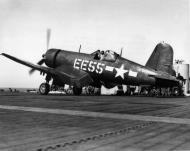
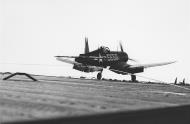
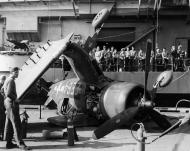
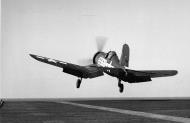
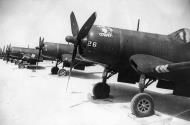
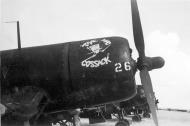
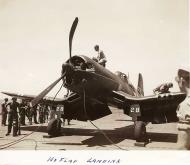
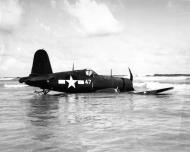
After loading fuel at Alameda, and ammunition at San Diego, the escort carrier conducted a month of shakedown training with Marine Air Group (MAG) Two embarked, comprising 12 General Motors TBM Avengers in Marine Torpedo Bombing Squadron (VMB) 143 and 18 Vought F4U or Goodyear FG Corsairs as well as two Grumman F6F Hellcats in Marine Fighter Squadron (VMF) 512. Gilbert Islands then departed San Diego on 12 April 1945 for a week of air operations and gunnery exercises in Hawaiian waters.
After the short but intense workup period, the escort carrier sailed for the Caroline Islands on 2 May 1945, arriving at Ulithi on the 14th. The voyage was marked by repeated submarine contacts reported by her escorts Caperton (DD-650), Cogswell (DD-651) and Ingersoll (DD-652), all of which were later evaluated as "doubtful." That remark in the war diary was followed by the melancholy phrase "This war was tough for whales." Three days later the escort carrier steamed for the Ryukyu Islands, joining Task Unit (TU) 52.1.1 off Okinawa on 21 May.
For the first three days on station, the escort carrier provided local combat air patrol and anti-submarine (ASW) patrols for the task unit. Once the pilots got some combat flying experience the missions broadened, and MAG Two began flying escort and strike missions against fortified Japanese positions around Shuri Castle in southern Okinawa. During these operations, a fighter piloted by Capt. Thomas Liggett, Jr., USMC, shot down a twin-engine Mitsubishi Ki. 46 Dinah reconaissance plane, which turned out to be the only air victory for MAG Two and Gilbert Islands during the war. Attacks against concrete dugouts, trench lines and supply dumps lasted until the end of May, with one pilot lost on the 23rd when his F4U dipped too low during a turn and splashed into the sea.
Shifting to TU 32.1.3 on 1 June 1945, Gilbert Islands aircraft then heavily bombed and strafed airfields on ths Sakishima Gunto group for over two weeks, repeatedly striking installations on Ishigaki Shima, Erabu Shima and Miyako Shima with bombs and rockets. Radio and radar stations were also destroyed, with barracks, port facilities and villages repeatedly bombed and strafed. The intense air activity did not come without cost, with four planes, two fighters and two bombers, lost in combat. Two aircraft, a fighter and a bomber, ditched at sea following battle damage with the loss of one radioman. Two other aircraft were shot down over their targets, with the loss of two pilots, a radioman and a gunner.
After retiring to San Pedro Bay, Leyte, on 16 June 1945 for "rest, recreation and repairs," the crew of the escort carrier spent five hectic days receiving fuel, bombs rockets and other ammunition, general stores and provisions in between badly needed maintenance work. Then, just as the crew was getting around to the "rest and recreation" part, the warship was ordered south to the Dutch East Indies. Underway 26 June, Gilbert Islands joined Task Group (TG) 78.4, comprising two other escort carriers, Suwanee (CVE-27) and Block Island (CVE-106), and six escorts and steamed south to Borneo, via the Philippine Sea, Celebes Sea and Makassar Strait. Starting on 30 June, Marine pilots began bombing and strafing Japanese buildings, troops and vehicles in and around Balikpapan in support of Australian landings there. One plane was lost during these strikes, when an F6F Hellcat flew into a flurry of anti-aircraft fire during a low-level strafing run, killing the pilot. With the beachhead securely established by 4 July, the escort carrier turned north for Leyte. During the two day voyage back to San Pedro Bay the warship crossed the equator and was deemed far enough away from "any Japanese held bases to indulge in some relaxation." Unfortunately for some, the war diarist noted, "King Neptune and all of his Shellbacks exerted themselves so vigorously that the Pollywogs were not able to relax for several days.
"Gilbert Islands finally received some rest and recreation at Leyte, spending most of the month there, before getting underway 29 July 1945 to screen logistic ships replenishing Third Fleet striking forces along the coast of Japan. This duty included helping escorts shepherd eight oilers and tugs away from a typhoon between 10-12 August. On that station 15 August she joined TG 30.8, which included nearly all of the Third Fleet, and heard Adm. William F. Halsey, Jr.'s laconic direction "Apparently the war is over and you are ordered to cease firing; so, if you see any Jap planes in the air, you will just have to shoot them down in a friendly manner." They later heard his formal speech regarding the armistice where Adm. Halsey began by declaring "a barbarous and treacherous foe has been brought to its knees in abject submission," and, as declared by the war diarist, the Admiral only then "gradually warmed up to his subject."
War!
USS Gilbert Islands (CVE-107) cruise map of 1945
A map of the 1945-cruise of the USS Gilbert Islands (CVE-107) and VMF-512 operations
Following workups off California and Hawaii, on 25 May, the Gilbert Islands arrived off Okinawa as part of the Fifth Fleet and, joining Task Unit (TU) 52.1.1, sent up her first CAP and close air support strikes against Japanese targets.
It was during these operations that VMF-512’s Capt. Thomas Liggett bagged a twin-engine Mitsubishi Ki. 46 Dinah reconnaissance plane – the only aerial victory for MAG Two and Gilbert Islands during the war.
The carrier also lost her first pilot around this time.
From her War History:
On 23 May we lost our first pilot, Second Lieutenant Edgar Thomas Miller, U. S. Marine Corps Reserve, who crashed into the sea in an F4U, within sight of the ship, apparently as the result of making too tight a turn and losing flying speed. And, for some reason that Is hard to explain, we were much more affected by this first loss than by the equivalent losses which were to follow. But the Chaplain, who had adopted the habit of saying a little prayer over the public address system every night at sunset, made a particularly fine and soul-stirring prayer that night and we all felt better.
On 1 June, Gilbert Islands joined her sister Marine carrier Block Island in TU 32.1.3 under Third Fleet control, then got busy neutralizing enemy installations in the Sakishima Gunto area via liberal application of rockets, bombs, and .50 caliber rounds.
As detailed by her War History, just take a look at this 10-day period (including a three-day gap to run to Kerama Retto for more ordnance), keeping in mind that this was carried out by a group of just ~30 aircraft:
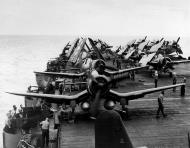
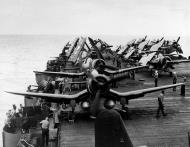
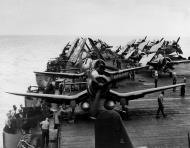
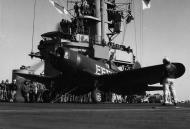
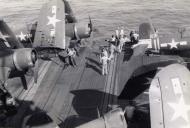
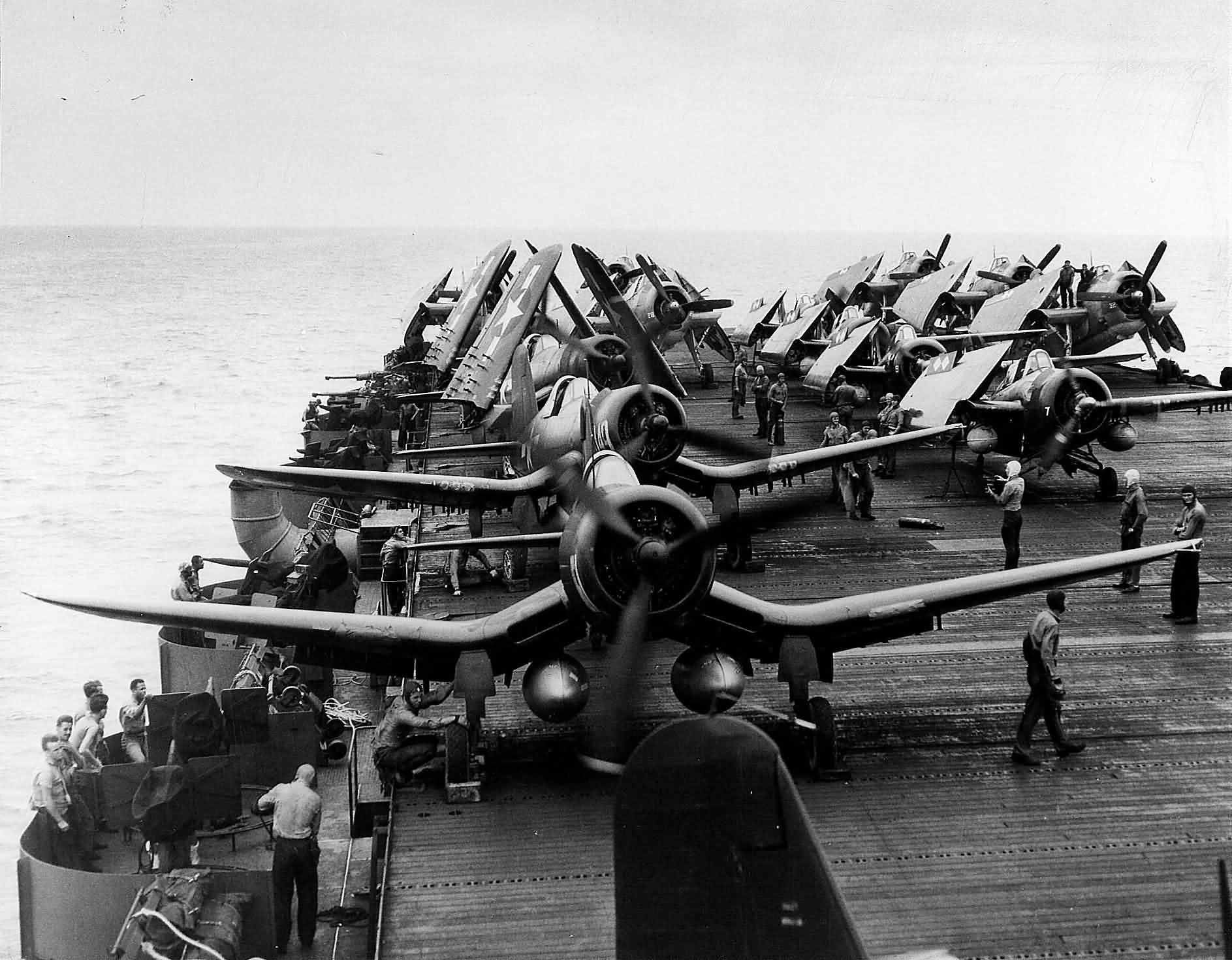
Goodyear FG 1D Corsair VMF-512 TBM Avengers FM Wildcats aboard 2nd Jun 1945
Photo description: Goodyear FG 1D Corsair VMF-512 TBM Avengers FM Wildcats aboard 2nd Jun 1945
On 6 June our planes made 49 sorties over the targets, firing 196 rockets and dropping 73 500-lb. bombs. Ishigaki field and Miyara field were bombed and the runway received 21 observed hits. At Ishigaki, buildings, a grounded plane, and revetments were strafed, and buildings at the eastern end of the north east-southwest runway were strafed and rocketed. A filling beat in the bay to the east of Ishi Saki was strafed. A bridge on the road between Ishigaki field and Miyara field was rocketed. A truck convoy on the road running from the west coast of Ishigaki Shima near Nagaishi Saki northeast into the hilly wooded area was strafed and fired, and three loaded trucks were burned. Explosions and fires were caused by a strafed unidentified target in the wooded area to the north of Yaeyama Sugar Refinery, and four fires were set in the towns of Hirage and Ohama.
On 8 June the planes made 25 sorties over the targets, firing 116 rockets and dropping 40 500-lb. bombs, Ishigaki field and Hirara field were bombed. Nine 500-lb. bomb hits were observed on the northeast-southwest runway at Ishigaki field, and 23 500-lb. bomb hits were observed on the northeast-southwest runway at Hirara field. Rockets were fired at the radar station on Ishigaki Shima, a dispersal area on Miyako Shima, a building on Erabu Shima, a bridge on Erabu Shlua, and installations at the south end of Ishigaki field. AA installations northwest of Ishigaki field were strafed, as was also a village on Miyako Shima, and five or six camouflaged ships in the bay on the west coast of Iriomote Shima, estimated 100 to 150 feet in length, were strafed and left burning and emitting much black smoke.
On 9 June the planes made 20 sorties over the targets, dropping 8.4 tons of bombs and firing 66 rockets. Forty-eight rockets were fired on the eastern boundary of Ishigaki field and 32 500-lb. bombs were dropped there. Three 500-lb. bombs were dropped and 18 rockets were fired on a bridge on Ishigaki Shima. Barges were strafed south of Obama Shima and in the bay on the west coast of Iriomote Shima, and radio or radar installations were strafed on the most westerly point of Iriomote Shima.
On 11 June the planes of the ship made 40 sorties over the targets, dropping bombs and depth charges, firing rockets. Ishigaki field was well plastered with 19 500-lb. bombs, 120 100-lb bombs, 11 depth charges, and 52 rockets. Eighty-four rockets were fired and three depth charges were dropped at towns on Ishigaki Shima, Miyako Shima, and Ikeme Shima. Sixteen rockets were fired at emplacements, 28 rockets were fired at shops and bridges, and 24 rockets were fired at storage facilities and other installations on Ishigaki Shima. All towns and installations were strafed. Six rockets were fired at barracks on Erabu Shima, five rockets were fired at barracks on Iriomote Shima, five rockets were fired at barracks on a small island just west of Iriomote Shima, and two 500-lb. bombs were dropped on barracks on Iriomote Shima. Three direct hits were observed on barracks.
On 12 June our planes made 36 sorties over the targets, dropping 20.5 tons of bombs and firing 4# rockets. Twenty-four 500-lb. bombs were dropped on the east-west runway at Ishigaki field and eight 500-lb. bombs on the northeast-southwest runway. Nineteen hits were observed on the east-west runway and five on the northeast-southwest runway Twenty-three 500-lb. bombs were dropped on the east-west runway at Nobara field, and eighteen hits were observed. Four 500-lb. bombs were dropped on the north-south runway at Hirara field, and one hit was observed. AA installations on Miyako Shima, Erabu Shima, and Ishigaki Shima were strafed, fourteen rockets were fired at those installations, and ten rockets were fired at revetments and a bridge in the western part of Ishigaki Shima.
On 13 June the planes made 39 sorties over the targets, dropping 15*5 tons of bombs and firing 182 rockets. Thirty-two 500-lb. bombs were dropped on the northeast-southwest runway at Ishigaki field and five 500-lb. bombs were dropped on the east-west runway there. Fourteen hits where observed on the northeast-southwest runway and five on the east-west runway. Twenty-one 500-lb. bombs were dropped on the north-south runway at Nobara field and three 500-lb. bombs were dropped on the northeast-southwest runway there. Seven hits were observed on the north-south runway and one on the northeast-southwest runway. Eighteen rockets were fired at the northeast-southwest runway at Ishigaki field. Twenty-eight rockets were fired at buildings on Ishigaki Shima and Miyako Shima, eighteen at barges west of Iriomote Shima and east of Erabu Shima, twelve at storage facilities on Ishigaki Shima, Miyako Shima, and Erabu Shima, sixteen at towns on Ishigaki Shima, forty-six on AA emplacements on Ishigaki Shima and Miyako Shima, eight at a bridge and two at caves on Miyako Shima and four at revetments on Ishigaki Shima. One good "Dinah” was strafed and destroyed at the north end of the northeast-southwest runway at Hirara field.
On 14 June our planes made forty sorties over the targets, dropping 13.6 tens of bombs and firing 172 rockets. Eleven 500-lb. bombs and 183 100-lb. bombs were dropped and 42 rockets were fired on the east-west runway at Ishigaki field and seven 500-lb. bombs and 28 rockets on the northeast-southwest runway there. Seventeen 500-lb. bomb hits and sixty 100-lb. bomb hits were observed on the runways. Rockets were fired also at bridges, towns, buildings, revetments, AA installations, a wharf, and barracks on Ishigaki Shima, and trucks and automobiles were burned there.
On 15 June the planes made eight sorties over the targets, dropping 1.75 tons of bombs. Seven 500-lb. bombs were dropped on the runways at Hirara field, and six hits were observed. The planes also strafed trucks, installations near the runways, and AA installations. The trucks were observed to be set on fire and the personnel manning them killed.
Finally, on 16 June one flight of three planes flew over Sakishima Gunto, dropping four 500-lb. bombs on the east-west runway at Hirara field, with three hits observed, firing eighteen rockets at boats, and strafing the boats and barracks and towns. And, on that same day, 16 June, a larger flight, consisting of seven torpedo bombers and five fighters, left the ship at 0515 to proceed to Okinawa for staging and briefing and participate in a proposed strike at Kyushu, but, being unable to get into that target because of the low ceiling, struck their alternate target, the Koniya sea plane base on Amami O Shima. There they dropped four 500-lb. bombs and 84 100-lb. bombs and fired 80 rockets, and observed a large percentage of hits. At least one 500-lb. bombs and two rockets exploded inside buildings, and four large fires were started.
In addition to all of this combat flying, the planes of this ship provided local combat air and anti-submarine patrols on seven days during the period of our operations with Task Unit 32.1.3.
Sent to San Pedro Bay, Leyte, on 16 June for 10 days of rest, replenishment, and repairs, Gilbert Islands was then dispatched south as part of TG 78.4 along with Block Island to cover the landings of Australian and Free Dutch forces during Operation Oboe II at Balikpapan.
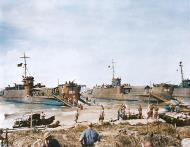
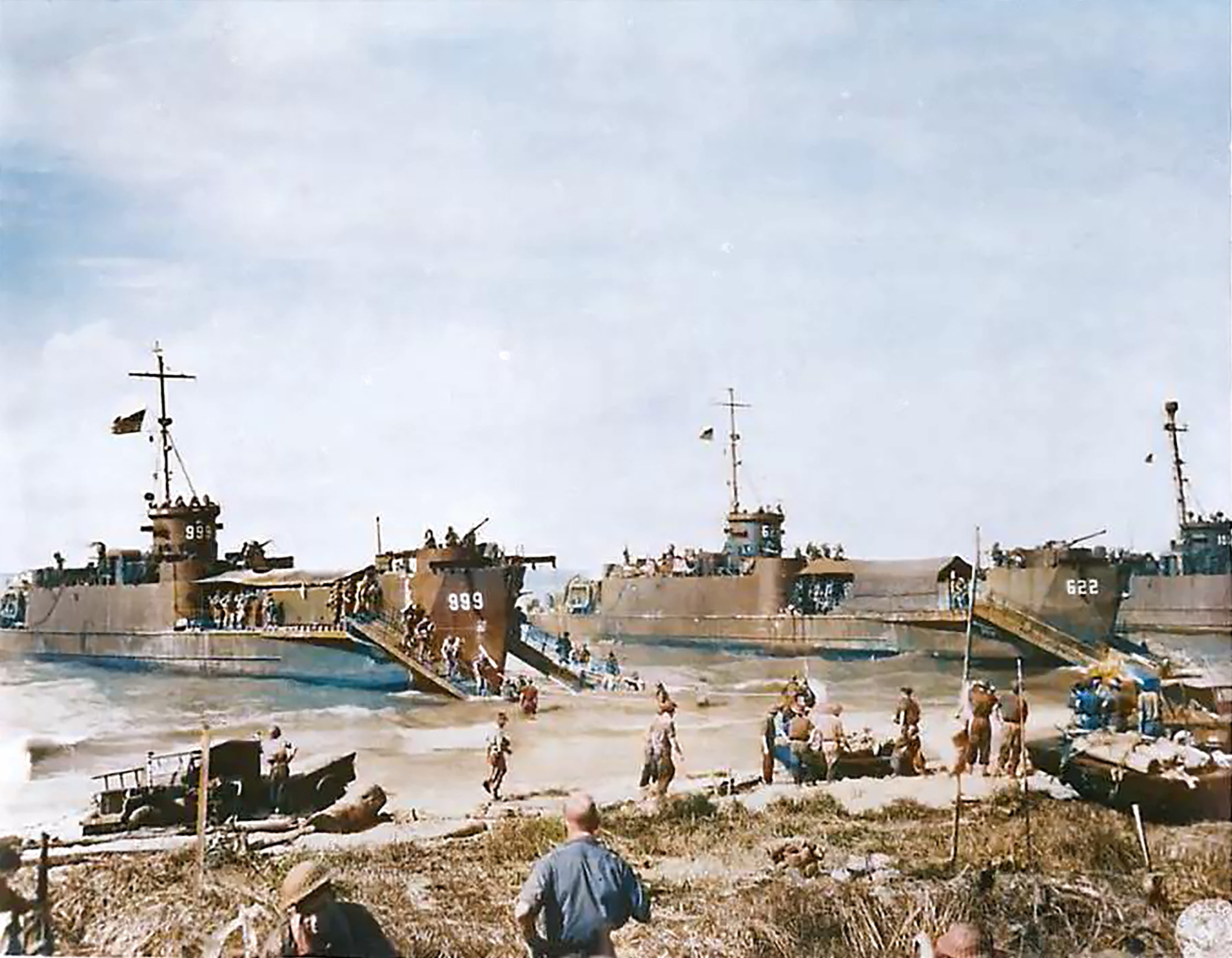
7th Division Australian troops come ashore near Balikpapan oil fields in Borneo
Photo description: With the path cleared by UDT-18, 7th Division Australian troops come ashore from landing craft during a landing near Balikpapan oil fields in Borneo.
Some 33,000-strong combined Australian and Royal Netherlands Indies amphibious forces (the largest ever amphibious assault by Australian forces)It ended up being somewhat anti-climactic, although she did lose one of her F6F drivers, 1Lt James Benjamin Crawford, to Japanese AAA fire.
The operation at Balikpapan turned out to be not at all difficult.
On 30 June our planes made eight sorties over targets on shore as directed. On 1 July the planes made 26 sorties over the target area; from 75 to 100 trucks and armored vehicles, parked alongside Samorinda Highway, were strafed, a number were hit, and at least two were left burning; other targets of opportunity were bombed and strafed, and many houses were damaged and one demolished by two 500-lb. and two 350-lb. bomb hits. On 2 July the planes made twelve sorties over the target area, and buildings and oil tanks were set on fire and a concentration of troops was strafed and scattered. And on 3 July the planes from our ship made twenty sorties over the target area; good coverage was obtained on troops, buildings, vehicles and stores; three direct rocket hits were made on barracks; many fires were started by bomb hits, and buildings and troops were strafed in the vicinity of Manggar airfield.
Sent back to San Pedro Bay after the 4th of July– making sure to dip her pollywogs along the way– she spent the rest of the month there, briefly serving as the flag of Carrier Division 27.
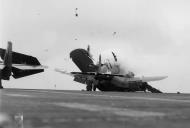
During operations in the PI, her plane guard, the "Green Dragon" USS Lee Fox (APD-45), suffered a bow bender while transferring the ditched Capt. Leggett was back aboard on the morning of 25 July 1945.
USS Lee Fox (APD-45) after colliding with USS Gilbert Islands (CVE-107) in 1945
Photo description: USS Fox on USS Gilbert Islands.
The crack-up carried away the carrier’s starboard boat boom and caused superficial damage,
with no injuries on either ship.Sailing to Ulithi Atoll at the end of July in company with the escort carrier USS Chenango, she attached to TG. 30.8, a third fleet service squadron, to provide them with air cover. It is with this group that on 10-15 August, Capt. Rice, as senior officer afloat, was given command of half the group, TU 30.8.2– the oilers USS Kankakee, Cahaba, Neosho, and Cache; the destroyer USS Wilkes and the escorts USS Willmart, Leray Wilson, Lyman, and William C. Miller; and four tugs, to get on the run from an approaching typhoon.
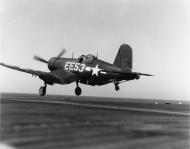
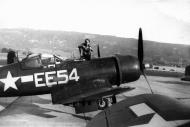
F4U-1D Corsair VMF-512 White 24 behind typhoon barrier, USS Gilbert Island in 1945
Photo description: F4U-1D Corsair VMF-512 White 24 behind typhoon barrier, USS Gilbert Islands
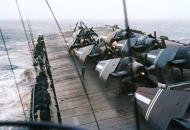
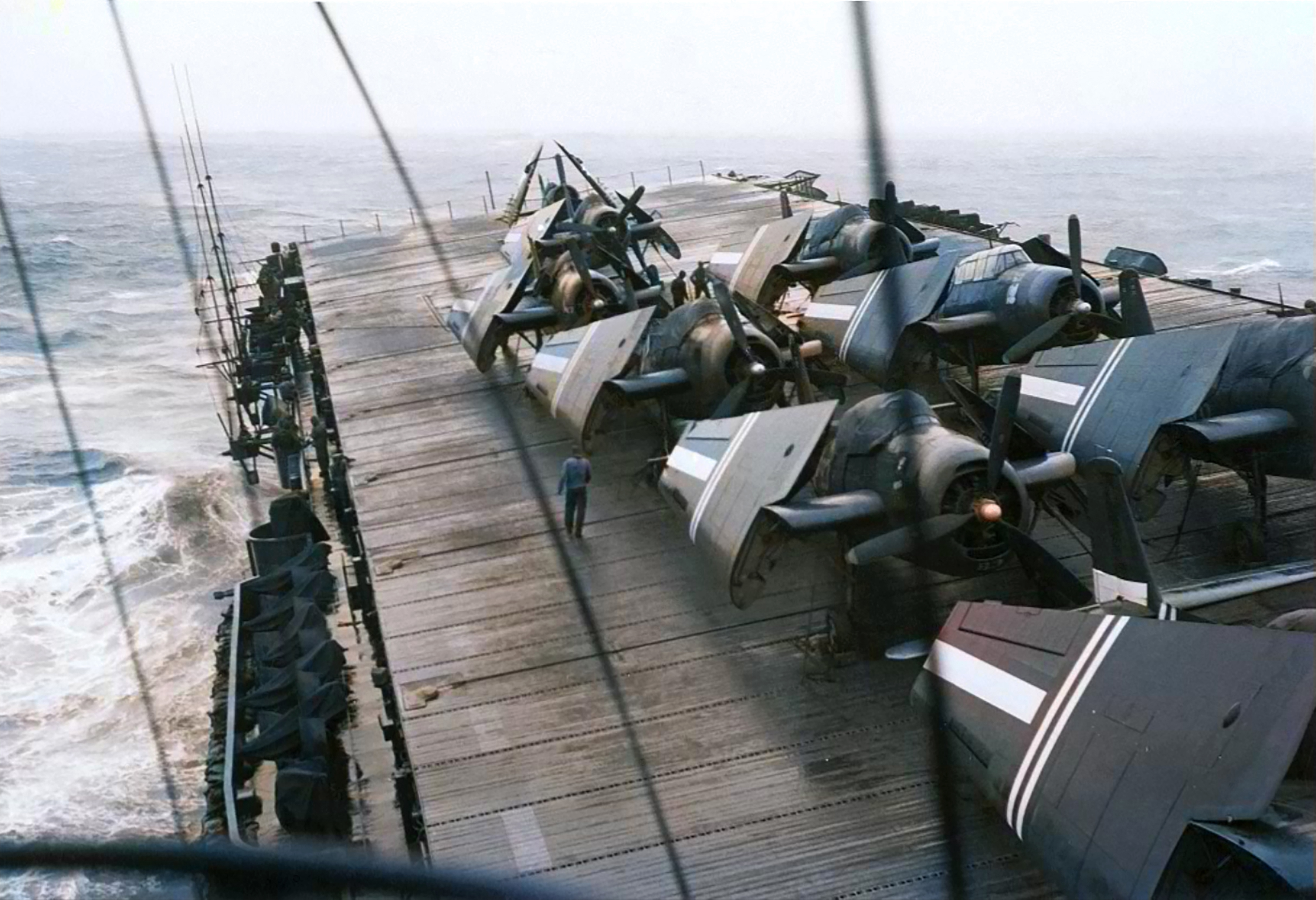
USS Gilbert Islands (CVE-107) in rough seas 1945
Photo description: USS Gilbert Islands (CVE-107) in rough seas, circa 1945 NNAM 1996.488.253.1578
Vectoring in a big box, heading north at first, then southeasterly, then south and west, "The maneuver was successful, no heavy weather was encountered, and no damage was sustained by any of the vessels."
By the time the storm was gone, the war was over, and the message that Japan had surrendered unconditionally was received at 0850 on 15 August 1945.
She then performed occupational duty. Sent to Okinawa with Carrier Division 27, she once again had to go to sea to dodge an incoming typhoon.
Carrier Division 27 during a China Sea Typhoon in 1945
Photo description: Carrier Division 27 successfully weathering China Sea Typhoon.
Taken by USS Salerno Bay (CVE 110).
Ships shown are: USS Block Island (CVE 106); USS Siboney (CVE 112) and USS Gilbert Island (CVE 107). 80-G-354604
Photo description: Carrier Division 27 successfully weathering China Sea Typhoon.
Taken by USS Salerno Bay (CVE 110). The ships shown are: the USS Block Island (CVE 106) and USS Gilbert Island (CVE 107).
Photographed October 1945. 80-G-354600CarDiv27, Gilbert Islands included, then appeared off Japanese-occupied Formosa on 15 October to have their planes as a "show of force" over the island and covering the landings of the Chinese KMT 70th Army at Kiirun on 16-17 October. "Observation over Formosa indicated enemy activity was non-existent." She nonetheless spent a week off the island until the 20th, firing over 18,000 rounds of 20mm and 40mm ammunition in AAA drills while her planes expended 16 bombs and 32 5-inch rockets.
Dispatched to Saipan, she arrived there on the 23rd, then, with stops at Pearl Harbor and San Diego along the way, arrived at Norfolk on 7 February 1946. Her war was over, and the Marine Carrier Groups disbanded. She would decommission on 21 May and then would be mothballed, first in Norfolk and then in Philadelphia.
Of her sisters, all survived the war, and 15 of 18 (excepting Block Island, Sicily, and Mindoro) were all laid up following the conflict.
In the course of her career during World War II, Gilbert Islands received three battle stars.
Web Reference: https://laststandonzombieisland.com/2025/02/page/5/
Detached from TG 30.8 on 2 September 1945, the escort carrier remained at Okinawa for almost six weeks before sailing south to Formosa, where she covered the landing of the Chinese Nationalist 70th Army at Kiirun. She was then routed onward via Saipan (to embark passengers) and Pearl Harbor to San Diego, arriving 4 December 1945. She remained in port until 21 January 1946, then set course for Norfolk where, after arrival on 7 February 1946, Gilbert Islands decommissioned 21 May 1946 and was placed in reserve. The mothballed escort carrier was later towed to the Inactive Ship Facility at Philadelphia in November 1949.
Following the outbreak of the Korean War in the summer of 1950, many mothballed warships were recalled to service, including Gilbert Islands which recommissioned at Philadelphia on 7 September 1951, Capt. Carl E. Giese in command. After a six month overahaul at Boston Naval Shipyard starting on 25 November, the escort carrier joined the Atlantic Fleet on 1 August 1952. The warship sailed eight days later with a cargo of jets for Yokohama, Japan, arriving 18 September, and returned to her new homeport of Quonset Point, R.I., on 22 October. Gilbert Islands got underway 5 January 1953 for a short training cruise to the West Indies, returning to New England waters in the spring to continue those duties through the summer and fall of that year. Following a cruise to Halifax and overhaul at Boston, the escort carrier stood out 5 January 1954 for a two-month Mediterranean cruise, returning to Quonset Point on 12 March for reserve training and other exercises. She became the first of her class to have jets make touch-and-go landings on the flight deck while she had no way on, a dangerous experiment successfully conducted on 9 June 1954.
Gilbert Islands left Rhode Island on 25 June 1954 for Boston and decommissioned there on 15 January 1955. Reclassified as an aircraft ferry (AKV-39) on 7 May 1959, Gilbert Islands remained in reserve until her name was stricken from the Navy List on 1 June 1961. Five months later, the old warship was reinstated on the Navy List and she was reclassified as a communications relay ship (AGMR-1) on 1 June 1963. Renamed Annapolis on 22 June 1963, the communications relay ship recommissioned on 7 March 1964, Capt. John J. Rowan in command.
As the Navy's first major communication relay ship, Annapolis was designed to provide a mobile command and control communications center for areas where shore-based communications do not exist or are inadequate. In addition to handling message traffic through teletype or multi-channel radio circuits, the ship had approximately 30 radio transmitters, with five major antenna towers installed on the former flight deck, now called the antenna deck. By relaying large volumes of routine message traffic through Annapolis, the communications relay ship lightened the traffic load on regular ship-to-ship or ship-to-shore circuits. This was a critical function during crisis response or humanitarian operations, as the large number of ships often clogged up the frequencies available. As part of her acceptance trials, Annapolis demonstrated those capabilities by handling fleet broadcasts and ship-to-ship communications during Operation Steel Pike, an 80-ship U.S.-Spanish exercise held in October, before officially joining the Atlantic Fleet on 16 December 1964.
After operations out of Norfolk during the first half of 1965, Annapolis was assigned Long Beach as home port on 28 June 1965. In September she got underway for the Far East, providing fleet communications services for Seventh Fleet units off the coast of Vietnam. The ship mainly served as the relay point by which Seventh Fleet units sent mesages to ground-based Western Pacific communications stations but she also provided cryptographic support and rebroadcast fleet bulletins as well as daily news summaries to the Fleet. For such services, Annapolis received a Meritorious Unit Commendation for Fleet operations in Southeast Asia from 9 January 1967 to 29 January 1968. With the exception of periodic port visits to Hong Kong, Formosa, and the Philippines for liberty and upkeep, as well as periodic overhauls at Yokosuka, Japan, Annapolis remained on station in the western Pacific for the next four years, conducting 19 communications patrols before finally turning for home on 9 April 1969.
The ship initially sailed into the Indian Ocean, visiting the Mauritius' and Angola in May before sailing around the Cape of Good Hope enroute to Senegal. On 19 May 1969 Annapolis crossed the equator at 00'00 latitude and 00'00 longitude, initiating her Royal Order of Trusty Shellbacks into the Golden Order of Shellbacks. Following a short visit to Dakar, the ship stopped at Lisbon, Portugal and Rota, Spain, before commencing two months of operations with Sixth Fleet out of Naples, Italy. Finally underway for home on 29 August, she arrived at Philadelphia via Norfolk on 1 October 1969.
Annapolis decommissioned at Philadelphia on 20 December 1969 and was placed in reserve. She was stricken from the Naval Vessel Register on 15 October 1976 and sold for scrap to the Union Minerals & Alloys Corp. on 19 December 1979.
Gilbert Islands received three battle stars for World War II service; Annapolis received a Meritorious Unit Commendation and eight battle stars for her service in the Vietnam War.
04 June 2007, updated 25 October 2017 - Published: Tue Jun 20 17:28:14 EDT 2023
https://www.history.navy.mil/research/histories/ship-histories/danfs/g/gilbert-islands.html
Goodyear FG-1D Corsair VMF-512 on board USS Sargent Bay CVE- 8 with TBM Avengers FM Wildcats 2nd Jun 1945 01
Goodyear FG-1D Corsair VMF-512 with TBM Avengers and FM Wildcats aboard CVE- 83 Sargent Bay 2nd Jun 1945 01
Bibliography:
- Abrams, Richard. F4U Corsair at War. London: Ian Allan Ltd., 1977. ISBN 0-7110-0766-7.
- Angelucci, Enzo with Peter M. Bowers. The American Fighter. New York: Orion Books, 1985. ISBN 0-517-56588-9.
- Barber, S.B. Naval Aviation Combat Statistics: World War II, OPNAV-P-23V No. A129. Washington, D.C.: Air Branch, Office of Naval Intelligence, 1946.
- Bell, Dana. F4U-1 Corsair, Vol. 1, Aircraft Pictorial, No. 7. Tucson: Classic Warships Publishing, 2014. ISBN 978-0-9857149-7-0.
- Blackburn, Tom. The Jolly Rogers. New York: Orion Books, 1989. ISBN 0-517-57075-0.
- Bowman, Martin W. Vought F4U Corsair. Marlborough, UK: The Crowood Press Ltd., 2002. ISBN 1-86126-492-5.
- Condon, John Pomeroy. Corsairs and Flattops: Marine Carrier Warfare, 1944–1945. Annapolis, Maryland: Naval Institute Press, 1998. ISBN 1-55750-127-0.
- Current, Colonel John D., ed. American Warplanes of WWII. Mainz, Germany: PediaPress, 2011. No ISBN.
- Dean, Francis H. America's Hundred Thousand. Atglen, Pennsylvania: Schiffer Publishing Ltd., 1997. ISBN 0-7643-0072-5.
- Donald, David, ed. American Warplanes of World War II. London: Aerospace Publishing. 1995. ISBN 1-874023-72-7.
- Dorr, Robert F. "Marine Air, The History of the Flying Leathernecks in Words and Photos" New York: Berkley Publishing Group, 2005. ISBN 978-0-425-21364-3.
- Drendel, Lou. U.S. Navy Carrier Fighters of World War II. Carrollton, Texas: Squadron/Signal Publications Inc., 1987. ISBN 0-89747-194-6.
- Green, William. Famous Fighters of the Second World War. Garden City, New York: Doubleday & Company, 1975. ISBN 0-385-12395-7.
- Green, William. "Vought F4U-1, F4U-4 (FG-1 Corsair)". War Planes of the Second World War, Volume Four: Fighters. Garden City, New York: Doubleday & Company, 1973, pp. 188–194. ISBN 0-385-03259-5.
- Green, William and Gordon Swanborough. "Chance Vought F4U Corsair". WW2 Aircraft Fact Files: U.S. Navy and Marine Corps Fighters. London: Macdonald and Jane's Publishers Ltd., 1976, pp. 16–29. ISBN 0-356-08222-9.
- Grossnick, Roy A. and William J. Armstrong. United States Naval Aviation, 1910–1995. Annapolis, Maryland: Naval Historical Center, 1997. ISBN 0-16-049124-X.
- Guyton, Boone T. Whistling Death: The Test Pilot's Story of the F4U Corsair. Atglen, Pennsylvania: Schiffer Publishing Ltd., 1996. ISBN 0-88740-732-3.
- The Illustrated Encyclopedia of Aircraft. London: Aerospace Publishing/Orbis Publishing, 1985.
- Jablonski, Edward. Airwar. New York: Doubleday & Co., 1979. ISBN 0-385-14279-X.
- Johnsen, Frederick A. F4U Corsair. New York: Crown Publishers, 1983. ISBN 0-517-55007-5.
- Kinzey, Bert. F4U Corsair Part 2: F4U-4 Through F4U-7: Detail and Scale Vol 56. Carrolton, Texas: Squadron Signal Publications, 1998. ISBN 1-888974-09-5
- Maloney, Edward T. and Uwe Feist. Chance Vought F4U Corsair, Vol. 11. Fallbrook, California: Aero Publishers, Inc., 1967. ISBN 0-8168-0540-7.
- Mondey, David. The Hamlyn Concise Guide to American Aircraft of World War II. London: Octopus Publishing Group Ltd., 1982. ISBN 0-7537-1461-2.
- Moran, Gerard P., Aeroplanes Vought, 1917–1977. Terre Haute, Indiana: Aviation Heritage Books, Sunshine House, Inc., 1978. ISBN 0-911852-83-2.
- Morris, David. Corsair KD431: The Time Capsule Fighter. Stroud, UK: Sutton Publishing Ltd., 2006. ISBN 0-7509-4305-X.
- Musciano, Walter A. Corsair Aces: The Bent-wing Bird Over the Pacific. New York: Arco Publishing Company, Inc., 1979. ISBN 0-668-04597-3.
- Núñez, Padin and Jorge Félix. Vought F4U-5,-5N & 5NL Corsair (serie Aeronaval Nro.18) (in Spanish). Buenos Aires, Argentina: Museo de la Aviacón Naval, Instituto Aeronaval, 2004.
- Okumiya, Masatake and Jiro Horikoshi, with Martin Caidin. Zero! New York: E.P. Dutton & Co., 1956.
- O'Leary, Michael. United States Naval Fighters of World War II in Action. Poole, Dorset, UK: Blandford Press, 1980. ISBN 0-7137-0956-1.
- Pautigny, Bruno (translated from the French by Alan McKay). Corsair: 30 Years of Filibustering 1940–1970. Paris: Histoire & Collections, 2003. ISBN 2-913903-28-2.
- Pilots Manual for F4U Corsair. Appleton, Wisconsin: Aviation Publications, 1977 (reprint). ISBN 0-87994-026-3.
- Pilot's Notes for Corsair I-IV: Air Publications 2351A, B, C & D-P.N.. London: Air Ministry, August 1944.
- Russell, Warren P. Chance Vought F4U-1/F4U-1D and Goodyear FG-1D Corsair: NZPAF, RNZAF Aircraft colour schemes. Invercargill, New Zealand: New Zealand Aero Products, 1984. ISBN 0-473-00245-0
- Sakaida, Henry. Imperial Japanese Navy Aces 1937–45 – Osprey Aircraft of the Aces 22. Botley, Oxford: Osprey Publishing, 1998, ISBN 978-1855327276.
- Sherrod, Robert. History of Marine Corps Aviation in World War II. Washington, D.C.: Combat Forces Press, 1952. No ISBN.
- Shettle, M.L. Marine Corps Air Stations of World War II. Bowersville, Georgia: Schaertel Publishing Co., 2001. ISBN 0-9643388-2-3.
- Styling, Mark. Corsair Aces of World War 2 (Osprey Aircraft of the Aces No 8). London: Osprey Publishing, 1995. ISBN 1-85532-530-6.
- Sullivan, Jim. F4U Corsair in action. Carrollton, TX: Squadron/Signal Publications, 1977. ISBN 0-89747-028-1.
- Swanborough, Gordon and Peter M. Bowers. United States Navy Aircraft since 1911. London: Putnam, Second edition, 1976. ISBN 0-370-10054-9.
- Thetford, Owen. British Naval Aircraft since 1912. London: Putnam, Fourth edition, 1978. ISBN 0-370-30021-1.
- Thompson, Warren. "Marine Corsairs in Korea". International Air Power Review, Volume 11, Winter 2003/2004, Norwalk, CO: AirTime Publishing, 2004. ISBN 1-880588-60-9.
- Thompson, Warren. F4U Corsair Units of the Korean War: Osprey Combat Aircraft 78. Botley, Oxford UK: Osprey Publishing, 2009. ISBN 978-1-84603-411-4
- Tillman, Barrett. Corsair — The F4U in World War II and Korea. Annapolis, Maryland: Naval Institute Press, 1979. ISBN 1-55750-994-8.
- Tillman, Barrett. Vought F4U Corsair. Warbird Tech Series, Vol. 4. North Branch, Minnesota: Speciality Press, 1996. ISBN 0-933424-67-1.
- Veronico, Nick and John M. and Donna Campbell. F4U Corsair. St. Paul, Minnesota: Motorbooks International, 1994. ISBN 0-87938-854-4.
- Wilson, Randy. "From Bent-winged Bird to Whistling Death." The Dispatch. Midland, Texas: Confederate Air Force, 1996.
- Wings of the Navy Captain Eric M. Brown, edited by William Green and Gordon Swanbrough Pilot Press / Janes, 1980 ISBN 0-7106-0002-X
- F4U Corsair in Action Jim Sullivan Squadron/Signal Publications (Aircraft No.29), 1977.
- The Complete Book of Fighters William Green and Gordon Swanborough Salamander Books, 1994 ISBN 0-86101-643-2
- Thunderbolt -- A documentary history of the Republic P-47 Roger A. Freeman Arms And Armour Press, 1978, 1992 ISBN 1-85409-171-9
- Nightfighter -- A Concise History of Nightfighting Since 1914 Anthony Robinson Ian Allan Ltd., 1988 ISBN 0-7110-1757-3
- The Illustrated Direcory of Fighting Aircraft of World War II Bill Gunston Salamander Books, 1988 ISBN 0-86101-390-5
- Sea, Sky and Stars -- An Illustrated History of Grumman Aircraft Michael J. Hardy Arms And Armour Press, 1987 ISBN 0-85368-832-X
- The Ironworks -- Grummans Fighting Aeroplanes Terry Treadwell Airlife, 1990 ISBN 1-85310-070-6
- Bernard Vurpillot et le Corsair Bernard Lestrade Le Fana de lAviation, Mai 1994 Editions Lariviere
- Gregory "Pappy" Boyington -- Legende et Realite Bernard Baeza Le Fana de lAviation, Avril/Mai/Juin 1995 Editions Lariviere
- Victory in the Air Aeroplane Monthly, VE-day 50th Anniversary edition IPC Magazines Ltd, 1995.
- Airplane Nr.162 DeAgostini (Netherlands), 1996.
- US Navy and Marine Corps Fighters (WW2 Aircraft Fact Files) Willand Green and Gordon Swanborough Macdonald and Janes, 1976.
- Les Avions de Combat de lUS Navy de la deuxieme geurre mondiale. Le Fana de LAviation, Hors Serie. Editions Lariviere, 1997.
Magazine References: +
- Airfix Magazines (English) - http://www.airfix.com/
- Avions (French) - http://www.aerostories.org/~aerobiblio/rubrique10.html
- FlyPast (English) - http://www.flypast.com/
- Flugzeug Publikations GmbH (German) - http://vdmedien.com/flugzeug-publikations-gmbh-hersteller_verlag-vdm-heinz-nickel-33.html
- Flugzeug Classic (German) - http://www.flugzeugclassic.de/
- Klassiker (German) - http://shop.flugrevue.de/abo/klassiker-der-luftfahrt
- Le Fana de L'Aviation (French) - http://boutique.editions-lariviere.fr/site/abonnement-le-fana-de-l-aviation-626-4-6.html
- Le Fana de L'Aviation (French) - http://www.pdfmagazines.org/tags/Le+Fana+De+L+Aviation/
- Osprey (English) - http://www.ospreypublishing.com/
- Revi Magazines (Czech) - http://www.revi.cz/
Web References: +
- History of RAF Organisation: http://www.rafweb.org
- http://en.wikipedia.org/wiki/F4U Corsair
- http://warbirdregistry.org/corsairregistry/corsairregistry.html
- Wikipedia, the free encyclopedia: http://en.wikipedia.org/
 Editor for Asisbiz: Matthew Laird Acred
Please help us to improve these articles with any additional information or photo's.
If you should encounter any bugs broken links, or display errors just email us.
If you love our website please donate so we can make this site even better !!
-from-her-commissioning-booklet-Feb-1945-01.jpg)
-underway-in-the-early-1950s-with-AF-Guardian-aircraft-from-VS-24-squadron-on-deck-01.jpg)
-and-VMF-512-operations-0A.jpg)
-after-colliding-with-USS-Gilbert-Islands-(CVE-107)-in-1945-01.jpg)
-01.jpg)
-USS-Siboney-(CVE-112)-and-USS-Gilbert-Island-(CVE-107).jpg)
-Oct-1945-01.jpg)
